

By James Hinton — 19 November 2026
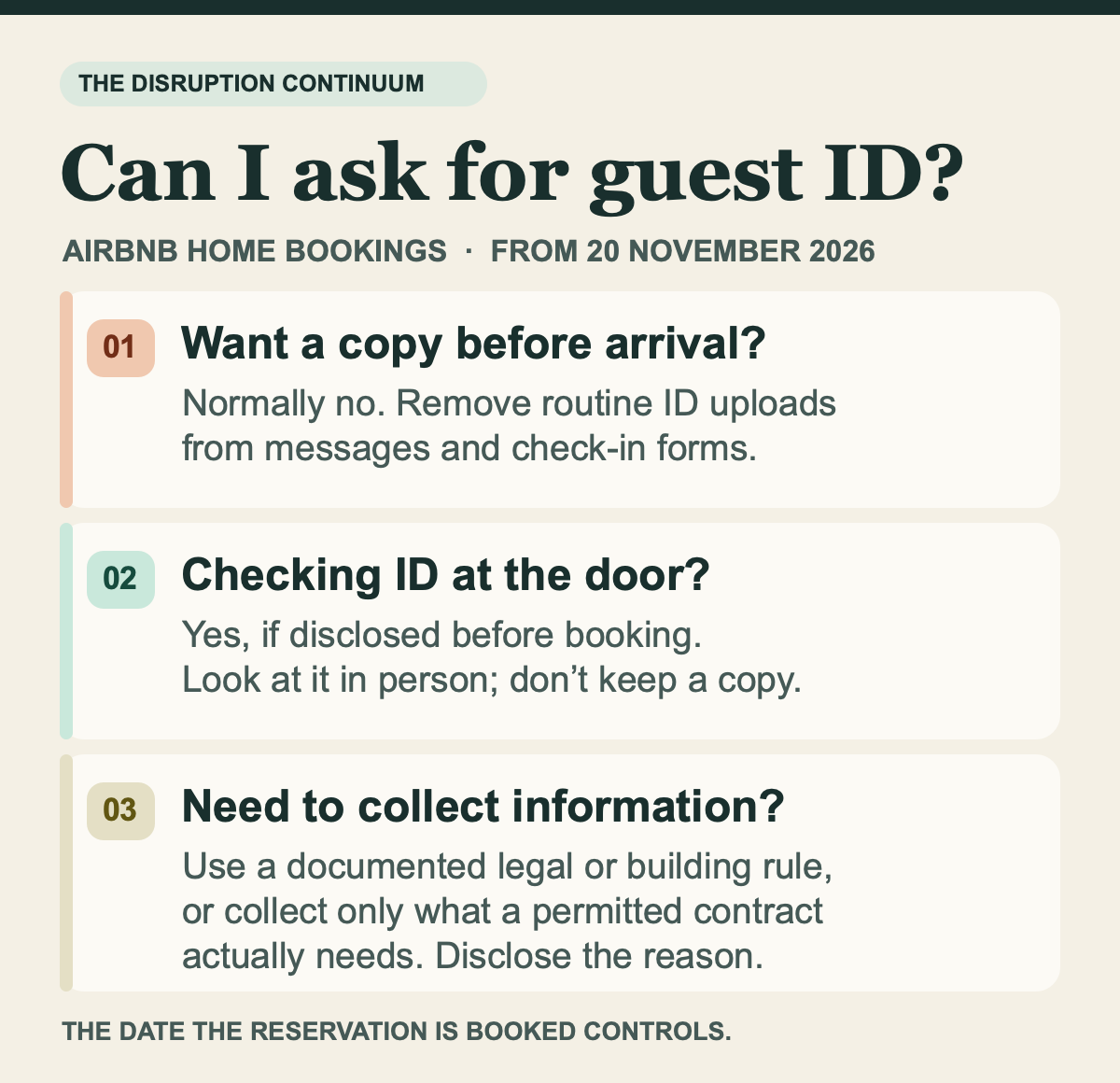
TL;DR: For reservations booked on or after 20 November 2026, Airbnb hosts generally may not ask guests for ID, contact details, or a separate rental agreement. You can still check a guest's ID in person at check-in, if you disclose it in your listing — but you may not keep a copy unless an exception below applies. The cutoff is the booking date, not the stay date.
If you have ever asked a guest to send a photo of their passport before arrival, or to fill in a check-in form with their phone number and email, this one matters.
Airbnb has updated its policy, "Limiting host-imposed contracts and other requirements" (Help Centre article 4169). It applies to reservations booked on or after 20 November 2026. Reservations booked before that date stay under the previous policy, even if the stay happens later. That policy already restricted routine requests for pre-arrival ID photos.
Airbnb's reasoning is simple: guests want to know they won't face unexpected requests that compromise their privacy. So the platform is drawing a line around what a host can ask for, on or off Airbnb.
This is not legal advice, and Airbnb's Help Centre is the final word. But here is what the policy actually says, in plain language, and what I would do about it.
Book my Airbnb services
What you can no longer ask for
With limited exceptions, hosts may not solicit personal data at any point during the booking process or the stay. That includes:
- Contact information — a guest's phone number, home address, or email address
- Identification details or documents — a passport, driver's licence, social security number, or photo
- Credit card numbers, bank account information, or other financial data, except where permitted under Airbnb's pricing and payment transparency policy
- Background check information or credit history
- Biometric or health data — fingerprints, facial recognition, or medical records
It also covers how guests get in. With limited exceptions, hosts may not require use of a third-party app or registration on another website to gain entry to a listing or access a critical amenity.
That means WiFi portals that ask for a guest's email address or other personal information are not allowed, unless the listing is a hotel or resort, or one of the exceptions below applies.
Keyless entry apps that require registration are different: you may offer them, but you must provide an alternate access method if a guest asks for one. Optional apps that make the stay easier — Sonos, Nest, a concierge app — are fine, as long as they are optional.
What you can still do: check ID in person
This is the part most hosts miss, and it matters.
You may physically check a guest's ID to verify identity in person at check-in, if you disclose the requirement in the additional rules section of your listing.
What you may not do is retain a digital or physical copy of it — except where one of the exceptions below applies.
So: look at it, confirm the person in front of you is a guest on the reservation, hand it back. Do not photograph it, do not keep a scan, do not ask them to send it in advance.
Airbnb already verifies booking guests itself, and it points hosts to that verification as the reason you should feel confident about who you are hosting. That is the trade-off Airbnb is making: its verification, not yours.
The exceptions — and they are narrow
Airbnb allows collection of personal information, or registration on a separate website or app, only where necessary to:
- Comply with applicable law or a documented community association rule — for example, an HOA or building security requirement, or a local guest-registration law, or
- Facilitate signature of an allowed contract — see the contracts section below.
If one of these exceptions applies, you must clearly disclose what information is required of guests, and why, in the additional rules section of your listing, so guests can review it before booking.
You may not collect more data than the law or rule calls for, or than is necessary to execute and share the permitted contract. You are responsible for securely storing and disposing of any sensitive data. Airbnb may ask you to provide evidence that an exception applies.
In practice: if you think a local law requires you to collect guest details, keep the written rule on file, disclose exactly what you collect and why, and collect nothing extra. Do not use "security" or "insurance" as a general reason — under the new policy, those are not exceptions on their own.
Separate rental agreements: generally no
The same policy covers contracts. Hosts generally may not ask guests to sign a separate contract or rental agreement, unless it is:
- Required by law or community association rules, or by the host's insurance provider
- Necessary to facilitate access to an optional amenity, such as a golf cart rental
- Requested in connection with a monthly stay (28 nights or more)
- Related to a stay at a Luxe listing
The terms of any allowed contract must comply with Airbnb's policies and terms, and must be relevant to the stay. You must always disclose the terms in the designated section of your listing, and you may be asked to provide evidence that your contract meets one of the criteria. Do not include personal information in your contracts — they are publicly visible.
Airbnb does not require guests to sign host-imposed contracts, and it does not help enforce them. You are responsible for collecting the signature.
What else is covered
Two other parts of the same policy are worth knowing:
- Separate activity or reviews: hosts may not require or pressure guests to do something unrelated to the stay, such as attending a timeshare presentation or buying a subscription. You can recommend local experiences and restaurants, as long as they are optional and any financial benefit to you is disclosed. You may not ask guests to review an Airbnb stay on a separate website, unless the listing is a hotel.
- Enforcement: if Airbnb determines a host violated the policy, it says it will take appropriate action, including educating the host, issuing warnings, suspending or removing listings, or suspending or removing the account for repeat offences.
What I would do now
Work through this before 20 November, and do it in this order:
- Remove any request for a photo of ID, passport, or driver's licence from your messages, guidebook, check-in form, and Guest App, unless one of the exceptions above requires it.
- Remove any request for a guest's phone number or email, on or off Airbnb, unless one of the exceptions above applies — and if it does, disclose it in your listing's additional rules.
- If you check ID in person at check-in, add that to your additional rules. Make it clear you check it, you do not keep a copy.
- Check your smart lock, WiFi portal, and any check-in app. Offer an alternative if a guest asks not to use a keyless entry app. Remove any other registration or personal information requirement that your listing is not allowed to impose.
- Check any separate rental agreement you use. If it does not fit one of the four exceptions above, stop asking guests to sign it.
- If you do have a legal or HOA exception, keep the written rule on file, disclose exactly what you collect and why, and collect nothing more.
That is the whole job. It is not about trusting guests less — it is about using Airbnb's verification, and your own eyes at check-in, instead of collecting documents you then have to store, protect, and eventually delete.
Source
Airbnb Help Centre, "Limiting host-imposed contracts and other requirements", article 4169 — https://www.airbnb.com/help/article/4169
Applies to reservations booked on or after 20 November 2026. Reservations booked before that date are covered by the previous policy, printed at the bottom of the same page.