
Australia economic report · 21 November 2026
Indicator | Latest | Note |
Policy rate | Cash rate target 4.85% | Raised 25 points on 3 Nov, 6–3 vote; fifth hike of 2026; highest since 2008 |
Inflation | 4.3% year on year (Sep) | Monthly measure, ABS 28 Oct; trimmed mean 3.6% (monthly) / 3.7% (quarterly) |
Growth | +0.4% in Q2 2026, +2.1% year on year | ABS National Accounts, 2 Sep; Q3 print due 2 Dec |
Labour market | Unemployment 4.9% (Oct, monthly) | Seasonally adjusted monthly print; trend 4.8%. Highest since Oct 2021; employment fell 43,500 in the month (ABS, 19 Nov) |
Public debt | Gross debt A$1,051bn forecast for 2026–27, 34.0% of GDP | Budget, 12 May 2026; underlying cash deficit A$31.5bn, 1.0% of GDP |
Australian dollar | RBA 4pm fix was already 0.6720 on 18 Nov, before the jobs release; the decline began in early November and continued after it |
On 3 November the Reserve Bank raised the cash rate to 4.85%, six votes to three, on a story of excess demand that it expected to persist until the middle of 2027. Sixteen days later the Bureau of Statistics reported unemployment at 4.9% in October, after employment fell by 43,500 in a single month. The comparison that matters needs its qualification stated up front, not buried below a chart: 4.9% is one month's seasonally adjusted print, and the Bank's forecasts are quarterly averages. Its November table does not reach 4.9% until the December quarter of 2027. In trend terms, October's rate was 4.8% — itself the level the Bank forecast for the June quarter of 2027. So the claim is narrower than "a year early", and it is still stark: the smoothed series is running about eight months ahead of the Bank's path, and a single monthly print has touched the end-2027 level fourteen months early. My call: the hiking sequence is over for now. The Board holds on 8 December, and the argument moves to whether October's inflation print, due on 25 November, is bad enough to reopen a case that the labour market has just closed. The live question is no longer whether policy is restrictive. It is whether the Bank tightened five times into a labour market that was already turning.
AI-assisted economic analysis; not investment advice.
The week the timetable broke
Three releases landed in four days, and they do not sit comfortably together.
First, the minutes of the 2–3 November meeting, published on 17 November. They show a Board split six to three for the hike, with the three dissenters preferring to stay at 4.60%. The majority's case, in the minutes' own terms, was "the further deterioration in the outlook for inflation, continued upside risks to the inflation forecast and an assessment that financial conditions may not be as restrictive as that backdrop required". Members assessed the economy to be in excess demand, expected that to persist until around mid-2027, and judged that the stronger September-quarter inflation outcome "reflected greater domestic capacity pressures than had been assessed previously". On the staff forecasts finalised on 28 October, headline and trimmed mean inflation remain above 3% until late 2027 and do not return to the 2.5% midpoint of the target band until mid-2028 — with the detailed table putting the December-quarter 2027 through-year rates at 2.7% for headline CPI and 2.9% for the trimmed mean.
Second, the Wage Price Index for the September quarter, published on 18 November: wages rose 1.1% in the quarter and 3.5% over the year. That is not a steady print; it is an acceleration — up from 0.7% in the June quarter on the September release's restated figures and 3.2% over the year to June, and the strongest quarterly rise since the December quarter 2023. (The June release originally printed June's quarterly rise as 0.8%; the September release restates it to 0.7%, and this report uses the latest vintage throughout.) Two qualifications decide what it means. The first is composition: the public sector rose 1.3% in the quarter and 3.9% over the year, against 1.0% and 3.4% in the private sector, and the ABS attributes the public-sector strength to state enterprise agreements — nurses, midwives, police — while the Fair Work Commission's 4.75% award increase, effective 1 July, lifted award-covered pay. A large part of the acceleration is administered and scheduled, not bargained in a tightening market. The second is timing: the WPI is a September-quarter photograph of the economy the Board was already looking at when it hiked — it cannot describe the labour market October's jobs data reveal. But nor can it be waved away. It removes "wages are behaving" from the case for a pause, and it is the hawks' strongest card for February if the jobs data stabilise.
Third, the Labour Force survey for October, published on 19 November, which is the subject of the next section. Read together, the three releases describe an institution looking at the economy through the September quarter — when its concern was justified by the data in front of it — while the October data describe an economy already cooling at the margin that matters most: jobs.
The labour market, followed through
Figure 1 · The Reserve Bank's timetable versus the data
Measure | RBA November forecast | Actual |
Unemployment, Dec quarter 2026 average | 4.7% | 4.9% in October alone (monthly; trend 4.8%) |
Unemployment reaches 4.9% | Dec quarter 2027 (quarterly average) | A single monthly print at 4.9% in October 2026; the quarterly average is not yet known |
Unemployment, end of 2028 | 5.1% | Path not yet testable — one monthly print does not set a quarterly path |
RBA Statement on Monetary Policy, November 2026, Table 3.1 (forecasts finalised 28 October); ABS Labour Force, Australia, October 2026 (19 November). The comparison is of a monthly print against quarterly-average forecasts, so one month does not settle the quarter — but the direction and the size of the miss are the point.
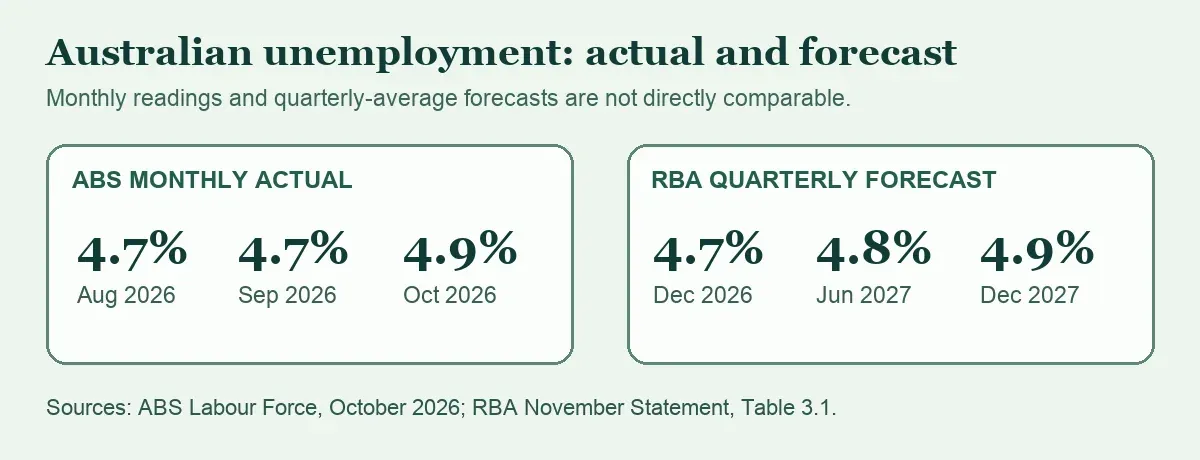
Employment fell by 43,500 in October, against expectations of a rise. It was the second large monthly fall in a row, after September's decline of about 36,400. The unemployment rate stood at 4.7% in both August and September on the October release's rounded figures, then rose to 4.9% in October — its highest since October 2021. The number of unemployed people rose 17,800 in the month to 753,700, and is up 95,400, or 14.5%, over the year. Over the same year employment grew by only 83,500, or 0.6%: more Australians joined the jobless queue than found work.
The composition matters. Part-time employment fell 40,600; full-time employment fell only 2,900. Employers are cutting hours and marginal roles before they cut core staff — the classic first stage of a labour-market turn, and the stage at which the data can still reverse. Participation fell 0.2 points to 66.6%, which flatters the unemployment rate: had participation held, the rate would be higher. Underemployment edged down to 6.2%, and the broader underutilisation rate was flat at 11.1%. Youth unemployment rose to 11.3% — young workers, last hired, are first released, exactly as a price-clearing labour market would predict.
Two bounds on what this shows. One month of Labour Force data is volatile, and rotation-group effects — the incoming survey sample differing from the group it replaces — can move a single month's print. And trend employment still rose, if only by about 7,000, against roughly 20,000 a month six months earlier. But the trend measures lag by construction; the seasonally adjusted series has now fallen twice, hard, and the unemployment rate stepped up sharply in October after two months at 4.7% on the rounded figures. The honest reading is not "recession". It is that the labour market the Board described on 3 November — tight enough that a higher estimate of full-employment unemployment was needed to reconcile it with the inflation data — no longer exists in that form.
Inflation, followed through
The inflation problem that drove the hike is real, and this report does not minimise it. Headline CPI rose 4.3% in the year to September, up from 4.0% in August, with prices up 0.8% in the month and 1.3% in the September quarter. The quarterly trimmed mean rose 1.0% in the quarter and 3.7% over the year (3.6% on the monthly measure). Inflation has now been above the top of the 2–3% target band for fourteen consecutive months. Housing and automotive fuel were the largest drivers in September; transport rose 8.7% over the year, housing 5.2%. Automotive fuel was excluded from September's trimmed mean calculation, which is part of why headline and underlying measures diverged.
Decompose it the way this series always does. The first round is imported: fuel and energy, priced in a world market dislocated by the Middle East conflict, arriving in an economy that imports nearly all its liquid fuel and holds among the lowest stocks cover in the developed world. The second round is domestic: market services inflation and unit labour costs, which the Bank's staff judged stronger than previously assessed, and which are the reason the Board concluded the September surprise was capacity pressure rather than noise. The RBA's November forecasts — headline peaking at 4.5% in the December quarter of 2026, trimmed mean 3.6% at the same point, both measures above 3% until late 2027 on the Statement's own wording, with Table 3.1's through-year rates for the December quarter of 2027 at 2.7% headline and 2.9% trimmed mean — were built on that judgement.
What the October labour data change is not the inflation that has already happened but the mechanism that would sustain it. Second-round inflation needs workers with bargaining power and firms with order books full enough to pass costs on. An economy shedding part-time jobs, with unemployment running well ahead of the central bank's schedule, is losing both. Wages at 3.5% year on year — and accelerating in the quarter, to 1.1%, the fastest quarterly pace since December 2023 — against productivity growth near zero on recent national accounts, still imply unit labour cost growth too fast for a 2.5% inflation target. That is the hawks' best remaining argument, and after the WPI print it is a stronger one than this report's first draft allowed. The qualifications are composition and timing, set out above: much of the quarterly jump was the award decision and public-sector agreements landing on schedule, in a quarter that ended before the jobs turn. The direction of travel in the October labour series is the opposite one, and it is not toward a wage-price spiral.
What the data does not show: October's CPI. It is published on 25 November, and my own trigger is a headline print at or above about 4.7% year on year — that would be a new cycle high. If a print at that level lands, the Board will face a genuinely stagflationary pair of prints — prices accelerating, jobs falling — and this report's call will be tested within the week. I flag that here rather than pretend the labour data settle the argument alone.
Growth, followed through
The latest national accounts are for the June quarter: GDP rose 0.4% in the quarter and 2.1% over the year, with GDP per capita flat in the quarter and up 0.7% over the year. Household consumption rose 0.4%, public final demand 0.2%, and the terms of trade fell 1.6% as import prices — fuels, fertilisers, plastics — rose. The current account deficit was A$27.2 billion in the quarter. The RBA expects growth of 1.6% over 2026 and 1.3% over 2027 (Table 3.1), below potential, as restrictive policy accumulates; the September-quarter accounts are due on 2 December.
Two structural features deserve the space the headline growth rate does not. The first is the composition of investment. The Bank itself notes that data-centre investment has supported stronger-than-expected activity: private capital, spending its own money on its own reading of demand for computing capacity, is doing for Australian growth what it is doing in the United States. That is the dispersed-knowledge economy working. The second is housing. Established home prices are down about 4.7% from their March peak on the measures reported this month, and new home loan commitments are well below their late-2025 peak. Five hikes in a year transmit through a mortgage market in which most borrowers are on variable rates: the cash-flow channel in Australia is fast, direct, and regressive in its incidence — it falls on recent buyers with the least equity, not on the economy evenly. None of that makes the hikes wrong. It does mean the Board should count the transmission it has already delivered before delivering more.
The fiscal position, followed through
Australia's public finances are, by the standards of this series, the least alarming on the page — and still not helping. The May 2026 Budget put the underlying cash deficit at A$31.5 billion in 2026–27, 1.0% of GDP, with deficits of roughly 1% of GDP across the forward estimates and no return to balance projected until 2034–35. Gross debt reaches A$1,051 billion in 2026–27, 34.0% of GDP, peaking at 35.8% of GDP. Those ratios are a fraction of the United Kingdom's 95.8% or the United States' roughly 125%, and the improvement against earlier forecasts is real.
The qualification is the direction of the impulse at the margin. A deficit of 1% of GDP is modest crowding out, not the American kind. But the Budget also layered cost-of-living and fuel-security relief onto an economy the central bank was simultaneously judging to be in excess demand. Fiscal and monetary policy are pulling against each other in miniature: every dollar of untargeted relief is a dollar the cash rate must offset. The neo-classical point is not that the deficit is large. It is that in an economy with no spare capacity, the consolidated stance is what matters, and Australia's consolidated stance is looser than the cash rate alone suggests.
The dollar
The Australian dollar's decline was already well underway before the jobs print, and the sequence matters. The currency had fallen for six straight sessions into mid-November: the Reserve Bank's 4pm fix was 0.6742 on 17 November and 0.6720 on 18 November — the day before the Labour Force release. The slide then continued after the jobs data, to a New York close of about US$0.662 on 20 November, the dollar's lowest level of 2026. Keep the two snapshots distinct: the 0.6720 is the RBA's Sydney 4pm fix on 18 November; the 0.662 is the New York close two days later. They are different fixings on different clocks, but on either basis the story is the same — a decline that began in early November, driven first by the US dollar and fading expectations of further RBA hikes, which 19 November extended rather than started, as the market unwound the further hikes it had priced. Two forces are at work. The first is the US dollar itself, strong against everything as the Federal Reserve tightens into strength: every currency in this series is cheaper against it. The second is now domestic: a currency is, among other things, the price of a country's expected interest-rate path, and on 19 November that path shortened. The fall is the market doing the easing the Board has not — an automatic stabiliser for an economy whose exporters are paid in US dollars, arriving exactly when the labour market needs it. A central bank that understands prices as information will read the exchange rate this week as evidence, not as a problem to be corrected.
The bottom line
Australia this week is the cleanest case in this series of the limits of demand management against a supply shock. The inflation is substantially imported and administered — fuel, energy, housing — and the instrument available, the cash rate, works by making Australians poorer in a particular order: part-time workers and the young first. The Board's November judgement was defensible on September's data. October's data say the economy it was judging has already changed. The Hayekian point cuts both ways, and both ways favour a pause: prices are information, and the newest prices — the unemployment rate, the participation rate, the exchange rate — are all saying the same thing, that restraint is now biting. A Board that hiked because it trusted its reading of capacity should hold because it trusts its reading of the same signals when they turn. Credibility is not never changing course. It is changing course when the evidence does, and saying why.
Previous checkpoints
The three releases the last report was waiting on have all fallen due this week and are scored in the sections above. The November minutes (17 November) confirmed the 6–3 split and the excess-demand assessment — scored as the majority's case, now overtaken on its own timetable. The September-quarter Wage Price Index (18 November) printed an acceleration — 1.1% in the quarter, the strongest quarterly rise since December 2023, and 3.5% over the year, up from 3.2% — which scores against the pause call on its face; the qualifications are its composition (the award decision and public-sector enterprise agreements) and its timing (a September-quarter measure, taken before the turn). The October Labour Force (19 November) is the decisive one: a monthly unemployment print of 4.9% (trend 4.8%) against a quarterly-average forecast path that reaches 4.9% only in the December quarter of 2027. The Board's next dated items — the October CPI on 25 November and its own meeting on 7–8 December — are carried into the list below.
What would change my call?
25 November 2026 — October CPI (ABS).* Headline at or above 4.7% year on year with the trimmed mean rising would reopen the February hike case and I would soften "the sequence is over" to "paused". A print at or below September's 4.3% confirms the pause.
2 December 2026 — September-quarter GDP (ABS).* Growth at or below 0.2% in the quarter, with household consumption flat or falling, would confirm the labour-market turn is a demand turn. Growth of 0.6% or more would say the economy absorbed the hikes better than the jobs data suggest.
7–8 December 2026 — the RBA meeting (decision 8 December, 2.30 pm AEDT).* I expect a hold at 4.85%. A hike after a 4.9% unemployment print would tell me the Board is targeting its forecast rather than the economy, and I would expect it to be cutting by the middle of 2027.
17 December 2026 — November Labour Force (ABS).* A third consecutive fall in employment, or unemployment at 5.0% or above, and the conversation moves from pause to the timing of cuts. A rebound in employment with unemployment back at 4.7% would mark October as noise, and I would say so.
Sources: Reserve Bank of Australia, Minutes of the Monetary Policy Board meeting, 2–3 November 2026 (published 17 November 2026) and Statement on Monetary Policy, November 2026; Australian Bureau of Statistics, Labour Force, Australia, October 2026 (19 November 2026), Wage Price Index, September quarter 2026 (18 November 2026), Consumer Price Index, Australia, September 2026 (28 October 2026) and Australian National Accounts, June quarter 2026 (2 September 2026); Commonwealth of Australia, Budget 2026–27 (12 May 2026); Reserve Bank of Australia, daily exchange rate fixings (4pm, 17–18 November 2026); AUD/USD New York close, OANDA via Finnhub, 20 November 2026.