
The Disruption Continuum · James Hinton
In October, Microsoft opened a time-limited Voluntary Exit Offer to eligible employees at level 70 and below in participating teams in Canada, India, the United Kingdom and the United States. Microsoft confirmed to CRN that about 60,000 employees were eligible — roughly 27% of the 223,000 full-time staff it reported at 30 June. That is an eligibility figure, not a departure count: Microsoft has not disclosed how many have accepted, and it did not say that taking the offer was a way to avoid a layoff. Satya Nadella explained the thinking behind it twice in three days — first on The Pragmatic Engineer podcast, published on Monday 16 November, and then at the DealBook Summit on Wednesday 18 November. His explanation is the most honest account I have heard from an incumbent chief executive of what the innovator's dilemma actually feels like from the inside. It is also, for an investor, a nearly perfect test case: a genuine disruption signal, delivered as a speech, by a company whose shares I cannot buy at anything near my price. What my framework does with a story like this is the subject of this article.
What Nadella actually said
Strip away the headline and the claim is not the one doing the rounds. He is not replacing software engineers with AI. He is reorganising Microsoft so that everyone works through AI, and every job becomes, in his phrase, managing the agents that do the work. Software engineering, he said at DealBook, has passed through three beliefs in quick succession: AI can never do software; AI can do all software, so who needs engineers; and now the rediscovery that engineering thrives, "except the way the team is organised and the work that a software engineer does has now got a new operating point."
His example was the team behind Cowork, the AI agent inside Microsoft 365. Eleven developers. "They build a software factory that builds the product. They don't build the product."
Then the part that matters for investors. Microsoft is a 51-year-old company that did not grow up AI-first. The question, as he put it at DealBook, is how quickly an incumbent can transform the work, the workflow and the work artifact, with all the wage support that goes with it. His own answer was that it is going to take a bit more time than anyone expects. The buyout exists, he said, "to make sure that at least everyone felt like they had agency in making choices" — because the alternative, telling people the revolution has made them anxious and then restructuring around them anyway, produces a workforce that resists the change it is being asked to make. On the podcast two days earlier he had made the anxiety point directly: the way the AI revolution has been talked about has left people feeling they do not have control of their own destiny. Asked whether the offers were a prelude to layoffs, he did not say yes — and he did not say no.
Three facts around the offer are worth keeping separate, because they are easy to blend. First, the money: on the 28 October earnings call, CFO Amy Hood said Microsoft's cost guidance across COGS and operating expenses "includes an estimate for the recently announced employee voluntary exit offer" — no standalone amount, and no comparison with the cost of layoffs. Second, this is not the retirement programme: Microsoft's earlier Voluntary Retirement Program, launched in April for about 8,750 US employees who met age and tenure conditions, is a different scheme — the company disclosed in July that more than 30% of those eligible took it. Third, it is not the Washington WARN filing either: the September filing covering 277 Puget Sound position eliminations effective 21 November is a separate matter, and it does not identify who was eligible for the October offer.
The dilemma has moved inside the firm
Christensen's original dilemma was about resource allocation. The existing customers are profitable, they can name what they want, and every budget round they win against the small, inferior, unproven thing that eventually replaces the franchise. My LDV framework — Leadership Quality, Disruption Aware, Value Investing — was built around that problem: financial strength tells me a company can fund the future; it cannot tell me whether management will.
Nadella's version adds a second capture. It is not only the customers who hold the budget hostage. It is the workflow. Microsoft's existing work is done by people whose skills, status and pay are attached to doing it the current way. An incumbent can fund all the AI research it likes and still fail, because the organisation's daily practice routes around the new thing. His answer is not a skunkworks or an acquisition. It is to re-found the work itself, and to price the human cost of doing so — a voluntary exit, with financial support, open to eligible staff who do not want to make the crossing.
That is a slower answer than a layoff round. Which is precisely why it is informative.
Where LDV reads a move like this
LDV scores companies from filings, not speeches. But its tests were designed to detect exactly this quality — a management willing to spend today's money on tomorrow's business — and it is worth mapping the buyout onto the tests to see what the framework can and cannot see.
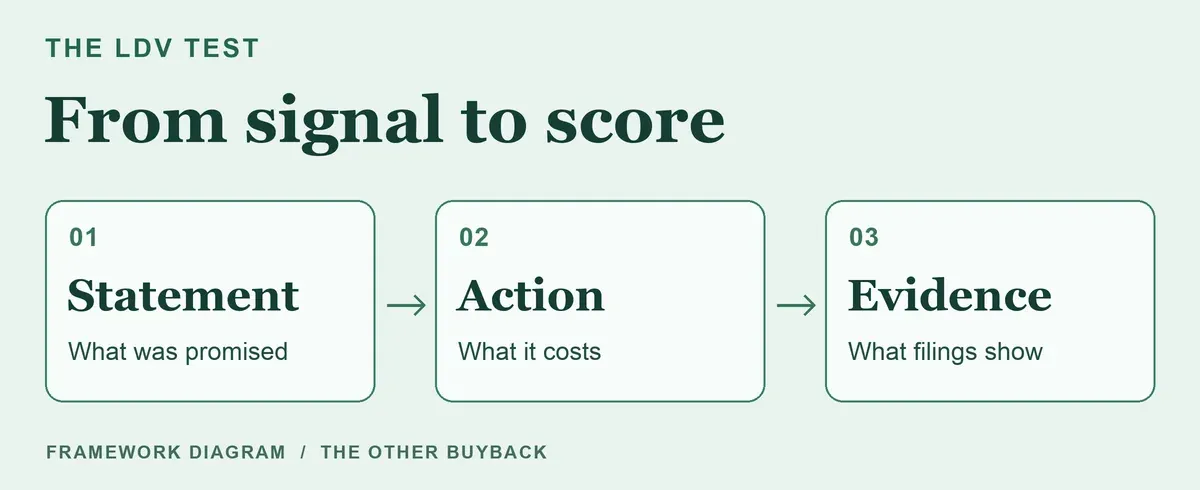
The move | Where LDV reads it | What would confirm it, in time |
A time-limited voluntary exit offer open to about 60,000 eligible staff — level 70 and below, in participating teams in Canada, India, the UK and the US — with financial support | Test 3, innovation culture (items 17–18): is the transformation claim backed by costly action, or contradicted by the numbers? | Restructuring charges actually taken; the programme completed rather than quietly dropped; delivery scored against what was promised |
Reorganising engineering around agent-managing teams (the 11-person Cowork team) | Test 2, Tier 2 investigation: a rival cost structure, not a rival product, is the threat this previews | Gross margin held while the model spreads; revenue per employee rising without revenue trailing the industry (veto V3 stays untripped) |
Funding the transition while returning cash to shareholders | Test 1, shareholder-yield guard: buybacks must not be funded by starving reinvestment | R&D and capex sustained through the programme; buybacks funded from free cash flow, not from hollowing out the business |
A public, dated, falsifiable account of the change | Test 3, communication and delivery (items 12, 19–20) | The promises get scored when they fall due — that is what the delivery items are for |
There are two kinds of buyback in this story. One returns cash to shareholders. The other buys organisational change — paying people to leave so that the people who remain can work differently. The first is easy to score and mostly tells you about the past. The second is the one that decides whether there is a future worth scoring.
What LDV refuses to do with it
Three refusals, and they matter more than the mapping.
No verdict from a speech. An exit offer is an announcement, not a result. About 60,000 people were eligible for the offer; how many take it, who they are, and whether the work genuinely changes are facts that will arrive in filings over the next several years, or not at all. LDV's delivery items exist because managers are at their most persuasive at the start of a programme. The framework scores the programme when the evidence lands.
No exemption for quality. Microsoft will get its LDV scorecard in its turn, under the same gates as a R166 watchlist industrial in Johannesburg. On price, the bar is not close: the framework buys at fifteen times normal earnings or below, and Microsoft — like NVIDIA, which failed that gate at 48 times — trades far above it. A true transformation story at a full price is still a full price. The watchlist exists for exactly this situation: a company you would happily own at your ceiling, and not a cent above it.
No new points for narrative. It would be easy to add a "management is disrupting itself" bonus to the disruption test. I am not doing it. The moment a test can be passed with a good speech, it stops being a test. Moves like Nadella's belong in the investigation notes that surround the score — they tell the analyst where to dig — while the score itself stays binary, auditable and boring.
The questions this adds to every other scorecard
The transferable value of the Microsoft story is not Microsoft. It is a short list of questions I will now ask of every incumbent the programme scores:
Is management re-founding the workflow, or bolting the new technology onto the old one and calling the press release a transformation?
Is the change funded like capital expenditure — real money, taken through the accounts — or expensed like marketing?
Who was offered the exit, and who actually took it? A programme the best people use to leave is a different signal from one the organisation uses to renew itself.
When the new operating point arrives in the numbers, does it arrive as margin defended, or as revenue quietly trailing the industry — the one disruption signal with a published link to what happens next?
The cruellest feature of the innovator's dilemma is that the profitable present pays for everything, including its own replacement. Most incumbents respond by protecting the present and hoping. Nadella has at least named the bill, in public, and started paying it. LDV's job is less inspiring and more useful: check, company by company, whether the bill is actually being paid — and refuse to pay for it a second time in the share price.
Further reading
Daily Investment Intelligence — 21 November 2026 — NVIDIA's 14% fall, and the scorecard that said no at 48 times earnings.
Building the Age of AI — The price of finished work — what happens to the value of work when AI finishes it.
Daily Investment Intelligence — 20 November 2026 — the Anthropic IPO and the market it landed in.
Research data, not investment advice.