
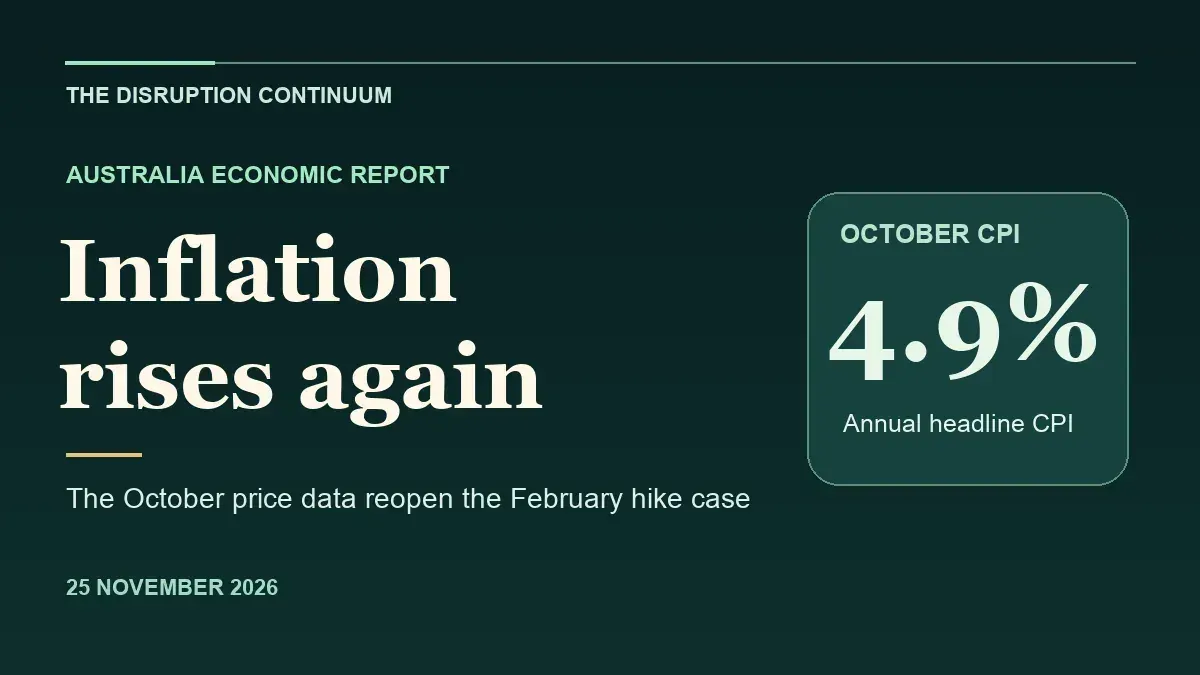
Australia economic report · 25 November 2026
Indicator | Latest | Note |
Policy rate | Cash rate target 4.85% | Raised 25 points on 3 Nov, 6–3 vote; next decision 8 Dec |
Inflation | 4.9% year on year (Oct) | ABS, 25 Nov; trimmed mean 3.8% year on year, up from 3.6% in Sep |
Growth | +0.4% in Q2 2026, +2.1% year on year | ABS National Accounts, 2 Sep; Q3 print due 2 Dec |
Labour market | Unemployment 4.9% (Oct) | Highest since Oct 2021; employment fell 43,500 in the month (ABS, 19 Nov) |
Public debt | Gross debt A$1,051bn forecast for 2026–27, 34.0% of GDP | Budget, 12 May 2026; underlying cash deficit A$31.5bn, 1.0% of GDP |
Australian dollar | About US$0.663 on 25 Nov after the CPI release | Briefly US$0.6664 in Asian trade; close on 20 Nov was US$0.662 |
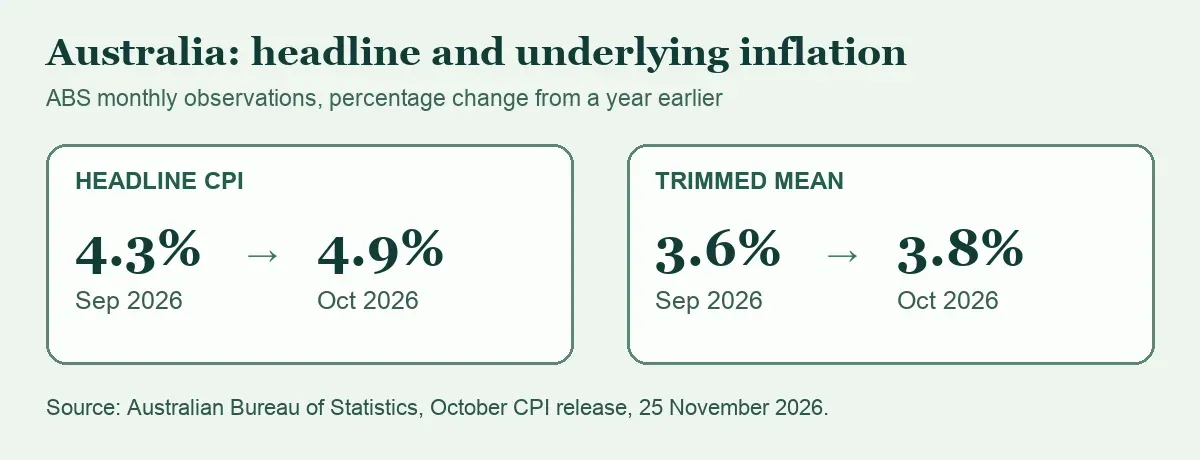
The Bureau of Statistics reported on 25 November that consumer prices rose 4.9% in the year to October, up from 4.3% in September, with trimmed mean inflation rising to 3.8% from 3.6%. That monthly year-on-year rate sits above the level of the Reserve Bank's November forecast peak — 4.5% for headline inflation in the December quarter — but one month does not establish that the quarter itself will beat that forecast. It lands alongside unemployment at 4.9% — a five-year high. My call changes on the evidence I set out on 21 November: the hiking sequence is paused, not over. I still expect the Board to hold at 4.85% on 8 December, because it will not hike into a labour market turning this fast on one inflation print. But February is now live. The live question is whether October is the administered and imported part of the index doing its work — electricity rebates ending, fuel dearer — or whether underlying pressure, measured by the trimmed mean at 0.5% in the month, is broadening again while demand is already contracting.
AI-assisted economic analysis; not investment advice.
The print, in full
Headline CPI rose 0.5% in October in original terms and 0.7% seasonally adjusted, taking the annual rate to 4.9%. The trimmed mean rose 0.5% in the month seasonally adjusted and 3.8% over the year. The weighted median was 3.4% over the year. Prices excluding volatile items rose 3.9% over the year.
Two groups did most of the work, and the ABS names them plainly. Housing rose 6.4% over the year, up from 5.2% in September, and was the largest contributor. Inside housing, electricity rose 25.2% over the year, up from 12.8% in September. The ABS attributes that rise to Commonwealth government rebates that reduced household electricity costs last year and are no longer in place. New dwelling prices rose 5.1% over the year, up from 4.7%, which the ABS attributes to builders passing on higher costs for materials and labour. Transport was the second largest contributor, rising 10.6% over the year. Automotive fuel rose 6.3% in October alone, after 9.4% in September, on higher world oil prices. Automotive fuel was excluded from the trimmed mean calculation in October, which the ABS notes was a key driver of the gap between headline and trimmed mean.
The rest of the basket is where the argument sits. Food and non-alcoholic beverages rose 3.5% over the year. Goods inflation was 5.8% over the year; services inflation was 4.0% over the year and flat in the month. Tradables inflation was 5.3% over the year; non-tradables 4.7%. Education rose 4.7%, health 4.0%, recreation and culture 4.3%, insurance and financial services 3.7%. Furnishings, household equipment and services rose only 1.4%.
Figure 1 · October CPI by group (year on year, %)
Group / measure | Sep 2026 | Oct 2026 |
All groups CPI | 4.3 | 4.9 |
Trimmed mean | 3.6 | 3.8 |
Housing | 5.2 | 6.4 |
Electricity (within housing) | 12.8 | 25.2 |
New dwellings (within housing) | 4.7 | 5.1 |
Transport | — | 10.6 |
Food and non-alcoholic beverages | — | 3.5 |
Goods | — | 5.8 |
Services | — | 4.0 |
ABS, Consumer Price Index, Australia, October 2026 (25 November 2026). Dashes mean the September group rate is not restated here; the report uses only the September rates the ABS release itself compares — headline, trimmed mean, housing, electricity and new dwellings. Transport, food, goods and services October rates are as published.
What is administered, what is imported, and what is underlying
Decompose October the way this series always does, because the three parts call for different responses and only one of them is the cash rate's business.
The administered part is electricity. A rebate that lowered the measured price last year has ended, so the annual comparison now measures the absence of a subsidy as if it were a price rise. In one sense it is: households pay more than they did under the rebate. In the sense that matters for monetary policy it is not a signal of excess demand. It is a fiscal decision changing a regulated price, and its effect on the annual rate will persist for twelve months and then drop out, whatever the Board does. A central bank that hikes because a subsidy ended is taxing mortgage holders to offset a Treasury line item. That is the wrong assignment, and the Board knows it.
The imported part is fuel. Transport at 10.6% over the year, fuel up 6.3% in the month, is the same Middle East supply shock running through every report in this series — South Africa's fuel inflation at 42.9%, Britain's motor fuels at 33.2%. Australia imports nearly all its liquid fuel. The cash rate does not produce oil. What it can do is stop the imported relative-price change being ratified into domestic wages and margins. That is a second-round argument, and it has to be judged on second-round evidence.
The third part is underlying pressure, and the trimmed mean is its measure — not a domestic-only measure. Trimming removes the largest price moves, whatever their source: in October it excluded automotive fuel, but the trimmed basket still carries other imported prices and the indirect costs passed through from them. Even on that measure, inflation still rose, to 3.8% over the year and 0.5% in the month. That is the uncomfortable part of this release. Annualised, 0.5% a month is about 6%. One month annualised is a noisy thing to lean on, and I do not lean on it as a forecast. I note it as direction: underlying pressure did not fall back while the headline jumped; it rose. New dwellings at 5.1%, with builders citing materials and labour costs, is domestic cost pressure in the sector most sensitive to the policy rate — which cuts both ways, as evidence of pressure and as evidence that further tightening lands on housing supply itself.
What the data does not show is just as important. Services prices were flat in the month, even though they are 4.0% higher than a year ago. A broadening second round would normally show services accelerating month on month; October does not show it. The release contains no wages data — the September-quarter Wage Price Index, at 3.5% over the year on 18 November, is still the latest — and no November labour data. So the honest statement is narrow: October's monthly print came in above the level of the RBA's December-quarter forecast peak, and underlying inflation rose with it, and the two mechanisms that would turn this into a sustained problem — services repricing and wage settlements — are not in this release at all.
The labour market and demand, followed through
Nothing in today's release changes the labour facts from 19 November, and they remain the strongest argument against a December hike. Unemployment rose to 4.9% in October, its highest since October 2021, after employment fell 43,500 in the month — the second large monthly fall in a row. The number of unemployed people rose to 753,700. Participation fell to 66.6%, which flatters the rate. The Reserve Bank's November forecasts did not expect unemployment to reach 4.9% until the end of 2027; it arrived in October 2026.
The demand surveys since then point the same way. The S&P Global flash composite PMI for November, published on 23 November, was 46.1, down from 48.2 in October and the lowest since August 2021 — a fifth year low for private-sector activity on that measure, with new orders falling, firms cutting staff for the second time in three months, and business confidence at a three-year low. Input-cost and selling-price inflation in that survey eased. A flash survey is preliminary, and the finals are due on 1 and 3 December; I treat it as corroboration of the Labour Force direction, not as a substitute for it.
Put the two halves together and Australia has the pair of prints central banks dread: inflation at 4.9% and rising, activity contracting and jobs falling. That combination does not tell the Board what to do by itself. It tells it that both errors are now costly. Hike, and it tightens into a labour turn it did not forecast. Hold and guide hawkish, and it risks the trimmed mean drifting further from the 2–3% band it has already missed for fourteen consecutive months before October — fifteen now, on the headline measure's time above the band top as reported in the 21 November report. My judgement is that a Board that split 6–3 to hike on 3 November, with the three dissenters preferring to hold, will not find six votes to hike again on 8 December with unemployment at 4.9%. It will hold, and it will make February the meeting that decides.
Growth and the fiscal position, followed through
The latest national accounts remain the June quarter: GDP rose 0.4% in the quarter and 2.1% over the year, with GDP per capita flat in the quarter. The September-quarter accounts are due on 2 December, six days before the Board meets, and they are now the second leg of the December decision. Growth at or below 0.2% in the quarter would confirm that the labour turn is a demand turn. Growth of 0.6% or more would say the economy absorbed five hikes better than the jobs and survey data suggest, and would strengthen the hawks materially.
The fiscal facts are unchanged from the 21 November report, and today's release sharpens why they matter. The May 2026 Budget put the underlying cash deficit at A$31.5 billion in 2026–27, 1.0% of GDP, with gross debt at A$1,051 billion, 34.0% of GDP. Those ratios remain modest by the standards of this series. But October's largest single contributor is a fiscal artefact: the ending of Commonwealth electricity rebates added directly to measured inflation. When the state first suppresses a price with a rebate and then withdraws the rebate, it manufactures first a flattering print and then a hostile one, and the central bank is left explaining both. Prices that are allowed to signal do not jump when a budget line expires. The neo-classical point is not that relief is never warranted. It is that relief delivered by distorting the price itself corrupts the information every other decision — including the Board's — depends on, and October is the bill arriving.
The dollar
The Australian dollar rose on the release, briefly to about US$0.6664 in Asian trade before easing to about US$0.663, against a close of about US$0.662 on 20 November and a 2026 low near US$0.6600 touched on Monday. Market pricing moved the way the data pointed: a December hold remains overwhelmingly favoured, the small probability of a December cut fell further, and the implied policy rate for September 2027 rose, as traders pushed back the cuts they had priced for 2027 and put some probability back on a further hike.
Read the currency as information, as this series always does. A week ago the dollar fell because the market shortened the expected rate path after the jobs print. Today it rose because the market lengthened it again after the prices print. Both moves are the exchange rate doing its job — repricing the country's expected policy path as the evidence changes — and a firmer dollar, if it holds, does a small part of the tightening for the Board by cheapening imports. The larger force remains the US dollar itself and the Federal Reserve's decision on 9 December, the day after the RBA's. Australia's Board meets first, into a currency set largely in Washington.
The bottom line
On 21 November I wrote that the hiking sequence looked over, and I named the test that would prove me wrong: headline at or above 4.7% with the trimmed mean rising. October printed 4.9% with the trimmed mean at 3.8%, up from 3.6%. The test was met, so the call changes — that is what a checkpoint is for. That is a statement about October's monthly print against my checkpoint, not a claim that the December quarter has beaten the RBA's 4.5% forecast — the quarter still has November and December to run. What has not changed is the structure underneath. A large part of October is administered and imported: a rebate ending and a fuel shock, neither of which a cash rate can repeal. What remains is underlying pressure — the trimmed mean, which trims the largest moves but is not a domestic-only measure — and it rose, which is enough to reopen February and to end any talk of cuts in early 2027. It is not, on its own, enough to justify hiking in December into unemployment at a five-year high and private-sector activity contracting at its fastest in five years on the flash survey. Hold in December, say plainly that February depends on November and December prices and on whether services start moving month on month, and let the next two prints — GDP on 2 December and the November Labour Force on 17 December — share the decision with the next CPI. Prices are information. October's information is that restraint has not finished its work on prices, and has already started its work on jobs. A board that trusts price signals has to hear both sentences.
Previous checkpoints
One checkpoint from the 21 November report has fallen due and is scored here. The 25 November October CPI printed headline 4.9% year on year — above the 4.7% threshold in that report — with the trimmed mean rising to 3.8% from 3.6%. On the terms set on 21 November, that reopens the February hike case, and the earlier wording "the sequence is over" is therefore softened to "paused", as that report promised. The other checkpoints from 21 November — September-quarter GDP on 2 December, the RBA meeting on 7–8 December, and the November Labour Force on 17 December — have not fallen due and are carried into the list below.
What would change my call?
2 December 2026 — September-quarter GDP (ABS). Growth at or below 0.2% in the quarter, with household consumption flat or falling, confirms the demand turn and makes a February hike hard to justify on activity grounds. Growth of 0.6% or more, and I would move February from live to likely if prices stay hot.
8 December 2026 — the RBA decision. I expect a hold at 4.85%. A hike on 8 December, after unemployment at 4.9%, would tell me the Board is targeting its forecast rather than the economy in front of it. A hold with guidance that plays down February would tell me it is discounting the trimmed mean, and I would say so.
17 December 2026 — November Labour Force (ABS). A third consecutive fall in employment, or unemployment at 5.0% or above, pushes the balance back toward pause-for-longer even after today's print. A rebound in employment with unemployment back at 4.7% or below would mark October's jobs fall as partly noise and strengthen the hike case.
6 January 2027 — November CPI (ABS). This is the deciding print for February. Trimmed mean at or above 3.8% again, with services rising month on month, and I would expect a February hike. Trimmed mean back at 3.6% or below, with the headline rise confined to electricity and fuel, and the pause extends.
9 February 2027 — the RBA's first meeting of 2027. My current call is that this meeting, not December, is where a sixth hike would come if the next two CPI prints stay hot. Two soft prints before it, and February passes too.
Sources: Australian Bureau of Statistics, Consumer Price Index, Australia, October 2026 (25 November 2026) and ABS media release "CPI rose 4.9% in the year to October 2026" (25 November 2026); ABS, Labour Force, Australia, October 2026 (19 November 2026) and Wage Price Index, September quarter 2026 (18 November 2026); Reserve Bank of Australia, Minutes of the Monetary Policy Board meeting, 2–3 November 2026 (published 17 November 2026) and Statement on Monetary Policy, November 2026; ABS, Australian National Accounts, June quarter 2026 (2 September 2026); Commonwealth of Australia, Budget 2026–27 (12 May 2026); S&P Global flash PMI, November 2026 (23 November 2026), as reported; AUD/USD and market pricing, reports of 25 November 2026.