
AI Weekly Newsletter · Issue 04 · 21–28 November 2026
TL;DR — No frontier lab shipped a new flagship model this week. What shipped instead was capability you can download: a 27-billion-parameter coding agent with a 5.9 GB model footprint that runs on a phone, a 105-billion-parameter open-weight model from India whose price fell by two-thirds, and coding models small enough to live inside an IDE. The week's biggest corporate story ran the other way — NVIDIA's board unanimously reinstated Jensen Huang eleven days after his resignation, while stating plainly that the investigation behind it is not finished. Anthropic closed the largest IPO in history — announcing the close on 20 November, with the documenting 8-K filed on 25 November — and within days watched its shares close below the offer price. And Anthropic's own interview study of 58 enterprise customers found the pattern underneath all of it: companies are hiring less, laying off few, and finding that the highest-value uses are the ones that involve reorganising the work. This issue follows the opportunities being created — and the ones being closed — story by story.
Story | What shipped or changed | Why it matters |
Ternary Bonsai 2.5 27B (24 Nov) | Open-weight coding agent with a 5.9 GB model footprint; SWE-bench Verified 75.6 against the full-precision base model's 80.6, on PrismML's own whitepaper | Near-frontier agentic coding now runs on a laptop, a phone and private files — no API, no data leaving the building |
Sarvam-105B-1711 (22 Nov) | Open-weight 105B checkpoint; eight-benchmark conversational average 42.6 → 73.9 on Sarvam's own setup; blended price cut from $0.44 to $0.15 per million tokens | A non-US lab matched the Flash-Lite class on its home ground — Indian languages and voice — at a third of its own previous price |
The open-weights cluster (23–26 Nov) | JetBrains Mellum2.1 Instruct (12B, Apache 2.0), KRAFTON Raon-1 mini, Z.ai's looped GLM-5.4 (subscription only, no weights) | The contest at the edge is now about architecture and footprint, not just parameter count |
NVIDIA (23 Nov) | Board unanimously reinstates Jensen Huang as President, CEO and director, effective immediately; the independent investigation continues | The resignation is reversed; the questions that caused it are explicitly not answered yet |
Anthropic (25 Nov filing) | IPO and private placement closed on 20 November (announced that day; documented in the 25 November Form 8-K): $93.5bn gross IPO plus $26.0bn private placement, about $119.5bn combined including selling holders; one $7 Class F share carries 50.1% of the voting power on matters submitted to stockholders generally, Class T director elections excepted | The largest raise in history is now a filed fact — and so is who controls the company afterwards |
Anthropic Institute (23 Nov) | Working with AI: 66 interviews, 58 enterprise customers; most reported hiring less, very few reported AI-driven layoffs | The first labour effect is the job that is never posted, not the job that is cut |
OpenAI protein design (24 Nov) | Research result (preprint): of 322 designed minibinders across five targets, 35 bound in the lab | A model designing molecules that physically bind is a different claim from a model writing about molecules — and binding is still not a drug |
Dell Q3 FY27 (24 Nov) | Revenue $54.9bn, up 103%; Infrastructure Solutions Group $42.0bn, up 198%; full-year guidance raised to $202.0bn | The build-out's cash is still flowing to the people who ship servers |
The lead: capability moved to the edge
The frontier labs had a quiet week — no new flagship from OpenAI, Anthropic, Google, Meta, xAI or Microsoft, a negative I checked against each lab's own releases rather than assumed. The open-weights world had the opposite week, and it is the more important one for anyone building outside a hyperscaler's walls.
A coding agent in 5.9 gigabytes
24 November · release, open weights (Apache 2.0). PrismML released Ternary Bonsai 2.5 27B, built on Qwen3.8 27B with every weight reduced to ternary values. The model footprint is 5.9 GB. On PrismML's own whitepaper figures — vendor-run, and worth treating as vendor-run — it scores 75.6 on SWE-bench Verified against 80.6 for the full-precision base model, 90.5 on AppWorld against the base model's 93.2, and 27.0 on DeepSWE, where the previous Bonsai scored zero. It generates at 204 tokens per second on a consumer RTX 4090 with MTP, runs on NVIDIA and Intel hardware through llama.cpp, and on Mac, iPhone and iPad through MLX. One practical caveat for builders: the smallest 5.9 GB file needs PrismML's own llama.cpp fork; the build that runs in stock llama.cpp is larger, at roughly 7.6 GB.
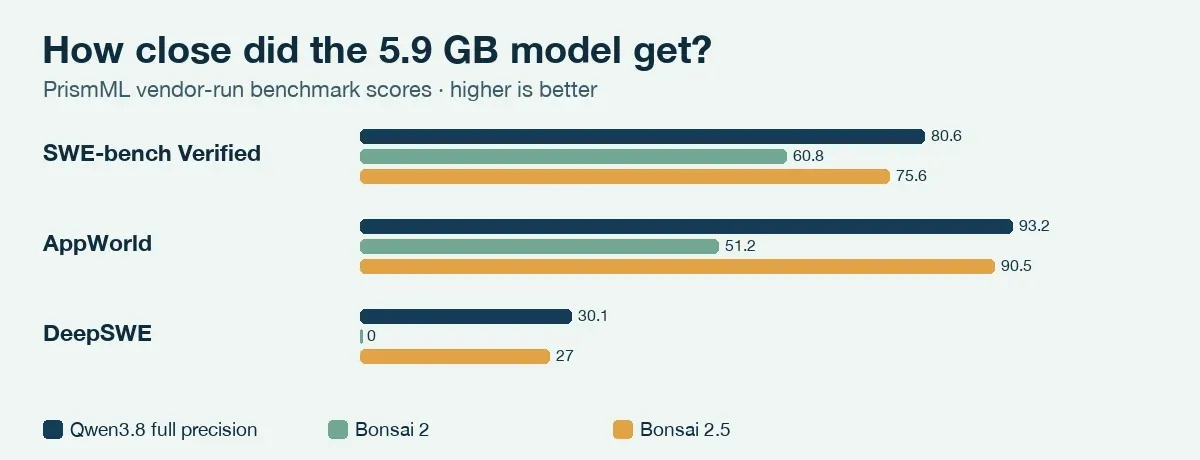
My view: the number that matters is not 75.6. It is 5.9. A model that can work through a private repository, call tools over many turns and recover when a step fails — on the machine already sitting on a developer's desk, with no code leaving the building — removes the two objections that have kept regulated and privacy-sensitive teams off agentic coding entirely: data exposure and per-seat API economics. It does not prove parity with the frontier on the hardest problems; DeepSWE at 27.0 against the base model's 30.1, and both far below what a top hosted model does with a full harness, says the gap is narrowed, not closed. But most coding work is not the hardest problem. It is the long tail of ordinary problems, and the long tail just got a local option.
India's Flash-Lite, at a third of the price
22 November · release, open weights. Sarvam AI released Sarvam-105B-1711, a new checkpoint of its 105B mixture-of-experts model built for customer support, voice agents and agentic work. On Sarvam's own evaluation setup, its average across eight conversational-agent benchmarks rose from 42.6 for the February checkpoint to 73.9 — level with Gemini 3.5 Flash-Lite's 74.0 in the same table, at a blended price Sarvam cut from $0.44 to $0.15 per million tokens (blended on a 3:1 input-to-output mix; Sarvam's list is ₹10 input / ₹25 output per million tokens). The weights are downloadable, and a 65 GB NVFP4 build runs on a single RTX PRO 6000 Blackwell workstation GPU at 99 tokens per second per user — a configuration Sarvam pitches explicitly at banks, government departments and strategic sectors that must run on their own premises. Its largest gains are where its home market lives: the Indic-language suite rose from 30.1 to 79.1.
My view: read the caveats first — every comparison in that table ran on Sarvam's own setup, against prices sourced partly from third-party routers, and a vendor's home benchmark suite is a home game. Then read the strategic fact underneath them: a lab outside the US–China axis shipped an open-weight model that is competitive in its class, dominant in its own languages, and cheap enough that the API bill stops being the argument. For South African and Australian builders the lesson transfers directly: the winning local model will not be the one that tops a global leaderboard, it will be the one that is best at the languages, accents and documents its own market actually produces.
The rest of the edge cluster
JetBrains Mellum2.1 Instruct · 25 November · release, open weights (Apache 2.0). A 12B mixture-of-experts model with 2.5B active parameters and a 131K context, built to answer directly rather than reason at length: JetBrains says it produces about half the output tokens of its Thinking sibling on agentic coding tasks while performing almost as well, and it ships in GGUF form on day one for local IDE use. This is a model designed to disappear into a tool, which is where most model usage is heading.
KRAFTON Raon-1 mini · 25 November · release, open weights (Apache 2.0). A 28.8B model (4.3B active) trained from scratch by a games company, with a novel attention design (Raon Delta Attention in 18 of 25 layers) and a 262K context; its quantised build fits a single 24 GB GPU. Vendor benchmark scores are strong and, as always, vendor-run. The fact worth keeping is the trainer: a games publisher now trains credible open models from scratch because its own products need them.
Z.ai GLM-5.4 · 23 November · release, subscription only — the counterpoint. GLM-5.4 is architecturally the week's most interesting announcement: a Loop Transformer that runs 28 layers of its roughly 750B base twice, reaching 1M context. It is also the week's least open: no weights, no API date, no published benchmarks or model card, access through a coding subscription from $18 a month. Looping — spending depth instead of parameters — is the same idea behind Thinking Machines' Inkling 2 Mini, which this newsletter covered last week. Two labs reaching for the same architecture in the same fortnight is a signal. Only one of them let you download anything.
Opportunities created: for builders in regulated industries (banking, health, government, law), who gain a local agentic option that answers the data-residency objection; for hardware — every capable local model sells workstations, high-memory laptops and Apple silicon; for regional labs, whose language and domain advantage is now demonstrably worth money; for small teams, whose inference bill for routine agentic work just fell again.
Opportunities lost: for API providers selling undifferentiated mid-tier inference into exactly these workloads — a 5.9 GB download is a competitor that charges nothing per token; for the assumption that open weights trail the frontier by a safe margin on agentic tasks; and for any vendor whose privacy pitch was "trust our cloud", now that "run it yourself" is a real alternative at this capability level.
For someone building with AI: download Bonsai 2.5 and Mellum2.1 this week and run your own hardest routine task through both, locally. The benchmark tables are vendor-run; your workload is the only evaluation that prices your decision.
Frontier models and access: a week of packaging, not launches
No new flagship frontier model was released in the window by OpenAI, Anthropic, Google/DeepMind, Meta, xAI or Microsoft — verified against the labs' own release notes and changelogs, not inferred from silence in the press. What changed was packaging around models launched just before the window (OpenAI's GPT-6.2 family on 17 November, Google's Gemini 4 Neon on 18 November):
OpenAI API changelog · 24 November · release (configuration). OpenAI added dedicated healthcare model configurations to the Responses API — including `gpt-6.2-astra-healthcare` and `gpt-6.2-sol-healthcare`, with a dedicated medical search index — and updated its `chat-latest` snapshot. No separate pricing was stated. The pattern matters more than the SKUs: the frontier is being sold as regulated-industry configurations, with the compliance surface as the product.
Alibaba · 25 November · access change. The Token Plan preview of Qwen4-Max, running since 11 November, reached its scheduled retirement; Qwen4-Max itself remains a closed, hosted model (general availability was last week's news, at $1.50 / $4.50 per million tokens on Alibaba's international pricing). A preview ending on schedule is not a setback — it is a reminder not to build production work on a preview ID, which is what this newsletter said when the preview opened.
My view: a week with no flagship launch is data, not a lull. The labs are monetising the models they have — industry configurations, subscriptions, distribution deals — while the open-weights ecosystem ships. That is what a maturing market looks like, and it is also what the top of a capability plateau would look like. The next flagship launches will tell us which; until then, price and packaging are the competition.
Opportunities created: for enterprise buyers, who can negotiate against a stable model line-up instead of re-evaluating monthly; for regulated industries, handed vendor-supported configurations instead of building the compliance layer themselves. Opportunities lost: for anyone whose product is a thin wrapper on "we use the newest model" — in a week with no newest model, the wrapper is the whole product, and it shows.
For someone building with AI: use quiet frontier weeks to lock in evaluations. A harness built now, against a stable target, is what lets you judge the next launch in a day instead of a month.
Emerging fields
A model designed proteins that bound — 35 times out of 322
24 November · research result (preprint, not peer-reviewed). OpenAI reported that its GPT-6 models designed protein minibinders that were then made and tested in a partner laboratory (Onava). Of 322 minibinders designed across five targets, 35 bound — 10.9%: 18 against IL-17A, 8 against VEGF-A, 5 against PD-L1, 3 against IL-7Rα and 1 against TrkA. OpenAI states its own limits plainly, and they are part of the result: binding is not function and not a drug; the pipeline was not end-to-end (a specialist model, SolubleMPNN, supplied sequences and other specialist models filtered candidates); and structure prediction was, in OpenAI's words, a clear weakness. There has been no independent replication.
My view: this is the shape of credible AI-for-science claims now — a physical measurement, a denominator, and the failure modes printed in the same document. 35 of 322 is a hit rate a medicinal chemist can reason about. What it does not prove is a discovery platform; it proves one pipeline, on five chosen targets, with specialist tools doing parts of the work. The opportunity is real and specific: design–test loops where the model's job is to propose candidates worth spending laboratory money on.
Verified quantum algorithms, and verified cryptography
23 November · research result. Google DeepMind and Quantum AI reported using agent teams with formal verification in Lean to find faster quantum algorithms: a fusion cost reduction of 11.8× (5,650 down to 4,338 qubits), 8× on a photochemistry problem, 2.5× on Cytochrome P450, and 2.57× on Grover's algorithm. These are formally verified resource estimates, not results run on quantum hardware — DeepMind itself notes the problems remain beyond the first error-corrected machines. The Lean library was open-sourced, which is what makes the claim checkable.
24 November · release (open proofs). Intrinsic Technologies published machine-checked proofs for 71 operations across 10 RustCrypto crates, verified at the x86-64 binary level in Lean 4 against the NIST, IETF and SECG specifications — with all proofs written by a multi-agent system. Their validation work also found more than 50 issues in Intel's official executable specification, since fixed. The guarantee is relative to their machine model and to human-translated specifications, for a bare-metal target; within that scope, it is the strongest kind of claim software can make, because a checker, not a reviewer, accepted it.
My view: put these two next to Issue 01's machine-checked verification of Signal's cryptographic implementation and a line appears: the highest-value use of agents in technical work may be producing proofs that a machine can check, because the checking does not depend on trusting the model. That is a business, not just a research direction — every regulated codebase is a queue of properties someone must eventually prove.
Robotics: a humanoid production line, and robots at work
25 November · preview / plan. XPENG announced its IRON humanoid — 76 degrees of freedom, a 21-degree-of-freedom hand, more than 1,500 tactile sensing points, three Turing chips delivering 2,250 TOPS — and a 50,000 m² data factory behind it. Treat every number as a manufacturer specification and design target: mass production is a January 2027 plan, the first role is training as a store assistant in Q1 2027, and no prices were given. Two smaller items carried the week's harder evidence: Circus SE's CA-1 cooking robot began operating at Meta's London office on 25 November (release; its second country for the same customer, after Munich a year earlier — a repeat order is a stronger signal than a first deployment, though no throughput or contract figures were disclosed), and YYForce launched a Jetson-based humanoid concierge for the Novotel Singapore on Stevens on 24 November (deployment announcement, with no performance metrics at all).
Opportunities created: for verification and formal-methods tooling, now with paying problems in cryptography and quantum computing alike; for protein-design pipelines and the laboratories that test their output; for robotics suppliers selling into repeat customers rather than pilots. Opportunities lost: for unverifiable AI-for-science claims — the standard set this week (denominators, named partners, printed limitations) is the standard the next claim will be judged against; and for humanoid timelines, which remain plans until a production line, not a press release, produces the robots.
For someone building with AI: the pattern to copy is the checker. Whatever your agents produce — code, proofs, designs — the durable advantage is an automatic way to know whether the output is right.
Adoption and the shape of work
The job that was never posted
23 November · research result. The Anthropic Institute published Working with AI, based on 66 interviews with 58 of Anthropic's US enterprise customers. Its findings, in the report's own framing: most value came from increasing output rather than cutting costs; across the interviews there were very few examples of domestic layoffs driven by AI, and only two firms where AI had fully eliminated a position — but two-thirds of the companies reported hiring less because of AI, mostly growth hiring that simply never happened; nine cut contractors, often offshore; ten hired more, in AI implementation and IT roles; five pushed out employees who would not adopt the tools; and six startups estimated they would need roughly four times the staff without AI. The highest-value uses involved reorganising work around the models, not dropping a tool into an unchanged process.
The caveats are in the report itself and they are not small: every company interviewed is an Anthropic customer, the sample is, in the authors' words, "not a random or systematically representative sample", the companies are anonymised, and the value claims are "primarily qualitative… not typically based on A/B tests". This is a well-conducted interview study of adopters, not a measurement of the economy.
My view: even with those caveats, this is the most useful adoption evidence published this year, because it names the mechanism everyone else gestures at. The first-order labour effect of AI, on this evidence, is not the layoff round — it is the requisition that is never opened, the contractor who is not renewed, and the junior role whose training function nobody has yet replaced. That last one is the sleeper: the report describes firms discovering that if juniors no longer write first drafts, juniors no longer learn to judge drafts. The companies reorganising well are the ones rebuilding that ladder on purpose. For South Africa and Australia, the contractor finding cuts closest: nine firms cutting offshore contractors is an early warning aimed directly at the business-services export model both economies sell into.
A second, independent line of evidence points the same way. A preprint posted on arXiv (first posted 20 November, revised 23 November; a preprint, not peer-reviewed) links firms' exposure to agentic AI to slower growth in job postings — a one-standard-deviation higher exposure measure associated with 2.11% lower posting growth at six months and 3.20% at nine months, concentrated in non-senior roles. Postings are not employment, and the exposure measure is a stock-market proxy, not a record of what firms actually use. Two imperfect instruments agreeing on direction — fewer postings, especially junior ones — is worth more than either alone, and less than a payroll dataset would be.
Opportunities created: for workers and firms selling reorganisation, not licences — the value in the study sits with the companies that redesigned roles; for senior judgement, which the evidence makes scarcer and more valuable, not less; for implementation and IT roles, the one category hiring more. Opportunities lost: for entry-level hiring pipelines and the training they quietly provided; for offshore business-services contractors, named in the study as the first spending cut; and for "AI transformation" programmes that buy tools without changing a single workflow — which is where the study found the lowest-value uses.
For someone building with AI: audit your own hiring before you audit your tooling. If AI has quietly deleted your junior roles, it has also deleted your future senior ones — rebuild the training path deliberately, or buy the problem back at senior salaries in three years.
Companies making moves
NVIDIA: the chief executive returns, the investigation does not end
23 November · release. NVIDIA's board voted unanimously to reinstate Jensen Huang as President, Chief Executive Officer and board director, effective immediately — eleven days after the resignation reported in Issue 01. Colette Kress, who served as interim CEO, continues as Chief Financial Officer. Harvey C. Jones remains board chair — Huang returns as president, CEO and director, not as chair. The board said it had received input from senior levels of the United States government and was confident, on that basis, that the reinstatement poses no national security risk. It also said, in the same release, that the independent directors' investigation into reporting that Huang was the target of a foreign intelligence effort "will proceed to conclusion", that a new National Security and Export Control Committee of independent directors has been formed, and that NVIDIA is searching for a Chief Compliance Officer who will report to the Nominating and Corporate Governance Committee — not to the new National Security and Export Control Committee.
My view: hold both halves of that release at once, because NVIDIA published both. The succession crisis is over, and the company's customers, suppliers and shareholders get the founder back — that is real, and it removes an uncertainty that hung over the entire AI supply chain. But a reinstatement is not an exoneration: the investigation is unfinished by the board's own statement, the release does not disclose what the government input was, and the new compliance machinery exists because the questions were serious. What this does not prove is that the underlying reporting was false. The next document that matters is the investigation's conclusion, and until it lands, the governance discount on the world's most important AI company is reduced, not removed.
Anthropic: the filing closes, the market marks it down
20 November · close announced; documented in the SEC Form 8-K filed 25 November. Anthropic announced the closing of its offering on 20 November, and the 8-K filed on 25 November documented it: 1,127,000,000 Class A shares at $83.00 — about $93.5bn gross for the IPO, including the underwriters' full 147,000,000-share option — of which Anthropic itself sold 1,103,351,354 shares and selling stockholders sold 23,648,646. The concurrent private placement also closed: 313,253,007 non-voting Class N shares at $83.00, about $26.0bn, bought by AMD, Broadcom, Google, Micron, Microsoft, NVIDIA and TSMC Partners. Combined gross: about $119.5bn including the selling holders' shares — the largest raise in history. The split matters: about $117.6bn of that gross went to Anthropic itself before expenses (about $91.6bn from the shares it sold in the IPO, plus the $26.0bn private placement); Anthropic received nothing from the selling stockholders' shares. The 8-K states no net figure. One governance line deserves its own sentence: immediately before closing, Anthropic sold a single Class F share to Anthropic Founders, LLC for $7.00, and that share carries votes equal to 50.1% of the total voting power on matters submitted to a vote of stockholders generally, including the election of directors other than the company's Class T directors. Public shareholders funded the largest IPO ever recorded; control of the company rests, by design, with one $7 share.
The market's first full week was colder than the listing day. ANT closed below its $83 offer price on both 24 November ($81.905) and 25 November ($82.79, after an intraday low of $73.85) — Nasdaq historical data, not company disclosure, and the 24 November close came before the 8-K was filed on 25 November; Anthropic has filed nothing commenting on the price. And on 23 November, Defiance launched ANTC and ANTQ, exchange-traded funds targeting twice ANT's daily move and twice its inverse, at 0.71% annual expenses each — leveraged, daily-reset instruments whose returns over any longer period will not be twice anything. A stock does not need to be old to be financialised; ANT was five trading days old.
My view: none of this reprices Anthropic's business, which the prospectus already described in unusual detail. It reprices the story — the same discrimination this newsletter tracked last week, when the market bought the filing and sold the theme. The Class F share is the item I would keep: it is legal, disclosed and now permanent, and every future governance question at the world's most scrutinised AI company will run through it.
Dell: the server business is the build-out's cash register
24 November · release (earnings). Dell Technologies reported third-quarter fiscal 2027 revenue of $54.937bn, up 103% year on year, with GAAP diluted EPS of $8.82 (up 287%) and non-GAAP EPS of $9.45 (up 265%). Infrastructure Solutions Group revenue was $42.0bn, up 198%. Dell raised full-year fiscal 2027 revenue guidance to $202.0bn, up 78%. Orders and backlog are not delivered revenue, and guidance is not a result — but a doubling of revenue at the largest server vendor is the build-out measured in invoices rather than announcements, and it corroborates, from the supplier side, the demand NVIDIA and Anthropic's filing described from theirs.
Smaller, and worth one line: Avicena (24 November · release) raised over $100m in a Series C for its microLED optical interconnects for AI infrastructure, with SK hynix Ventures, Samsung Catalyst and AMD Ventures among the investors and a new CEO, Kevin Pope, appointed in connection with the round; no valuation was disclosed. The interconnect — moving data between chips — is one of the build-out's genuine bottlenecks, and strategic investors from three rival chip ecosystems in one round says the bottleneck is priced that way.
Opportunities created: for NVIDIA's ecosystem, with the founder's return removing a supply-chain-wide uncertainty; for infrastructure suppliers with shipped product — Dell's quarter is what the build-out looks like when it is invoiced; for interconnect and component startups, where strategic money is actively hunting. Opportunities lost: for public-market governance purists at Anthropic, permanently, by design; for late buyers of the AI theme at any price — ANT below its offer price within a week is the market's tuition bill; and for leveraged-ETF holders who mistake a daily-reset product for a view on a company.
For someone building with AI: none of this week's corporate news changes what you should build. It changes what it costs to fund it and who controls the platforms you build on — read the 8-K's share-class pages before you build a business on any lab's goodwill.
Setbacks worth taking seriously
OpenAI service incidents · 25–26 November · release (official status page). ChatGPT, ChatGPT Work and Codex Cloud suffered elevated conversation errors on 25 November from 11:48 to 16:12 UTC, resolved with the root cause still under investigation at the time of the report; separately, Codex's GitHub pull-request review and merge functions errored from 25 November 16:27 UTC to 26 November 14:07 UTC — 21 hours 40 minutes — which OpenAI attributed to a GitHub disruption. A coding agent that cannot review or merge for most of a day is a workflow outage, not a chatbot outage; teams that have rebuilt their review process around it felt all 21 hours.
Anthropic · from 24 November · status report. The Claude add-in for Microsoft 365 went missing for personal-account Mac users from 24 November 00:10 UTC and was still unresolved at the window's close, with a mitigation applied at an upstream provider and Anthropic monitoring as of 27 November; the API itself stayed operational, alongside two brief resolved incidents (elevated errors across models on 25 November, and degraded Fable 5.2 performance for sixteen minutes on 27 November). The lesson is the same as OpenAI's: the integration layer, not the model, is where enterprise users actually live, and it is the layer that breaks.
The unfinished NVIDIA investigation · ongoing. Recorded here rather than only in the companies section, because it belongs in both: the board that reinstated the CEO also kept the investigation open. Until it concludes, every counterparty doing export-controlled business with NVIDIA carries a compliance question they did not have in October — and NVIDIA's own answer, a dedicated board committee and a Chief Compliance Officer reporting to the Nominating and Corporate Governance Committee, is an admission that the question is structural, not personal.
Opportunities created: for multi-provider architectures and boring fallbacks — every hour of agent downtime is a sales call for redundancy; for compliance and export-control expertise, now being hired at board level by the industry's largest supplier. Opportunities lost: for single-vendor agent workflows with no manual path back; an agent woven into review, merge and Office documents is an agent whose outage is your outage.
For someone building with AI: rehearse the outage. If your team's day stops when one provider's status page turns orange, the provider is not your risk — your architecture is.
Opportunity ledger
Opportunity | Created for | Closing for |
Local agentic coding at near-frontier quality | Regulated-industry builders; small teams; Apple-silicon and workstation vendors | Per-token API pricing for routine work; "trust our cloud" privacy pitches |
Regional open-weight models (Sarvam class) | Non-US labs; local-language products; on-prem enterprise buyers | The assumption that capability only ships from the US and China |
Machine-checkable agent output (proofs, designs with denominators) | Verification tooling; AI-for-science pipelines; regulated codebases | Unverifiable demo-driven claims |
Reorganisation-led adoption | Firms redesigning roles; senior judgement; AI implementation roles | Junior hiring pipelines; offshore contractor models; tool-only transformation programmes |
Build-out cash flow, invoiced | Server, interconnect and component suppliers shipping product | Theme buyers at any price; leveraged daily-reset products held as investments |
Platform governance, disclosed | Founders and controlling holders, by design | Public shareholders expecting control to follow capital |
Where I land
Three weeks into this newsletter, the pattern I keep landing on is that the durable moves are the ones with documents attached: a filing, a proof, a denominator, a repeat order. This week added a fourth kind of document — a downloadable file. A 5.9 GB model that does real agentic work on a laptop does not end the frontier race, and I am not calling the top of the capability curve on one quiet week. But it changes who the race is for. The frontier labs spent the week packaging, configuring and financialising what they already had; the edge spent it shipping. Both are rational. Only one of them puts capability in the hands of a builder in Midrand or Wollongong who has no hyperscaler account, no data-residency waiver and no intention of asking permission.
The two stories I will be watching next are the NVIDIA investigation's conclusion — the rare corporate document that will matter more than an earnings print — and whether Anthropic's first weeks below the offer price change how the next lab, and there will be a next one, chooses to come to market. The age of AI is being built. This week, noticeably more of it was built small enough to carry.
Primary sources for this issue: PrismML — Ternary Bonsai 2.5 27B announcement and whitepaper figures, 24 November 2026: https://prismml.com/news/bonsai-2-5-27b . Sarvam AI — Sarvam-105B-1711 release, 22 November 2026: https://www.sarvam.ai/blogs/sarvam-105b-1711 . JetBrains — Mellum2.1 Instruct release, 25 November 2026: https://blog.jetbrains.com/ai/2026/11/mellum2-1-instruct-is-out-bringing-faster-answers-for-coding-agents/ . NVIDIA — board reinstatement announcement, 23 November 2026: https://investor.nvidia.com/news/press-release-details/2026/NVIDIA-Board-Reinstates-Jensen-Huang-as-President-CEO-and-Board-Director/ . Anthropic — closing announcement, 20 November 2026: https://www.anthropic.com/news/ipo-close ; Form 8-K, filed 25 November 2026, SEC EDGAR: https://www.sec.gov/Archives/edgar/data/2130357/000162828026075973/ant-20261119.htm ; final prospectus (424B4), SEC EDGAR: https://www.sec.gov/Archives/edgar/data/2130357/000162828026074944/anthropicpbc-424b4.htm ; Working with AI, Anthropic Institute, 23 November 2026: https://www.anthropic.com/research/working-with-ai . OpenAI — GPT-6 protein design research, 24 November 2026: https://openai.com/index/gpt-6-models-demonstrate-intrinsic-protein-design-capabilities/ ; API changelog, 24 November 2026: https://developers.openai.com/api/docs/changelog ; status incident reports, 25–26 November 2026: https://status.openai.com/incidents/01M89RGC3STKK2MT53TXHFMY4H . Google DeepMind — quantum algorithms with agents and formal verification, 23 November 2026: https://deepmind.google/blog/finding-faster-quantum-algorithms-with-agents-and-formal-verification/ . Dell Technologies — Q3 FY27 results, 24 November 2026: https://www.dell.com/en-us/newsroom/announcements/dell-technologies-delivers-third-quarter-fiscal-2027-financial-results . Avicena — Series C announcement, 24 November 2026: https://avicena.tech/avicena-raises-100-million-series-c-to-accelerate-commercialization-of-microled-optical-interconnects-for-ai-infrastructure/ . XPENG — IRON humanoid announcement, 25 November 2026: https://www.globenewswire.com/news-release/2026/11/26/3410647/0/en/xpeng-achieves-new-milestone-in-humanoid-robotics-as-iron-brings-human-centric-intelligence-into-the-mass-production-era.html . Intrinsic Technologies — RustCrypto verification, 24 November 2026: https://www.intrinsictech.com/blog/rustcrypto-fv . Circus SE — CA-1 at Meta London, 25 November 2026: https://www.circus-group.com/articles/circus-enters-the-uk-meta-launches-ca-1-in-london . ANT share prices are Nasdaq historical data for 24–25 November 2026 (via Morningstar historical data: https://www.morningstar.com/stocks/xnas/ant/historical-data ), as labelled in the text; they are not company disclosures.
Reporting window closed Saturday 28 November 2026, 06:00 UTC. Releases, previews, research results and plans are labelled separately.