

Scored under the revised LDV framework, Module A (Industrials). Price: NZ$12.95, close Thursday 26 November 2026 (Finnhub previous close; NZX instrument page NZ$12.94). Accounting basis: NZ IFRS, year ended 30 June 2026 (FY2026 annual report). Market capitalisation ≈ NZ$2,321m on 179,210,402 shares. All figures from NZX/ASX announcements and Freightways' annual reports, researched 27 November 2026. Not investment advice.
The company
Freightways is a trans-Tasman express and information-services group: New Zealand Couriers, Post Haste, Castle Parcels and the Big Chill refrigerated network in New Zealand; Allied Express and VT Freight Express (VTFE, acquired in early 2026) in Australia; and the information-services arm built around Dataprint and the TIMG document businesses. FY2026 revenue grew 13.5% (about 11% excluding VTFE's five months) and NPAT rose to NZ$94.0m, the third consecutive record in a recovery that has taken reported profit from NZ$70.9m in FY2024 through NZ$80.1m to NZ$94.0m. The model is acquisition-led and has been for a decade: Big Chill (2020, NZ$117m for 80% plus a later earn-out), Allied Express (2022, A$160m, roughly A$100m of it scrip that lifted the share count from about 157m to about 178m), and now VTFE (A$71m cash, no earn-out, NZ$60.2m of goodwill). Net tangible assets are negative (NTA −NZ$1.13 a share) because the balance sheet is mostly acquired intangibles. Mark Troughear, who joined in 1996, has been chief executive since January 2018 — an internal succession from Dean Bracewell. Q1 FY2027 revenue rose 17.6% to NZ$408.3m with NPAT up 12.0%, but the October 2026 annual meeting outlook was cautious: same-customer volumes subdued until fuel costs ease.
The headline
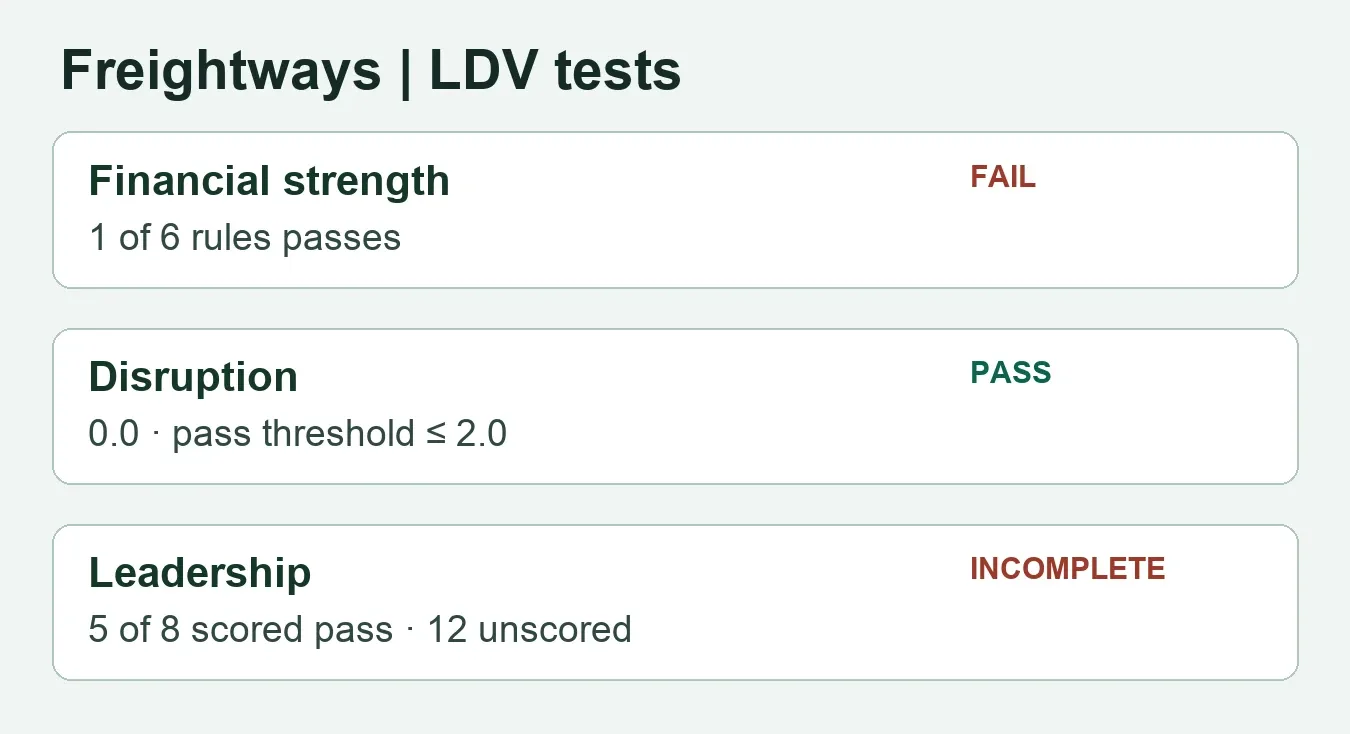
LDV gives Freightways no entry price — it fails Test 1 on five of six rules, and its leadership test cannot be completed. On normal earnings (39.8c, 44.7c and 52.4c across FY2024–FY2026, averaging 45.6c) the shares trade at 28.4× against a 15× gate. Book value is NZ$3.10 a share (P/B 4.18×), and net tangible assets are negative. The current ratio is 0.69×. Debt including leases is NZ$697.9m against equity of NZ$555.6m — 126%, against a 50% rule; even borrowings alone are 59%. The one near-pass is the shareholder-yield level: dividends of 37c, 40c and 45c average a 3.14% yield, above the 3.0% floor — but the guard fails, because there are no buybacks and the share count rises every year on LTI issuance. The earnings record is the clean pass: no loss year in a decade. The disruption test passes at 0.0, and the Step 4 base case gives a ceiling of NZ$7.11 at a 15× exit multiple — a little over half the NZ$12.95 price. A well-run, genuinely growing compounder whose price and lease-heavy balance sheet the framework refuses.
Recommendations
Buy price: none.
What it would take to buy: (1) P/E ≤ 15 on normal earnings — a price at or below NZ$6.84 on today's normal EPS of 45.6c, or normal EPS rising to at least 86.3c at NZ$12.95; (2) the P/B leg passing — price below NZ$4.65 at 1.5× the June 2026 book value of NZ$3.10, or the combined multiple below 22.5; (3) a current ratio at or above 2 as written (0.69× today); (4) debt/equity at or below 50% including leases (126% today; 59% on borrowings alone); (5) the shareholder-yield guard passing — a three-year period in which the diluted share count actually falls; (6) a completable leadership test — a disclosed ROIC, quantified objectives to score delivery, and the capital-allocation floor met; (7) on the valuation, a price at or below the NZ$7.11 base-case ceiling.
Sell price: none.
Test 1 — Financial strength, Module A: FAIL (1 of 6)
Rule | Requirement | Freightways | Verdict |
P/E | ≤ 15 on normal earnings (3-yr avg EPS) | EPS: FY2024 39.8c, FY2025 44.7c, FY2026 52.4c → normal EPS 45.6c → P/E 28.4× at NZ$12.95. Gate price: NZ$6.84 | FAIL |
P/B | ≤ 1.5, or P/E × P/B < 22.5 | Book value per share NZ$3.10 (equity NZ$555.6m / 179.0m shares) → P/B 4.18×; P/E × P/B = 118.6. Net tangible assets per share are −NZ$1.13 | FAIL |
Current ratio | ≥ 2 | 0.69× at 30 June 2026 (current assets NZ$240.1m / current liabilities NZ$348.6m, including NZ$83.0m of current borrowings) | FAIL |
Debt / equity | ≤ 50% (debt includes lease liabilities) | Borrowings NZ$328.6m + lease liabilities NZ$369.2m = NZ$697.9m / equity NZ$555.6m = 126%. On borrowings alone: 59% — still a fail. Net debt/EBITDA is 2.4× post-IFRS 16, inside the company's own 2.0–3.0× policy — the corrected AGM script confirms both the 2.4× ratio at 30 June 2026 and the 2–3× target range (an earlier script misstated it as 3–4×) | FAIL |
Earnings record | Positive in each of the past 10 years | Positive in every year FY2017–FY2026 (NZ$60.9m rising to NZ$94.0m; the softest years, FY2020–FY2021 at about NZ$47–48m, stayed profitable through COVID) | Pass |
Shareholder return | 3-yr avg total shareholder yield ≥ 3.0%, with the diluted share count falling and the payout inside FCFE | The level passes: dividends 37c / 40c / 45c average 3.14% at NZ$12.95, and the payout sits inside free cash flow (FY2026 operating FCF of NZ$89.8m after lease principal against about NZ$80m of dividends). The guard fails: no buybacks in FY2024–FY2026, and the weighted share count rose every year (178,366k → 178,766k → 178,919k) on LTI issuance. The count must fall; it rises | FAIL (guards) |
Freightways: three-test summary
Test 2 — Disruption, Module A: PASS, score 0.0 — with three items unscored
Veto | Rule | Freightways | Verdict |
V1 — Research starved | R&D below 50% of the sector median for 2 successive years | Unscored — open enquiry. No R&D expense is disclosed; the capability spend is systems (capitalised software additions of NZ$4.0m in FY2026) inside a route-and-network business. Not scored as zero, no veto assumed — the Mainfreight treatment in this programme | Not scored |
V2 — Margin collapse | Gross-margin fall of 5 points over 3 years, or operating margin down 2 years while revenue trails the industry | Not triggered on the disclosed margins: EBITDA margin was flat (19.0% → 19.3% → 19.0%) and EBITA margin edged up (12.3% → 12.3% → 12.4%). No gross-margin line is published. Flat is not strong — it is recorded — but it is not a collapse | Not triggered |
V3 — Losing share | Revenue trailing the industry by ≥ 5 points for 2 successive years | Unscored — open enquiry. No verified industry comparator. Revenue grew +7.8%, +6.6% and +13.5%, and +17.6% in Q1 FY2027 — growth of that order is not consistent with the share loss the veto targets, but the comparison itself was not verified | Not scored |
V4 — Concentrated customers | Top-1 above 20% of revenue, or top-5 above 40% | Unscored — open enquiry. Customer revenue shares are not disclosed; the annual report notes no significant credit-risk concentrations. A courier network's customer base is broad by construction, but the figure is not published and is not estimated | Not scored |
Tier 2 scored test: the PPE-only capex row does not score — PPE capex exceeded PPE depreciation in both years checked (FY2025: NZ$25.9m vs NZ$24.0m; FY2026: NZ$29.8m vs NZ$26.2m). CEO tenure is 8.9 years, below the 14-year point. No new-product credit is scored — the revenue share from services launched within five years is not disclosed, and the acquisition rule gives VTFE no credit: it closed in early 2026, is unseasoned, and in any case earns nothing until two years have passed with revenue and margin up; its NZ$60.2m of goodwill on NZ$82.5m of cash consideration is recorded for the revisit. Score 0.0 — pass, with V1, V3 and V4 recorded as open enquiries.
Test 3 — Leadership: FAIL — test incomplete (12 items unscored)
Scored from the FY2026 annual report, NZX/ASX announcements and the remuneration disclosures:
Capital allocation (1 of 2 scored): item 6 passes — net debt/EBITDA of 2.4× is at or below 3× and inside the company's own 2.0–3.0× policy band, with no distress refinancing. Item 5 fails — the share count has risen over five years (the FY2023 Allied scrip issue plus annual LTI issuance) and there are no buybacks. Items 1 and 2 (ROIC, ROIIC) are unscored — no ROIC is disclosed (calculated ROE is about 17.8%, which is not the item). Items 3 and 4 are unscored — no goodwill impairment above the threshold has been taken (accumulated goodwill impairment is NZ$26k), but the three-year post-deal ROIC test cannot be run on Allied or Big Chill from the disclosures; the annual report itself flags Big Chill as the one cash-generating unit without significant impairment headroom, which is recorded here as the item to watch. The 3-of-6 floor is not met on the scored items.
Ownership alignment (1 of 3 scored): item 7 fails — CEO Mark Troughear held 585,936 shares at August 2026, 0.33% of the company, below the 1% limb and not a founder holding. Item 8 passes on its second limb — the holding is worth about NZ$7.59m at the scoring price, about 7.1× his NZ$1.064m base salary, above the 5× bar, even though officers and directors together are nowhere near 5%. Item 9 fails — the verified dealings of the last three years are LTI vesting acquisitions, not open-market purchases, and one 11,100-share disposal (about NZ$133,788, August 2025, nature not verified) was found. Item 10 is unscored.
Communication (1 of 3 scored): item 11 passes — the FY2026 audit opinion is unqualified, no restatement of profit was identified (FY2024 comparatives were restated by reclassification only in the FY2025 report), and the two FY2026 corrections found (an LTI rTSR recalculation issuing 59,190 extra shares; a same-day correction to the annual-meeting net-debt script) are minor and disclosed. Items 12 and 13 are unscored — Freightways gives qualitative outlooks, not numeric guidance, so there is no guidance series to measure; that absence is itself recorded.
Succession (1 of 3 scored): item 16 passes — Troughear's tenure is 8.9 years. Items 14 and 15 are unscored — no named successor or candidates are disclosed, and no internal promotion to the executive team within the last three years was verified (the CEO's own internal succession was in 2018).
Innovation culture (1 of 2 scored): item 18 passes — the growth claims are backed by the numbers (revenue +13.5% in FY2026, +17.6% in Q1 FY2027; VTFE contributing NZ$39.9m of revenue in five months). Item 17 is unscored.
Delivery (0 of 2 scored): items 19 and 20 are unscored — with no quantified, dated public objectives, there is nothing to score delivery against. The one quantified goal found, an FY2026 margin goal described by the CEO at the result as about 70% achieved (secondary source), is below the minimum sample and is recorded, not scored.
Total: 5 of 8 scored items pass (63%) — below the 70% bar — and 12 of 20 items are unscored, more than the 5 allowed, so the test is incomplete and cannot pass; the capital-allocation floor is not met on the scored items. The honest summary is that Freightways discloses like a private company: a long-tenured internal CEO with real money in the stock (7.1× salary) is the strongest verified fact, and almost everything the checklist needs beyond that is not published.
Step 4 — Valuation (run for information; the gate fails, so it does not govern)
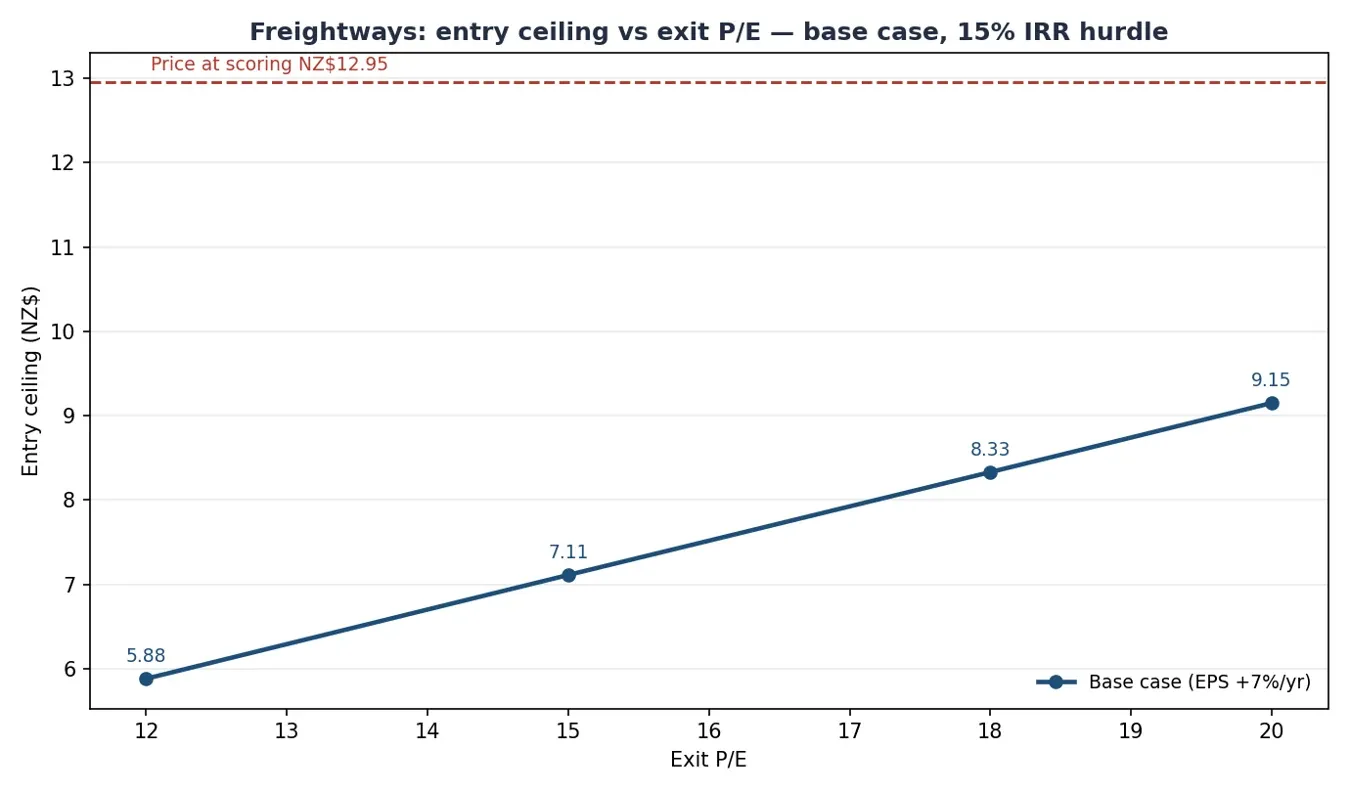
Base case: reported EPS growing 7% a year from FY2026's 52.4c — below FY2026's 17% EPS growth and the analyst FY2027 figure of 61c, allowing for the cautious volume outlook — giving year-3 EPS of 64.2c; dividends of NZ$1.54 over three years (45c growing at about 7%); an exit P/E of 15×; transaction costs of 0.15% at each end; the framework's AUD currency stress of −1% a year applied as the NZD proxy (flagged — the framework specifies rand and AUD only).
Exit P/E | Exit price | Ceiling price (clearing 15%) |
12× | NZ$7.70 | NZ$5.88 |
15× (base) | NZ$9.63 | NZ$7.11 |
18× | NZ$11.56 | NZ$8.33 |
20× | NZ$12.84 | NZ$9.15 |
Freightways: entry ceiling vs exit P/E — base case, 15% IRR hurdle
At NZ$12.95 the base case returns about −5.8% a year; even a 20× exit — above any multiple this programme has used as a base case for a logistics name — produces an IRR of only 2.4%. Note the cross-check against Test 1: the base-case ceiling (NZ$7.11) sits just above the P/E gate price (NZ$6.84), so if the balance-sheet and yield-guard rules were ever met, Freightways would become a WATCHLIST candidate at roughly the price the gate first passes — the valuation is not the binding constraint here; the balance sheet is.
What would have to change
The balance sheet: debt/equity at or below 50% including leases means roughly NZ$420m less debt or NZ$840m more equity than the June 2026 position — the single largest gap of any name scored this week, and a structural feature of the lease-heavy courier model. Recorded as the framework's standing question on lease-heavy balance sheets, not adjusted here.
Share count: buybacks outweighing LTI issuance for three years, so the yield guard can pass.
Disclosure: a published ROIC, post-deal reporting on Allied and VTFE, and quantified objectives — the three items that would most reduce the unscored count. Big Chill's impairment headroom is the named watch item.
The revisit trigger: the HY2027 interim result, expected February 2027 — the first half with a full VTFE contribution and the first test of the cautious volume outlook. The revisit is set for 26 February 2027.
Verdict
NO ENTRY. Freightways fails Test 1 on five of six rules — P/E 28.4× on normal earnings against a 15× gate, P/B 4.18× with negative net tangible assets, a current ratio of 0.69×, debt/equity of 126% including leases (59% on borrowings alone), and a shareholder-yield rule whose 3.14% level passes but whose share-count guard fails — passing only the ten-year earnings record. Its disruption test passes at 0.0, and its leadership test is incomplete (5 of 8 scored items pass; 12 unscored; the CEO's 7.1×-salary holding the standout verified fact). The valuation, run for information, puts the ceiling at NZ$7.11 against a NZ$12.95 price. A genuine compounder, priced and levered beyond what the framework will pay for.
Buy price: none.
What it would take to buy: price at or below NZ$6.84 (P/E gate) and NZ$7.11 (base-case ceiling) with the P/B leg passing; a current ratio at or above 2 as written (0.69× today); debt/equity at or below 50% including leases; a falling diluted share count over three years; a completable leadership test with the capital-allocation floor met.
Sell price: none.
---
Analyst consensus for reference (not part of LDV): aggregator consensus carries FY2027 revenue of about NZ$1.60bn and EPS of about NZ$0.61 — reported for reference only; no primary broker series was verified. Sources: Freightways Annual Report 2026, FY2026 results presentation, VTFE acquisition announcement, ASM outlook (29 October 2026), NZX capital change notices; Finnhub and NZX instrument page for price. Computed figures (normal EPS, P/E, P/B, current ratio, debt/equity, TSY, ceiling and IRR) are arithmetic from filing figures.
Sources
Freightways — corrected AGM script, net debt/EBITDA (NZX 482637) — 2.4× at 30 June 2026 against the 2.0–3.0× target range
Freightways — FY2026 full-year results (NZX 477926) — FY26 filing: leverage at about 2.4×, VTFE completed 30 January 2026
Freightways Annual Report 2026 (ASX filing) — financial statements, EPS history, balance sheet, goodwill notes
Freightways FY2026 results presentation — NPATA, margins, segment detail
Freightways — VTFE acquisition announcement — A$71m headline terms
Freightways ASM outlook, 29 October 2026 — volume outlook, Q1 FY2027 trading
Freightways capital change notice, August 2026 (NZX) — shares on issue
Freightways — NZX instrument page — price and capitalisation cross-check
Freightways CEO appointment, 2017 — Troughear succession from Bracewell
> LDV Investing Framework research data — not investment advice. This scorecard is research being developed and tested under the LDV Investing Framework. It is not investment advice, not a recommendation to buy or sell any security, and not personal financial advice. The entry and exit prices are the framework's mechanical outputs — the ceiling at which the base case clears a 15% annual IRR hurdle, and year-3 EPS × exit P/E — not price targets or advice. Do your own research, and consider seeking advice from a licensed financial adviser before making any investment decision.