
Rwanda economic report · 27 November 2026
Indicator | Latest | Note |
Policy rate | Central Bank Rate 9.50% | Raised 75 basis points on 26 Nov, from 8.75%; highest since 2009; average lending rate 15.87% (Q3) |
Inflation | 19.5% year on year (Oct, urban) | NISR, 10 Nov; underlying (ex fresh products and energy) 11.5%; target range 2–8%, medium-term objective 5% |
Growth | +9.4% year on year in Q2 2026 | NISR; industry +18%, services +7%, agriculture +4% |
Reserve requirement | 7% of deposits | Raised from 5% on 26 Nov, alongside the rate hike |
Public debt | 69.1% of GDP (Jun 2026) | Down from 74.8% a year earlier; S&P affirmed B+/Stable on 16 Nov |
Franc | Fell 1.43% against the dollar, Jan–Sep | Against 4.03% depreciation in the same months of 2025 (BNR) |
The National Bank of Rwanda raised its Central Bank Rate by 75 basis points to 9.50% on 26 November and, in the same decision, lifted the share of deposits banks must hold in reserve from 5% to 7%. I would plan on 9.50% holding into the first half of 2027, and on credit conditions tightening faster than the lending rate alone suggests, because the reserve move does work the rate has so far failed to do. The inflation this is aimed at is mainly a food shock: urban prices rose 19.5% in the year to October, fresh products 39.9%, and locally produced goods rose more than twice as fast as imports. The live question is whether tightening can stop a harvest problem becoming a general price level — without strangling the credit that finances the supply response.
AI-assisted economic analysis; not investment advice.
The decision, in full
The Monetary Policy Committee met on 25 November and Governor Soraya Hakuziyaremye announced the decision the next day. Two instruments moved together, and the pairing is the story. The rate rise is the fourth of 2026: the Central Bank Rate stood at 7.25% in February, rose to 8.25% in May and 8.75% in August, and is now 9.50% — above 9% for the first time in 17 years. The reserve requirement rise, from 5% to 7%, is a quantity tool aimed at the same target from the other side: the Bank said it would absorb excess liquidity and limit the additional inflationary pressure that liquidity could create.
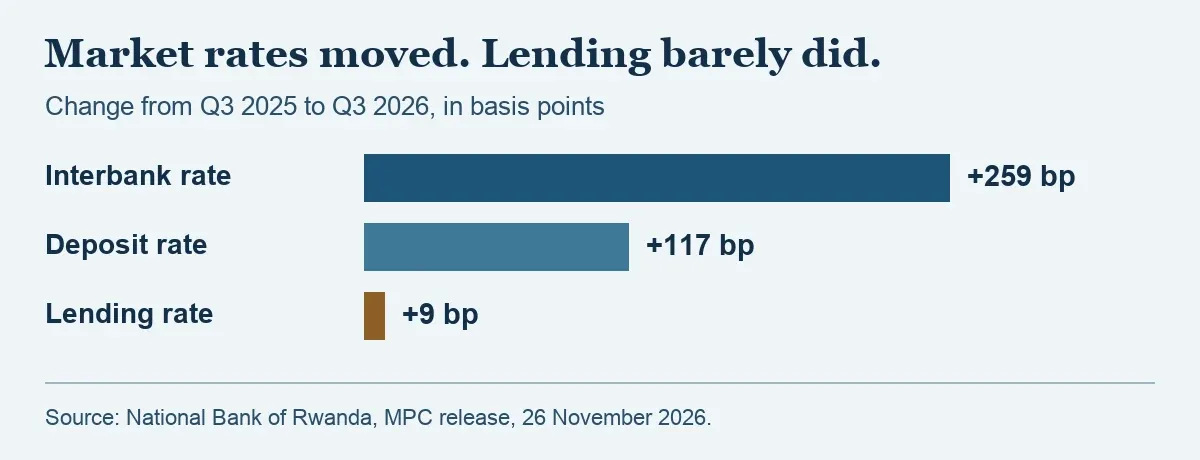
Why add a quantity tool to a price tool? The transmission evidence in the Bank's own briefing supplies the answer, and it is in the figure below. Through a year of hikes, the interbank rate and deposit rates have followed the policy rate up. The lending rate — the price that actually reaches firms and households — has barely moved: 15.87% in the third quarter, nine basis points higher than a year earlier. A central bank whose price signal is not reaching the borrower has two choices: raise the price further and hope, or restrict the quantity of lendable funds directly. On 26 November it did both. That is a more serious tightening than the headline 75 basis points suggests, and the transmission risk it creates is availability: borrowers are likelier to feel it in scarcer credit before they feel it in quoted rates.
The Bank's stated purpose is narrow and correct in its own terms: to stop food and energy shocks feeding into wider price increases, and to bring inflation back toward the 5% medium-term objective inside a 2–8% target range. It expects headline inflation to average 14.4% in 2026 — revised up from the 13.1% it forecast in August — to ease progressively from the second quarter of 2027, and to return inside the target range by the end of 2027. It stands ready, it said, to adjust further if pressures intensify beyond its projections.
Inflation, followed through
Figure 1 · The tightening is reaching savers, not borrowers: market rates, Q3 2025 to Q3 2026
Rate | Q3 2025 | Q3 2026 | Change |
Interbank rate | 5.85% | 8.44% | +259 basis points |
Deposit rate | 8.66% | 9.83% | +117 basis points |
Lending rate | 15.78% | 15.87% | +9 basis points |
Central Bank Rate (at quarter end) | — | 8.75% | Raised to 9.50% on 26 Nov |
National Bank of Rwanda, MPC/FSC press briefing, 26 November 2026. Quarterly averages as presented by the Bank. The comparison is this report's: over the same year in which the policy rate rose by well over a point, the average lending rate rose by nine hundredths of one. The reserve-requirement rise from 5% to 7% is a 40% increase in the share of deposits immobilised at the central bank — arithmetic on the Bank's announced ratios, before any allowance for deposits banks held above the minimum.
Now the price data the decision answers. Headline inflation averaged 15.8% in the third quarter, up from 13.2% in the second, and then jumped: October's urban index — the measure the Bank targets — rose 19.5% on the year and 3.3% in the month alone. The composition matters more than the headline. Fresh food inflation rose from 7.3% to 21.7% during the third quarter, on meat, fruit and vegetables (the Bank's account). In October, fresh products were 39.9% dearer than a year earlier; food and non-alcoholic beverages, 27% of the urban basket, rose 28.9% on the year and 7.8% in a single month; vegetables rose 56.4% on the year and 16.5% in the month. Energy was 36.3% higher than a year earlier but almost flat in the month, up 0.1% — the year's energy shock is in the base, not in October's momentum. Transport rose 22.4% on the year, restaurants and hotels 20.6%, and housing, water, electricity and fuels 14.2%.
Two facts discipline the reading. First, October's impulse was mainly a domestic food shock — but the shock is not purely domestic, and the local/imported split does not prove it is. Prices of locally produced goods rose 22.8% on the year against 9.5% for imported goods, and in October the local-goods index rose 4.3% in the month while import prices fell 0.1%. The franc, unusually for this region in this year, is not the October channel: it depreciated just 1.43% against the dollar between January and September, against 4.03% in the same months of 2025. But the Bank's own release names food and energy shocks together and flags imported oil risk, and the finance ministry's rating notice ties fuel and fertiliser costs to the Middle East conflict: imported costs reach local prices through fuel and fertiliser even when the franc is stable and the import index is flat for a month. Second, the headline urban figure understates what most Rwandans paid. Rural inflation was 31.3% in October and the national index 26.5%, because food is 48% of the rural basket against 27% in town, and rural food prices rose 43.5% on the year. A monetary policy set on the urban index is set on the mildest of the three measures.
Where is the second round? The honest answer is: present, but not yet dominant. Underlying inflation — excluding fresh products and energy — stood at 11.5% in October, up 0.8% in the month: well above the top of the target range, so price pressure has spread beyond the volatile items, but still eight points below the headline, so the shock has not yet generalised into the whole basket. The Bank adds that core inflation eased slightly during the third quarter. Those two statements can both be true — a quarterly easing followed by a firm October — and together they describe a central bank tightening against a risk it can see forming, not a fact already established. That is the defensible use of a rate rise against a supply shock: not to make vegetables cheaper, which it cannot do, but to keep every other price-setter from treating 19.5% as the new normal. The Hayekian distinction from our South Africa report applies with the signs reversed: there, a fuel shock risked ratification; here, a food shock does, and the Bank has chosen to pay a credit cost now to avoid paying an expectations cost later.
What the data does not show: there is no November print yet, no wage-settlement series in the releases to test whether pay is chasing prices, and no published core figure for October on the Bank's own definition to set against the statistics office's underlying measure. The claim that second-round effects are contained rests on one underlying reading, not a run of them.
Growth, followed through
The economy the Bank is tightening into is not weak, and that is what makes the decision possible. Real GDP grew 9.4% on the year in the second quarter, after 10.0% in the first. The production detail: industry grew 18% and contributed 3.9 points of the 9.4 — mining and quarrying up 26%, construction 24%, manufacturing 10%. Services, 51% of GDP, grew 7% and contributed 3.7 points, with wholesale and retail trade up 18% and information and communication up 29%. Agriculture, 21% of GDP, grew just 4% and contributed a single point: food crops rose 5% and livestock 6%, but export crops fell 20%, with coffee production down 33% partly offset by tea up 18%.
Set that second-quarter agriculture line beside October's prices — different periods, so a tension, not a causal test — and the economy's central tension appears in one paragraph. The sector that sets the price of the largest item in the household basket was the slowest-growing part of the economy in the second quarter, growing at less than half the national rate, with food-crop output up 5% in a year when food prices have since risen 28.9% on the year. Prices are doing their job — signalling scarcity loudly — but the supply response is measured in seasons and in investment in storage, irrigation, seed, logistics and processing, not in quarters. The Bank's own activity gauge says momentum has not faded since: its real Composite Index of Economic Activities rose 16.0% in the third quarter, against 13.5% a year earlier.
On the expenditure side, private consumption was 74% of GDP in the second quarter, government consumption 14% and gross capital formation 25%. Household consumption rose 13% in real terms, government consumption fell 6%, capital formation rose 32%, exports of goods and services rose 19% and imports rose 36%. An investment share of a quarter of GDP, growing at 32%, is the opposite of South Africa's 13% problem — Rwanda does not lack investment; the question the 14 November report in this series posed, and which this one keeps, is its composition. Capital poured into construction (up 24%) raises this year's GDP whether or not it lowers next year's food prices. Capital that cuts spoilage, moves produce faster and stores it through the lean season attacks the exact price that is now forcing the central bank's hand. The rate and reserve rises are designed to make credit dearer and tighter in availability; they cannot distinguish between the two kinds. Fiscal and regulatory choices can, and they matter more than the next 25 basis points on the Central Bank Rate.
The labour market is the soft underlay to the strong headline. The latest survey, measuring August, put unemployment at 15.6%, up from 13.4% a year earlier, with the employed share of the working-age population down to 54% from 57%. No newer labour release has landed since the 14 November report. Growth of 9.4% in the second quarter alongside weaker aggregate employment in August is growth that is not carrying jobs with it at the aggregate level. The survey gives no matching sector breakdown, so it does not show whether the expanding sectors — construction, mining, digital services — hired or shed; calling it jobless growth in those sectors would go beyond the evidence. What the aggregate does show is why a food-price shock lands so hard: a shrinking share of households has wage income to absorb it.
The fiscal position and the external account, followed through
The fiscal backdrop is, by the standards of this series, comparatively well behaved — and S&P said so, in its way, ten days before the rate decision. On 16 November the agency affirmed Rwanda's long-term foreign- and local-currency ratings at B+/Stable, expecting the 2025/26 fiscal deficit to come in at about 4.9% of GDP against 5.7% planned. Public and publicly guaranteed debt was Frw 17.85 trillion at June 2026, 69.1% of GDP, down from 74.8% a year earlier (MINECOFIN, Public Debt Statistical Bulletin, September 2026) — a falling ratio in a year of 9–10% real growth is partly arithmetic, since nominal GDP is growing faster still with inflation at these levels, and the report should not credit consolidation for what the denominator did. The genuine structural strength is composition: more than 87% of external debt is concessional, on low interest rates and long maturities, which blunts the crowding-out dynamic that dominates the South African story: the state borrows mostly from official lenders at administered concessional prices, not only from the domestic savings pool at market rates. That blunts the channel; it does not prove treasury issuance has crowded out no private lending, and this report does not claim it has. The credit tightening that is actually in the 26 November decision is the Bank's own — the rate and the reserve ratio — and its first effect to watch is tighter credit availability: a transmission risk, not yet a measured outcome. Concessional abundance can still fund projects whose returns would never clear a market test, and the 32% rise in capital formation deserves the same project-by-project scepticism wherever the money comes from.
Externally, the position improved through the shock. The Bank reports the trade deficit narrowed by 7.4% year on year in the third quarter and reserves stood at 4.2 months of prospective imports at the end of September, above its four-month benchmark. Remittances rose 31.1% on the year in the first half, mineral exports grew strongly, and S&P puts the external deficit at 10.9% of GDP in the first half of 2026, down from 13.4% a year earlier, with usable reserves averaging about US$2.3 billion over 2026–29 on its projections. September's goods trade deficit was US$336.3 million. A stable franc, rising remittances and a narrowing deficit together say the inflation is not a balance-of-payments crisis in disguise — which is precisely why the Bank could choose a measured 75 basis points plus a reserve move rather than an emergency response.
One companion release deserves a line. The Bank's October Monetary Policy and Financial Stability Statement puts new authorised loans at Frw 1.7 trillion in the first half of 2026, up 44.3% year on year — a rapid flow of new lending into what became 19.5% inflation. Loans written at that pace will be tested by the tightening that inflation provoked, and the reserve rise lands on banks whose newest lending is unseasoned.
The bottom line
Strip the week down and Rwanda's position is this: a central bank that has now raised its rate four times in a year, to its highest since 2009, and added a reserve squeeze because its own data show the lending rate ignoring it; an inflation whose October impulse is a domestic food-supply failure — local goods up 22.8%, imports up 9.5%, the franc nearly flat — with imported fuel and fertiliser costs pressing behind it, landing on rural households at 31.3%; and an economy growing at 9.4% whose slowest sector is the one that feeds it. The tightening is justified on the only ground a rate rise against a supply shock can be justified: not to cheapen food, but to stop 19.5% becoming the economy's reference price. Whether it succeeds will be decided less in the MPC room than in the fields and on the roads between them — in whether the next seasons' supply, and the investment that moves and stores it, answer the price signal the market is sending at full volume. Administered help that mutes that signal would slow the answer. Credit that finances it is now dearer, and that tension — the medicine raising the cost of the cure — is the honest cost of the path the Bank has chosen, and the reason the checkpoints below are about food and underlying prices, not about the rate itself.
Previous checkpoints
The 14 November report in this series was written in an earlier format and set no dated checkpoint list, so no dated checkpoint has fallen due to score. The event it identified as decisive — the National Bank of Rwanda's late-November policy decision — has now landed and is scored in the body of this report: the Bank raised the Central Bank Rate by 75 basis points to 9.50% and the reserve requirement from 5% to 7% on 26 November, a larger move than a simple hold-or-25-basis-points framing implied, with its 2026 inflation forecast revised up to a 14.4% average. The earlier report's open watch items — essential-goods inflation, manufacturing orders, employment and utilisation of completed infrastructure — remain open; no new labour or industrial release has landed since, and they are carried into the list below in dated form.
What would change my call?
10 December 2026 — November CPI (NISR). Per the NISR advance release calendar. The first print after the decision. Urban headline still accelerating above 19.5%, with underlying rising from 11.5%, would say the shock is generalising and I would expect a further hike at the next MPC. Headline easing on food, with underlying at or below 11.5%, supports holding at 9.50%.
The next MPC meeting — early 2027 (BNR calendar). I expect a hold at 9.50% with the reserve ratio at 7%. A further hike delivered while underlying inflation is falling would tell me the Bank is chasing the headline food print, and I would expect the stance to reverse within the year.
20 December 2026 — Q3 2026 GDP (NISR). Per the NISR advance release calendar. Growth holding near 9% with agriculture accelerating from 4% would say supply is responding. Agriculture at or below 4% again, alongside double-digit food inflation, confirms the structural reading and lengthens the expected path back to target.
Food inflation through the first half of 2027. The Bank's path has food elevated until it falls in the second half of 2027. Fresh-food inflation back below 10% before mid-2027 would pull the whole forecast forward and make cuts a live question in 2027; fresh food still above 20% at mid-2027 breaks the Bank's path and mine with it.
End-2027 — the Bank's own test. Headline back inside the 2–8% range by the end of 2027, as the Bank projects, vindicates tightening against a supply shock. Still in double digits at that date, with underlying above 8%, and the conclusion changes: the shock was ratified, and the cost was paid in credit without the benefit in prices.
---
Sources: National Bank of Rwanda, Monetary Policy Committee press release and MPC/FSC press briefing, 26 November 2026 (decision, forecasts, market rates, trade, reserves, franc); BNR, Monetary Policy and Financial Stability Statement Report, October 2026 (new authorised loans up 44.3% year on year to Frw 1.7 trillion in the first half of 2026); National Institute of Statistics of Rwanda, Consumer Price Index, October 2026 (released 10 November 2026), GDP, second quarter 2026 (released September 2026), Labour Force Survey, 2026 Q3 (measuring August 2026) and advance release calendar 2026 (November CPI on 10 December, Q3 GDP on 20 December); Ministry of Finance and Economic Planning, Public Debt Statistical Bulletin, September 2026 (public and publicly guaranteed debt Frw 17.85 trillion, 69.1% of GDP at June 2026) and S&P Global Ratings Affirms Rwanda's 'B+' Credit Rating with a Stable Outlook, 16 November 2026 (rating, fiscal deficit, concessional share, external deficit, remittances); Reuters and Bloomberg reporting of the 26 November decision, corroborating the rate, reserve ratio and highest-since-2009 characterisation.