

Fisher & Paykel opened at a record, then gave most of it back. South Africa's producer inflation jumped to 8.1% on fuel — and the JSE rose 1.8% anyway, on platinum. Australia's business investment surged 12.2% on data centres, Wall Street sat out Thanksgiving, and Wednesday's Bitcoin ETF outflow is now final at US$453 million, taking November to a record US$5.39 billion.
AI-generated — not investment advice. Prices are Thursday 26 November 2026 closes unless labelled intraday.
Today in one minute
Fisher & Paykel Healthcare traded its result — and faded. The shares opened at an all-time high of NZ$50.98 (+3.66%) and closed at NZ$49.52, +0.69%, keeping about a fifth of the opening gain. The result itself beat consensus: first-half profit of NZ$291.4 million against about NZ$274 million expected (NZX result). Two brokers raised targets after the print — to NZ$47.75 and NZ$48.80 — and both still sit below the close.
South Africa's producer inflation jumped to 8.1% year on year in October, from 6.2% in September and above the 7.6% consensus — but 5.6 of the 8.1 points came from one fuel-driven division, and producer inflation excluding petroleum was 3.6% (Stats SA, P0142.1 October 2026). The JSE All Share rose 1.80% to 106,631.52 on resources, and Discovery used its Capital Markets Day to raise its bank and cash-conversion targets.
Australia's private capital expenditure rose 12.2% in the September quarter — the biggest rise since 2011 — driven by data-centre equipment (ABS). The ASX 200 rose 0.82% on a mining rebound.
US markets were closed for Thanksgiving (NYSE calendar), so the US names carry Wednesday's closes. The day's US story was reported, not traded: the Financial Times reported NVIDIA has told server makers to halt shipments to four Southeast Asian countries under new export-licence rules (Reuters, carrying the FT report).
Wednesday's Bitcoin ETF flow is final: −US$453.0 million, a seventh straight outflow day. November's total is −US$5.39 billion over 18 sessions, the largest monthly outflow in Farside's records (Farside).
The tariff proposals that moved Wednesday's US session are now verified. The USTR's Section 301 proposals on 14 partners — capped rates, hearings on 25 January, nothing in force before then — were confirmed in Reuters' reporting, and China responded on Thursday (AAP). Europe read them as less severe than feared: the FTSE 100 rose 1.75%.
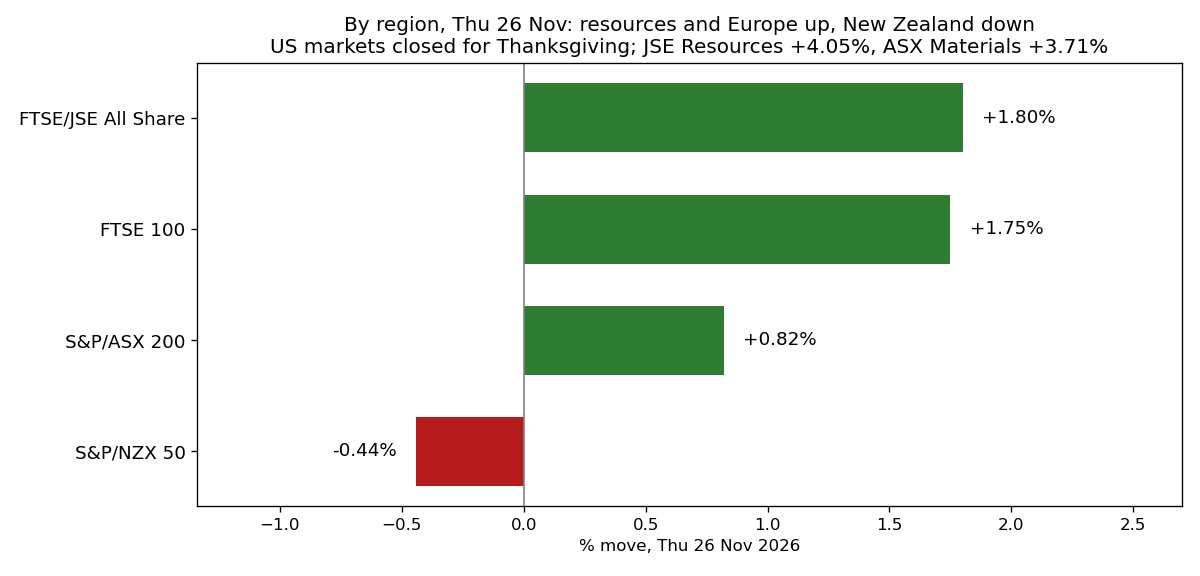
By region, Thu 26 Nov: resources and Europe up, New Zealand down
Fisher & Paykel: the beat held, the opening premium did not
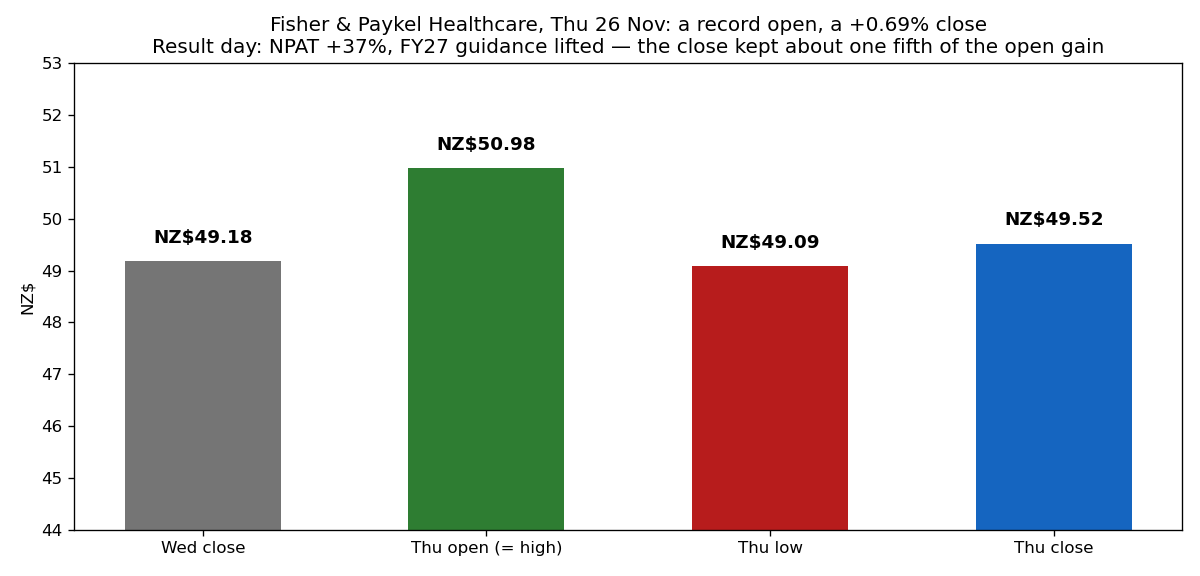
Fisher & Paykel Healthcare, Thu 26 Nov: a record open, a +0.69% close
Thursday was the first session on Fisher & Paykel Healthcare's half-year result, released at 08:30 NZDT on Thursday before the open (NZX). The shares opened at NZ$50.98 — an all-time high, +3.66% — traded as low as NZ$49.09, and closed at NZ$49.52, +0.69%, on turnover of NZ$35.4 million of the NZX's NZ$131 million day. About four-fifths of the opening gain faded. That is the market's verdict in one line: the result was good, and most of the good news was already in a share price up about 30% this year.
The result against expectations: Capital Brief, citing Visible Alpha consensus, puts first-half NPAT of NZ$291.4 million about 6.4% above the NZ$274 million consensus, revenue of NZ$1.25 billion against NZ$1.23 billion expected, and the 26.0-cent interim dividend against 25 cents expected (Capital Brief). Hospital revenue rose 22% to NZ$841.5 million, consumables 21%; Homecare rose 4% to NZ$412.3 million.
The guidance lift is a margin story, and one part of it needs care. FY27 NPAT guidance rose from about NZ$525–565 million to NZ$565–605 million — the midpoint up NZ$40 million, or 7.3% — on a revenue midpoint up only about NZ$30 million, to NZ$2.55 billion. The NZ$23 million US tariff refund inside the reported 66.4% gross margin was already in the August guidance (August guidance notice), so it does not explain the incremental NZ$40 million: excluding the refund, gross margin still rose 162 basis points to 64.6%. The cash conversion is the slower part of the story, as it was in yesterday's edition: operating cash flow rose NZ$57.4 million to NZ$303.2 million, but capital spending rose NZ$46.1 million to NZ$107.9 million — NZ$31.4 million of that increase was land and buildings, including East Tāmaki — taxes paid rose NZ$29.3 million, and free cash flow rose only NZ$10.2 million, about 6%, to NZ$183.4 million. Profit up 37%, free cash flow up 6%: unchanged as the result's summary line.
The analyst response landed the same day and still does not reach the price. Barrenjoey raised its target 8% to NZ$47.75 on Thursday, and Macquarie raised its target 2.7% to NZ$48.80 in an item published after Thursday's NZ close (Dow Jones newswire via TradingView: Barrenjoey, Macquarie). At NZ$49.52 the shares trade at roughly 49.7 times the NZ$585 million FY27 NPAT guidance midpoint. Our own work says the same thing more bluntly: the LDV deep dive on the result raised the entry ceiling from NZ$15.38 to NZ$17.30 on the stronger earnings path — the verdict stays NO ENTRY, and the close is 2.86 times the ceiling. Fundamentals improved; the price had already paid for more than the improvement. The interim dividend of 26.0 cents has its record date on 4 December and is paid on 16 December.
Kingfish (KFL) closed at NZ$1.170, +0.86% against the NZ$1.1600 price in the fund's latest official NAV notice — and the look-through runs against the headline. Fisher & Paykel is Kingfish's largest holding, at 20% of the portfolio in the 25 November NAV notice, which put NAV at NZ$1.2653 and the discount at about 8.3%. FPH's +0.69% on Thursday adds about +14 basis points to Kingfish's NAV. But the rest of the portfolio fell: screening all 16 holdings at their last full disclosed (30 September) weights against Thursday's NZX moves gives an indicative −54 basis points for the day — Mainfreight −10 basis points, Mercury −10, a2 Milk −9, Summerset −9, Vista −7, Infratil −6 — for an indicative NAV of about NZ$1.2585, not the official figure, which the fund will publish next week. Against that estimate, Thursday's NZ$1.170 close is an indicative discount of about 7.0%: the share price rose while the estimated NAV fell, so Thursday was a discount-narrowing day, not a Fisher & Paykel day, for Kingfish holders. One point of discount at this NAV is worth about 1.27 cents a share — more than FPH contributed at any point on Thursday. Our LDV scorecard on Kingfish gives no qualifying entry, with a modelled ceiling of NZ$1.07. The dividend record date is 3 December, payment 18 December.
South Africa: a fuel-led PPI shock, a resources-led rebound, and ratings day
Stats SA's producer price index for October, released at 11:30 on Thursday (Stats SA, P0142.1), showed final manufactured goods inflation at 8.1% year on year, up from 6.2% in September — the highest since April 2023 — and +1.7% month on month, against a 7.6% consensus in the Bloomberg survey reported by Business Day. Read the composition before the headline: the coke, petroleum, chemical, rubber and plastic products division rose 26.3% year on year and contributed 5.6 of the 8.1 percentage points (1.3 points of the monthly rise), after October's petrol and diesel increases. Producer inflation excluding petroleum was 3.6% year on year and +0.6% month on month, and the earlier stages of the pipeline slowed: intermediate manufactured goods inflation eased to 5.2% from 7.8%, electricity and water to 6.3%, mining to 3.4%, and agriculture to 1.4%. This is a fuel pass-through shock landing on top of October's 5.2% consumer inflation, not a broad re-acceleration — but it is exactly the upside risk the Reserve Bank flagged when it held the repo rate at 7.25% on 19 November, on a split 4–3 vote (SARB November statement). One print does not make a hike; what matters next is whether fuel feeds non-fuel consumer prices and expectations. The next rate decision is 28 January 2027.
The market did not trade it as a rates shock. The FTSE/JSE All Share rose 1.80% to 106,631.52 and the Top 40 rose 1.80% to 98,596.15 (JSE market data via AFX), led by the Resources index, +4.05%, as platinum rose about 3.5% to around US$1,285 an ounce: Sibanye-Stillwater +5.91% to R33.89 and Implats +5.31% were among the leaders, and Tiger Brands jumped 11.40% to R297.46 on its full-year results. Turnover fell by about a third with US markets closed. The rand was steady: the Reserve Bank's reference rate for 26 November was R17.5343 to the dollar, firmer than Wednesday's R17.5852, and the market traded around R17.54 into the evening (Sharenet). A mining-led rebound on a thin holiday session is not evidence the market shrugged off the PPI print — the two moved on different drivers.
Today is the risk event: Moody's and S&P publish their South Africa reviews on Friday 27 November, expected after the JSE close. Going in, Moody's is at Ba2 with a positive outlook and S&P at BB (foreign currency) / BB+ (local currency), also positive. Absa's base case, reported by Business Day, is that both hold, with risks tilted towards at least one upgrade; Investec's Annabel Bishop expects an S&P upgrade — both are attributed expectations, not decisions, and nothing from either agency was found on Thursday. In Johannesburg, the election of the mayor, deputy mayor, speaker and chief whip is set for Friday at 10:00 — the last legal day, with no extensions — after Thursday passed with coalition talks still unsigned in the reporting checked (Explain's Thursday unpacking).
Discovery (DSY) closed at R267.96, +0.67% (a second feed prints R267.75, +0.59%). Its news was its own: a Capital Markets Day SENS at 12:30 on Thursday (Sharenet SENS). Discovery reaffirmed its five-year ambition of normalised profit-from-operations growth in the middle-to-upper end of 15–20% a year, raised its cash-conversion target to 70–80% from 60–70%, and raised the Discovery Bank client target for FY2029 from 2 million to 3 million — the 2 million mark is now expected in FY2027, two years early — alongside an ambition to add 1 million policies across Discovery SA. The raised targets are ambitions restated at a capital markets day, not results; the test is delivery against them. Consensus: Buy, StockAnalysis average R308.59 (+15.2% vs R267.96).
Capitec (CPI) closed at R4,653.28, +0.96%. No SENS announcement dated Thursday was found; the latest remains Tuesday's debt-officer change. Consensus: Buy, StockAnalysis average R5,309.76 (+14.1%).
Hudaco (HDC) — a Watchlist name — closed at R177.80, −0.56% (one feed prints R177.98, −0.46%, apparently a pre-close snapshot). No announcement dated Thursday was found. The close stays above the R166 LDV entry price and below the R231.20 exit price in our Hudaco scorecard. Consensus: Strong Buy, average R271.30 (+52.6%, but only 2 analysts — thin coverage).
Australia: the capex boom is a data-centre boom
The ABS private capital expenditure release for the September quarter is the strongest Australian number in months: total new capital expenditure rose 12.2% in the quarter (seasonally adjusted) to A$59.5 billion, up 18.6% year on year — the largest quarterly rise since the September quarter of 2011, in the mining boom. The composition is the story. Equipment, plant and machinery rose 23.1% to a record, while buildings and structures rose only 1.7%, and the ABS's own headline names the driver: data-centre investment. Firms' fourth estimate of 2026-27 spending rose 11.8% to A$223.7 billion. Two cautions belong with the headline: much of the equipment is imported, so the flow into Australian output is smaller than the spending figure; and a capex surge of this kind, landing a day after October inflation printed at 4.9%, is not a number that argues for Reserve Bank relief at its 8 December decision, with the cash rate at 4.85%.
The S&P/ASX 200 closed at 8,763.8, +0.82% (CommBank market wrap), with Materials +3.71% and Energy +2.67% as the miners rebounded — BHP +3.39%, Rio Tinto +3.53%, Fortescue +3.90%.
The data-centre thread runs straight through Thursday's New Zealand session too. Meridian Energy's Datagrid announcement — US$30 million for an 11.27% stake, with a 140MW power purchase option over 15 years if called, commencing between July 2028 and January 2029 and subject to Electricity Authority clearance, for a 300MW project at North Makarewa that still needs Datagrid's final investment decision (NZX) — was announced before Thursday's open, and the gentailers fell on the day: they were the NZX 50's biggest drag. An option conditional on clearance and a final investment decision is capital committed today against earnings that are not contracted today. The timing is consistent with investors starting to price AI-infrastructure financing risk, though Thursday's fall alone does not establish that as the cause — the same week S&P put NVIDIA's AA rating on CreditWatch Negative and Bloomberg reported lenders pulling back from Asian data centres, on the market wrap's reporting.
In New Zealand the S&P/NZX 50 closed at 13,986.6, −0.44%, on turnover of NZ$131 million, with 32 index stocks down and 13 up (The Bottom Line market close). The kiwi dollar traded at 54.81 US cents at 5pm in Auckland.
The US names: no session, one reported shipment halt
US cash markets were closed on Thursday for Thanksgiving and close early on Friday, at 1:00 p.m. ET (NYSE). Equity futures traded a shortened session and pointed modestly higher — S&P 500 futures +0.54% at the 1:00 p.m. ET halt, on one snapshot — but futures snapshots are not closes, and the US entries below carry Wednesday 25 November closes.
NVIDIA (NVDA) — last close US$149.30, −3.91% (Wed). Thursday's story is attributed reporting, single-origin, and stated as such: Reuters reported on Thursday that the Financial Times reported NVIDIA has told manufacturing partners — Dell and Super Micro among them — to stop shipping servers containing its chips to Malaysia, Singapore, Thailand and Indonesia, after new US export-licence rules took effect on 19 November. Reuters could not immediately verify the FT report, and none of the three companies commented. The rule itself is a matter of record: the Commerce Department's Bureau of Industry and Security announced it on 16 November, requiring licences for qualifying advanced-computing exports to those four countries and Brazil, with cloud providers given 90 days — to about mid-February — to license existing arrangements. Whether the halt is temporary while compliance is worked out is not known. The shares first trade on the report on Friday, into the open items already on the calendar: the delayed 10-Q due by 4 December, the House transcribed interviews on 1–2 December, and the S&P CreditWatch Negative placement from Wednesday. No NVIDIA announcement dated Thursday was found. Consensus: Moderate Buy, TipRanks average US$233.36 (+56.3% vs the Wednesday close, Tuesday's snapshot, not re-snapshotted in this run).
Anthropic (ANT) — last close US$82.79, +1.08% (Wed). No announcement dated Thursday was found; the check was incomplete on Anthropic's own newsroom and filings, so that is stated as found. The week's dated items are Monday's Claude Ship launch and Wednesday's engineering report on the Messages API migration — neither is Thursday news. Unconfirmed reports of "Opus 5.6" testing are not confirmed by Anthropic and are not used. Consensus: Strong Buy, StockAnalysis average US$136.33 (+64.7%).
Apple (AAPL) — last close US$355.58, +0.43% (Wed). No announcement dated Thursday was found; the check was incomplete on the Apple newsroom, as in the previous edition. The only filing item in the window is a Form 4 dated Wednesday recording a planned (Rule 10b5-1) sale by an officer on Tuesday. The dated item ahead remains the senators' App Store letter, answers due 9 December. Consensus: Moderate Buy, TipRanks average US$343.69 (−3.3%, Tuesday's snapshot).
Disney (DIS) — last close US$125.60, +2.52% (Wed). No announcement dated Thursday was found; the check was incomplete. Thursday's coverage was a wrap of Wednesday's session — the first close above US$125 since 2022 — with part of the optimism attributed to a Bloomberg report that a federal judge has temporarily paused the FCC's early licence-renewal reviews of eight Disney-owned ABC stations while Disney's lawsuit proceeds; the court document itself was not read in this run. The mover explainer from yesterday's edition stands: the shares are up 13.2% since 30 October, the improvement in the business is real, and our LDV scorecard on Disney — NO ENTRY, entry ceiling US$79.89, modelled FY29 exit US$115.56 — sits below even the exit price the market has already passed. Consensus: Moderate Buy, MarketBeat average US$132.15 (+5.2%).
SpaceX (SPCX) — last close US$127.44, +1.30% (Wed). No announcement dated Thursday was found; the check was incomplete. One Thursday-dated item is flagged as attributed and single-source: TipRanks reported SpaceX is giving up an estimated US$738 million in federal broadband (BEAD) subsidies under a new standard agreement with the NTIA, while agreeing to serve about 476,000 rural homes and businesses with free equipment (TipRanks). No NTIA document was read in this run, so the figure is reported, not verified. Wednesday's FCC authorisation of up to 1 million Starmind satellites stands as reported yesterday: permission, with milestones to 2040, not deployment. Consensus: Buy, StockAnalysis average US$256.25 (+101.1%).
Gentex (GNTX) — a Watchlist name — last close US$19.66, +1.03% (Wed). No announcement dated Thursday was found. With no Thursday session, the position is unchanged: the close remains above the US$16.40 LDV entry price, and the next earnings date is 29 January 2027. Consensus: Hold, StockAnalysis average US$25.28 (+28.6%).
Wise: up 10% in a week, with no verified operating catalyst to explain it
Wise (WISE) is the week's mover in the coverage, and its entry needs the explainer treatment. The London line closed on Thursday at 884.80p, +2.38%, in a strong FTSE session — the FTSE 100 rose 1.75% to 10,609.30, led by Imperial Brands, up 13.27% after Altria confirmed it is considering a takeover approach (Sharecast London close). But Thursday was the end of a run, not the whole of it: from Friday's 801.50p close, the London line is up 10.4% in four sessions. The Nasdaq line's last close is Wednesday's US$11.68; there was no Thursday US session.
What is driving it: no fresh company catalyst was established in this run. A "Holding(s) in Company" (TR-1) notice dated Thursday appears in Wise's announcement index, but its holder was not verified, and the verified TR-1 in the window is Wednesday's: Baillie Gifford at 10.08% of voting rights. A TR-1 establishes only that a holder's disclosed voting rights changed; it does not establish that the holder's buying drove the price. The strong FTSE session is context, not a proven cause. Neither is a change in the business. Wise's own last results were released on 12 November (US) / 13 November (London).
What our own work says: the LDV scorecard on Wise of 22 November is NO ENTRY. It passes the disruption test cleanly, and its valuation is close — a central entry ceiling of US$10.36 against a US$10.85 scoring price — but the financial gate fails on price (the gate level is US$7.44 on today's normal earnings), on shareholder yield, and on the current-ratio rule as written, and the leadership test is incomplete with seven items unscored. Wednesday's Nasdaq close of US$11.68 is above the ceiling, and a 10% London rise moves every one of those numbers the wrong way.
So: fundamentals, or the market catching up? Neither leg has moved. Nothing verified this week changes Wise's earnings, its capital return, or the evidence gaps the scorecard records — the price rose alongside a strong market, with no established company cause — possible drivers are not established causes. In LDV terms the distance to an entry has widened, not narrowed. Consensus: Buy, MarketBeat average US$17.15 (+46.8% vs the Nasdaq close).
The rest of the coverage, company by company
Thursday 26 November closes. "No announcement found" means the NZX announcement list for Thursday was checked and nothing dated that day was found for that name.
Meridian Energy (MEL) closed at NZ$5.54, −1.42%. The Datagrid announcement was before Thursday's open (see the Australia section): US$30 million committed now for 11.27% of Datagrid, the 140MW option conditional on Electricity Authority clearance and Datagrid's final investment decision. The shares fell on the day the commitment was announced. The timing is consistent with the market pricing the commitment — the announcement preceded the session — but a one-day fall does not by itself establish the cause. Next: the option window opens between July 2028 and January 2029 if called.
Mercury NZ (MCY) closed at NZ$6.63, −2.21% — the largest fall among the gentailers. No announcement found. Mercury already holds about 13% of Datagrid on different terms, per Meridian's release, which gives it exposure to the same project; whether that exposure caused Thursday's fall is not established. Consensus figures for Mercury were not re-snapshotted in this run.
Contact Energy (CEN) closed at NZ$8.52, −0.70%. No announcement found on Thursday. The next dated item is the half-year result, on 15 February 2027, in a notice dated Friday morning. Consensus: Strong Buy, StockAnalysis average NZ$10.43 (+22.4%).
Infratil (IFT) closed at NZ$13.10, −0.38%. The only NZX items in the window are a bond (IFT280) maturity memo — debt administration, not equity news. Infratil's CDC data-centre business is the local read-across from the ABS capex print and the Datagrid reaction: the market is repricing the financing of AI infrastructure, and Infratil carries that exposure directly. Consensus: Strong Buy, average NZ$17.33 (+32.3%).
Mainfreight (MFT) closed at NZ$71.94, −1.11%. No announcement found. The market wrap attributed the fall to the tariff story: the USTR proposals confirmed on Wednesday cover China, the EU and 12 other partners — not New Zealand or Australia directly — with hearings on 25 January and nothing in force before then. A freight company's exposure is through its customers' trade lanes, not its own listing. Consensus: Buy, average NZ$81.55 (+13.4%).
a2 Milk (ATM) closed at NZ$7.45, −2.23% on the NZX line; the ASX line closed at A$6.11, −3.02% — both closes verified independently, the difference a cross-rate and timing effect. Thursday's NZX items were the class-action settlement approval (A$62 million, met by insurance, no impact on FY26 or FY27 earnings and no admission of liability — Wednesday's news, filed Thursday) and a substantial-holder notice: Perpetual Limited ceased to be a substantial holder on 24 November, falling to 4.894% from 5.051%. Neither item is a clean explanation for a 2.2% fall on a weak NZX day, and none is claimed. Consensus: Buy, StockAnalysis average NZ$9.36 (+25.6% vs the NZX close).
Auckland Airport (AIA) closed at NZ$9.12, +0.11%. No announcement found. The close rests on a single aggregator with a data artefact in its volume field.
Summerset (SUM) closed at NZ$5.90, −1.34%. No announcement found. One aggregator history table prints NZ$5.82 for Thursday; the overview prints, the exchange-snapshot previous-close field and the NZX returns screen all give NZ$5.90, which is used. Sector peer Ryman reported earlier in the week.
Vista Group (VGL) closed at NZ$2.55, −1.54%. No announcement found. Note on the base: the exchange's prior close for Vista is NZ$2.59, not the NZ$2.52 snapshot carried in yesterday's edition — Thursday's fall is measured from NZ$2.59, and yesterday's Vista close should be read as unverified.
Port of Tauranga (POT) closed at NZ$8.25, −0.48%. No announcement found. The close rests on one attributed market-close report.
Freightways (FRW) closed at NZ$12.95, +0.31%. No announcement found. The close is from a next-day snapshot's previous-close field and a returns screen; confidence is lower than for the other NZ names.
EBOS Group (EBO) closed at NZ$21.90, −0.41% on the NZX line; the ASX line closed at A$17.93, −1.43%. No announcement found. A second NZ print of NZ$21.72 exists and conflicts; the NZ$21.90 figure is the one consistent with the NZX returns screen.
Vulcan Steel (VSL) closed at NZ$6.51, +0.15% on the NZX line; the ASX line closed at A$5.37, −0.56% — the two lines diverged again, as they did on Wednesday. No announcement found on either exchange.
Delegat Group (DGL) closed at NZ$4.60, −2.13%. No announcement found. Tuesday's tariff-refund guidance lift stands: FY27 operating NPAT NZ$68–72 million, with underlying NZ$62–66 million unchanged.
Skellerup (SKL) closed at NZ$7.87, −1.63%. No announcement found.
Horizon Oil (HZN) closed at A$0.195, +2.63%. No ASX announcement found; the latest items remain 20 November's. There is no broker coverage — no consensus.
Analyst consensus — the full picture
Researched from public aggregators (TipRanks, MarketBeat, StockAnalysis.com) on 26–27 November 2026; implied moves are vs the closes stated. One provider per stock, consistently. No rating or target change dated Thursday 26 November was found for the US names; the dated Thursday changes are Fisher & Paykel's (Barrenjoey and Macquarie, in the lead story).
NVIDIA (NVDA) — Moderate Buy (TipRanks, Tue snapshot). Average US$233.36 (+56.3% vs US$149.30, Wed close).
Apple (AAPL) — Moderate Buy (TipRanks, Tue snapshot). Average US$343.69 (−3.3% vs US$355.58, Wed close).
Disney (DIS) — Moderate Buy (MarketBeat). Average US$132.15 (+5.2% vs US$125.60, Wed close).
Wise (WSE) — Buy (MarketBeat). Average US$17.15 (+46.8% vs the US$11.68 Nasdaq close, Wed).
SpaceX (SPCX) — Buy (StockAnalysis). Average US$256.25 (+101.1% vs US$127.44, Wed close).
Anthropic (ANT) — Strong Buy (StockAnalysis). Average US$136.33 (+64.7% vs US$82.79, Wed close).
Gentex (GNTX) — Hold (StockAnalysis). Average US$25.28 (+28.6% vs US$19.66, Wed close).
Capitec (CPI) — Buy. Average R5,309.76 (+14.1%). Discovery (DSY) — Buy. Average R308.59 (+15.2%). Hudaco (HDC) — Strong Buy. Average R271.30 (+52.6%, only 2 analysts).
a2 Milk (ATM) — Buy. Average NZ$9.36 (+25.6%). Fisher & Paykel (FPH) — post-result targets raised to NZ$47.75 (Barrenjoey) and NZ$48.80 (Macquarie), both below the NZ$49.52 close; the pre-result StockAnalysis average was NZ$46.77 and a newer snapshot prints NZ$48.09, which may pre-date the result and is not mixed with the dated changes. Mainfreight (MFT) — Buy. Average NZ$81.55 (+13.4%). Contact Energy (CEN) — Strong Buy. Average NZ$10.43 (+22.4%). Infratil (IFT) — Strong Buy. Average NZ$17.33 (+32.3%).
No consensus: Horizon Oil (no coverage), Kingfish (a listed investment company — the yardstick is the discount to NAV, about 8.3% on the official 25 November NAV of NZ$1.2653), and crypto (no analysts).
Crypto in brief
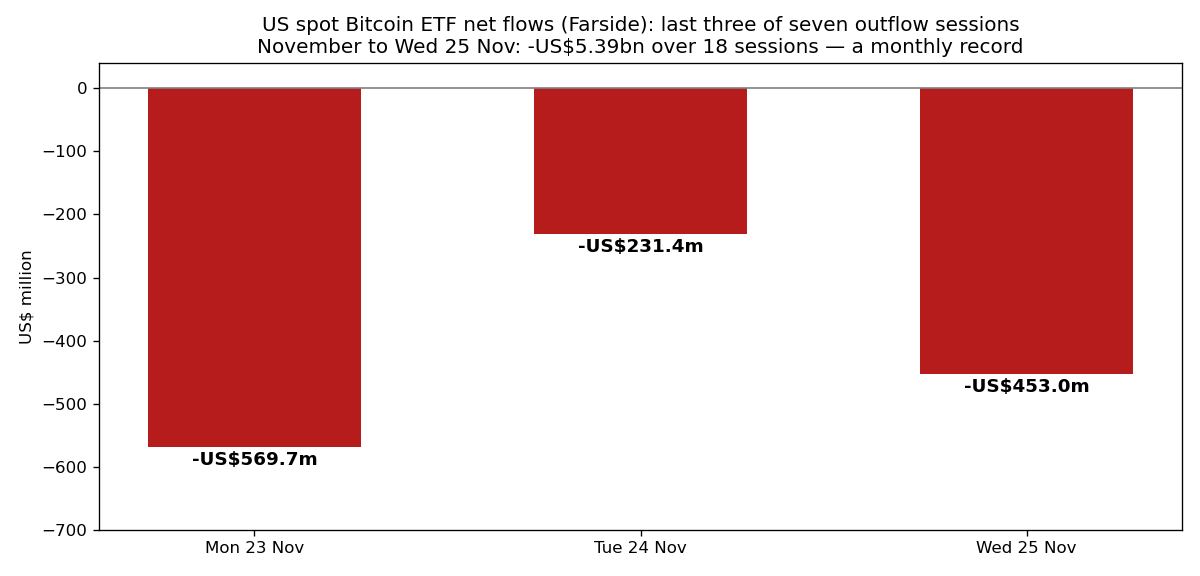
US spot Bitcoin ETF net flows (Farside): last three of seven outflow sessions
On the same labelled basis as the previous editions — Binance BTC/USDT and SOL/USDT UTC candles via Finnhub, current vintage — Bitcoin closed Thursday at US$60,660.05, +0.33%, and Solana at US$70.82, +0.50%. A basis warning belongs with those figures: Finnhub's current vintage prints Wednesday's closes as US$60,458.01 for Bitcoin and US$70.47 for Solana, which do not match the Wednesday closes printed in yesterday's edition (US$58,734.01 and US$67.83) on what was described as the same basis. Wednesday's intraday lows — about US$57,300 for Bitcoin — match across both vintages. Thursday's moves here are computed within the current vintage only, the two vintages are not blended, and the discrepancy is stated rather than smoothed over. Other providers' Thursday prints cluster around US$60,400–60,500 for Bitcoin, modestly higher on the day. The Alternative.me Fear & Greed index was 11 (Extreme Fear) for Thursday, down from 13 on Wednesday (one provider prints 12).
The flow figure is now complete for Wednesday: US spot Bitcoin ETFs recorded −US$453.0 million on Wednesday 25 November, a seventh straight outflow day, with no fund in inflow. BlackRock's IBIT accounted for −US$329.7 million of it, Grayscale's Bitcoin Mini Trust −US$60.1 million, Bitwise −US$18.2 million, ARK −US$14.9 million and GBTC −US$13.9 million (Farside). November's total through Wednesday is −US$5,391.1 million over 18 sessions — the largest monthly outflow in Farside's records, about 20% above June's previous record — with IBIT's November outflow at about US$4.50 billion. This supersedes the −US$4.94 billion figure in yesterday's edition, which ran only through Tuesday. There is no Thursday flow figure: US markets were closed. Solana spot ETFs were flat on Wednesday — US$0.0 million across all funds — which resolves the partial row flagged yesterday (2 of 8 funds reporting at that cut-off) as a final zero.
Solana on-chain (DefiLlama, as retrieved early Friday): total value locked US$4.628 billion, stablecoins US$13.074 billion, decentralised-exchange volume US$1.157 billion in 24 hours, chain fees US$415,331 in 24 hours. The near-term crypto event is Friday's monthly options expiry at 08:00 UTC — about US$6.8 billion of Bitcoin open interest on Deribit alone. There is no analyst consensus for crypto tokens.
AI Portfolio Manager
Thursday's inputs change prices, not positions: Gentex (US$19.66, Wednesday close — no Thursday US session) and Hudaco (R177.80) both remain above their LDV entry prices (US$16.40 and R166), so neither watchlist name is at its buy level. Fisher & Paykel's result lifted our own entry ceiling for it to NZ$17.30 — the framework crediting better fundamentals — while the market price sits at 2.86 times that ceiling. The portfolio still holds nothing, and Momentum still leads the watchlist. Decisions are taken in the AI Portfolio Manager series, not in this briefing.
Portfolio Manager line
Thursday was a day for separating headlines from composition: a producer-inflation print that is one fuel division wearing a headline's clothes, a guidance beat the market had already bought, and a capex boom that is mostly imported servers. The position is unchanged — and Friday brings the two verdicts that matter, South Africa's ratings reviews and a half-day US session trading the NVIDIA shipment report for the first time.
What to watch next
South Africa's ratings reviews, Friday after the JSE close: Moody's (Ba2, positive) and S&P (BB/BB+, positive). Any reaction trades on Monday. The Johannesburg mayoral and speaker vote is at 10:00 on Friday.
US half-day session, Friday (close 1:00 p.m. ET): the first trade on the reported NVIDIA server-shipment halt, and on the tariff proposals' second day. The delayed NVIDIA 10-Q is due by 4 December; House interviews are 1–2 December.
Fisher & Paykel: whether Friday holds Thursday's NZ$49.52 close, and the next Kingfish weekly NAV (as at 2 December), which will give the fund's next official mark — a multi-session figure that cannot verify Thursday's standalone estimated −54 basis points, which remains an estimate.
Bitcoin: Friday's 08:00 UTC options expiry (about US$6.8 billion on Deribit), and the next ETF flow print when US markets reopen — November is already the record outflow month at −US$5.39 billion through Wednesday.
Australia: September-quarter national accounts on 2 December will show how much of the capex surge reaches GDP, given the import content; the Reserve Bank decides on 8 December with October inflation at 4.9%.
---