
Scored under the revised LDV framework, Module A applied to the vehicle, per the schedule's flag: Kingfish is a listed investment company, not an operating business, and the framework's industrial ratios have limited meaning for it — where a ratio has no meaning, this scorecard says so rather than forcing a number. Price: NZ$1.15, NZX close Friday 20 November 2026. Latest published net asset value: NZ$1.2847 per share at 18 November 2026 — a discount of about 10.5% at the scoring price. Accounting basis: NZ IFRS, year ended 31 March 2026 (FY2026 annual report); the H1 FY2027 interim result (period ended 30 September 2026) had not been published as at this morning — last year it came on 24 November — and is flagged as imminent, not scored. All figures from NZX announcements, the FY2026 annual report, monthly NAV updates and public aggregators, researched 23 November 2026. Not investment advice.
The company
Kingfish is a listed investment company that holds a concentrated portfolio of New Zealand growth companies, managed by Fisher Funds under a management agreement. At 31 March 2026 the portfolio was worth NZ$422.1m inside total assets of NZ$432.1m, against liabilities of just NZ$0.7m — net assets of NZ$431.4m and no debt at all. The portfolio is concentrated by design: Fisher & Paykel Healthcare is 19% of it, Infratil 16–17%, and the top five (those two plus Mainfreight, Contact Energy and Auckland Airport) are 58%. Kingfish pays a quarterly dividend set at 2% of average NAV — 10.84c per share in FY2026 — regardless of earnings, which in FY2026 it did not have: the company made a loss of NZ$13.6m (EPS −3.85c) as the portfolio fell in value, an adjusted NAV return of −3.2% against the NZX 50 Gross Index's +5.2%. Fisher Funds is paid a base fee of 1.25% of gross asset value, reduced by an underperformance rebate to an effective 0.85% in FY2026 (fees of NZ$4.0m), plus a performance fee of 10% over a Bank Bill +7% hurdle subject to a high-water mark (NZ$1.07) and a 1.25% cap. The longer record is mixed: adjusted NAV returns of +9.3% a year over three years (benchmark +8.6%) but only +0.4% a year over five (benchmark +1.0%), and a one-year total shareholder return of −10.7% to 31 October 2026. The board changed this year: Andy Coupe retired as chair on 30 June 2026 after 13 years, succeeded by Fiona Oliver. The shares trade at a persistent discount of about 10% to NAV, and a buyback programme announced on 22 October 2026 had repurchased about 625,000 shares by 19 November.
The headline
LDV gives Kingfish no entry price — it fails Test 1 on earnings, price and the shareholder-yield guards, and Test 3 cannot be meaningfully completed for an externally managed vehicle. The earnings record is decisive on its own: an LIC's earnings are its portfolio's revaluations, and Kingfish has made a loss in three of the last ten years (FY2022, FY2023 and FY2026), which breaks the ten-year positive-earnings rule. Normal earnings — the three-year average EPS of 4.67c — put the P/E at 24.6× against the 15× gate. The celebrated dividend is not what the shareholder-yield rule measures: the 2%-of-NAV quarterly policy paid out NZ$112.2m over three years, but dividend reinvestment issuance and a warrant exercise added shares faster than buybacks retired them, so the share count drifts up and the net buyback leg is zero or negative — in FY2026 the distributions were paid through a loss, out of capital, and NAV per share fell. Disruption, as written, has almost nothing to bite on for an LIC, and this scorecard records that as a framework finding rather than manufacturing a pass with content. On a NAV-based valuation variant (flagged as such), the base case gives a ceiling of NZ$1.07 — just below the NZ$1.15 price: the 10% discount is roughly fair for the fee load and the record, not a bargain.
Recommendations
Buy price: none.
What it would take to buy: (1) the ten-year earnings rule healed — no further loss year, and FY2022 leaving the window (the rule cannot pass before FY2032 on the current record unless the framework adopts an LIC variant scoring NAV total return instead of accounting earnings — a decision for James, recorded below); (2) the P/E gate passes on the framework's LIC analogue — adjusted NAV total return, not revaluation EPS, sustained above the NZX 50 benchmark over five years (currently +0.4% a year vs +1.0%); (3) the shareholder-yield guards pass — the share count actually falling over three years, which needs buybacks at the current discount to exceed DRP and warrant issuance, or the DRP suspended while the discount persists; (4) a completable leadership test — disclosure that lets the manager's capital allocation (Fisher Funds' portfolio decisions) be scored, or a framework LIC protocol; (5) on the NAV variant, a price at or below NZ$1.07, or equivalently a discount widening beyond about 16% at today's NAV, with NAV performance at least matching the benchmark.
Sell price: none.
Test 1 — Financial strength, Module A applied to the vehicle: FAIL
Rule | Requirement | Kingfish | Verdict |
P/E | ≤ 15 on normal earnings (3-yr avg EPS) | EPS: FY2024 +5.96c, FY2025 +11.90c, FY2026 −3.85c → normal EPS 4.67c → P/E 24.6× at NZ$1.15. For an LIC this measures revaluation timing, not earning power — recorded, and scored as written | FAIL |
P/B | ≤ 1.5, or P/E × P/B < 22.5 | Price / NAV per share = 1.15 / 1.2847 = 0.90× — the LIC analogue of book value, and the one leg where the vehicle is genuinely cheap | Pass (on NAV) |
Current ratio | ≥ 2 | About 606× (assets NZ$432.1m, liabilities NZ$0.7m) — a meaningless number for an LIC with no operating liabilities; recorded as not meaningful, not as a pass that proves anything | Not meaningful |
Debt / equity | ≤ 50% | No debt. Gearing is nil against a permitted maximum of 20% of gross asset value | Pass |
Earnings record | Positive in each of the past 10 years | Three loss years: FY2022 (−NZ$17.3m), FY2023 (−NZ$19.5m), FY2026 (−NZ$13.6m) — all market-fall years, which is the point: the vehicle's earnings are the market | FAIL |
Shareholder return | 3-yr avg total shareholder yield ≥ 3.0%, with share count falling and payout inside FCFE | Dividends of NZ$112.2m over three years are a gross yield of about 28.6% of today's market cap — but the guards fail: gross buybacks were only NZ$6.94m across FY2025–FY2026, DRP issuance runs at about NZ$14m a year, the May 2026 warrant exercise added shares (1.22m of 87.0m warrants exercised at NZ$1.24), and the count drifts up (362m on issue). In FY2026 the dividend was paid through a loss — a return of capital by design, funded from the portfolio, not from earnings | FAIL (guards) |
The P/E gate price on normal EPS is NZ$0.70 (15 × 4.67c) — a number this scorecard reports because the framework requires it, while noting it would imply a 45% discount to NAV, which no LIC discount history supports. That absurdity is itself the finding: the industrial earnings legs do not describe an investment vehicle.
Test 2 — Disruption: NOT SCORABLE as written — recorded as a framework finding
Veto | Rule | Kingfish | Verdict |
V1 / V1D | R&D starved / supplier franchise lost | An LIC has no R&D and no suppliers. The analogue risk is single-manager dependence: the entire portfolio is one Fisher Funds team (lead portfolio manager Matt Peek, with Zoie Regan). Key-person loss is the LIC's supplier loss — no such event has occurred | Not applicable |
V2 — Margin collapse | Gross margin fall of 5 points over 3 years | No gross margin exists. The cost analogue: total fees and opex of NZ$5.2m in FY2026 on a NZ$422m portfolio, with the base fee rebated to 0.85% for underperformance — the fee mechanism worked as designed | Not applicable |
V3 — Losing share | Revenue trailing industry by ≥5 pts for 2 years | The analogue is benchmark-relative NAV return: 3 years +9.3% a year vs benchmark +8.6% (ahead); 5 years +0.4% vs +1.0% (behind); FY2026 −3.2% vs +5.2% (8.4 points behind in one year). One bad year is not two successive years — on the analogue, not triggered, but FY2027 is the deciding year | Not triggered (analogue) |
V4 — Concentrated customers | Top-1 above 20% of revenue, or top-5 above 40% | No customers. The portfolio analogue: top-1 holding 19% (Fisher & Paykel Healthcare — just under the 20% line), top-5 58%. Concentration is the strategy, disclosed and stable across Oct–Nov 2026 | Not applicable — concentration flagged |
Scored test: no row of the Tier 2 table describes an LIC's economics, so no score is manufactured. Test 2 is recorded as not scorable for a listed investment company — neither a pass that would flatter the verdict nor a fail invented from rows that do not apply. The disruption risks that are real for Kingfish sit one level down, in the portfolio: Vista Group fell 55% in FY2026 on exactly the AI-disruption question this framework exists to ask, and the top two holdings are 35% of the fund. A framework LIC protocol would score the manager on those — see the finding in the verdict section.
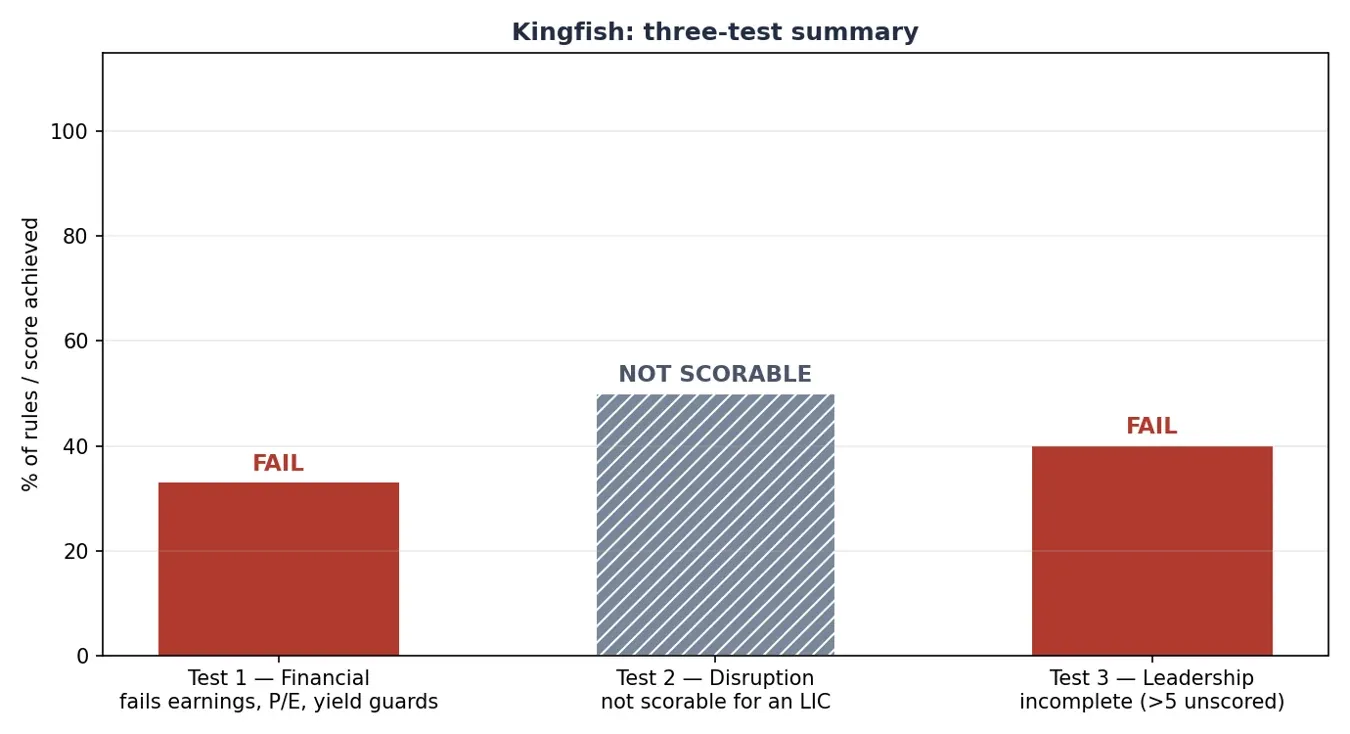
Kingfish: three-test summary
Test 3 — Leadership: FAIL — test incomplete for an externally managed vehicle
Kingfish has no executives of its own: the board (chair Fiona Oliver since 30 June 2026, with David McClatchy, Dan Coman and Simon Flood — all independent) oversees Fisher Funds, which makes every investment decision. Scored as far as the disclosure allows:
Capital allocation (the manager's, in substance): the portfolio decisions are Fisher Funds', and the checklist's ROIC/ROIIC items have no LIC analogue that can be computed from the annual report (items 1–2 unscored). The discount-management record is scoreable and mixed: buybacks exist and were active in November 2026, but at NZ$6.94m over two years against about NZ$14m a year of DRP issuance they do not retire shares net (item 5 fails). No goodwill or acquisitions exist at the vehicle level (items 3–4 not applicable). Item 6 passes (no debt, no refinancing risk of any kind).
Ownership alignment: directors' holdings are small — the chair holds 12,243 shares (about NZ$14,000); the full directors' total was not verified (items 7–8 fail on the figures available for a vehicle of NZ$416m market value; flagged). Items 9–10 unscored (no officers in the industrial sense; manager remuneration is the fee schedule, disclosed and rebated for underperformance — a genuinely aligned feature the checklist has no row for).
Communication: item 11 passes (no restatement, late filing or qualification found; monthly NAV disclosure is exemplary — the best disclosure cadence in the programme). Items 12–13 not applicable (an LIC gives no guidance).
Succession: the board transition was orderly — a 13-year chair retired on schedule and an internal successor (a director since 2022) took over (items 14–16 pass on the board analogue). Manager key-person succession (Peek) is undisclosed — flagged.
Innovation culture and delivery: items 17–20 unscored — there are no objectives, guidance or product claims at the vehicle level to score.
Total: fewer than half the items can be scored at all, which makes the test incomplete and unable to pass under the framework's rule. As with Capitec and Discovery, this is substantially a disclosure-and-design verdict: the checklist was built for operating companies with executives, and an externally managed LIC strands it. Recorded as a framework finding; no item was bent to fit.
Step 4 — Valuation (NAV variant, run for information; the gate fails, so it does not govern)
The framework's EPS model has no meaning for an LIC — year-3 EPS is whatever the NZX does in FY2029. This scorecard therefore runs the LIC variant and labels it as such: NAV per share of NZ$1.2847 growing at 5% a year (between the 3-year +9.3% and 5-year +0.4% records, and below the benchmark's long-run return), an exit at the same 10% discount to NAV, dividends of about NZ$0.34 over three years at the 2%-of-NAV policy, the framework's AUD stress of −1% a year applied as the NZD proxy (flagged), and costs of 0.15% at each end.
Scenario | Year-3 NAV | Exit price (at 10% discount) | Ceiling price (clearing 15%, after currency stress) | IRR at NZ$1.15 |
Base: NAV +5% a year | NZ$1.4872 | NZ$1.3385 | NZ$1.07 | 12.2% |
Stronger: NAV +7% a year | NZ$1.5738 | NZ$1.4164 | NZ$1.13 | 14.2% |
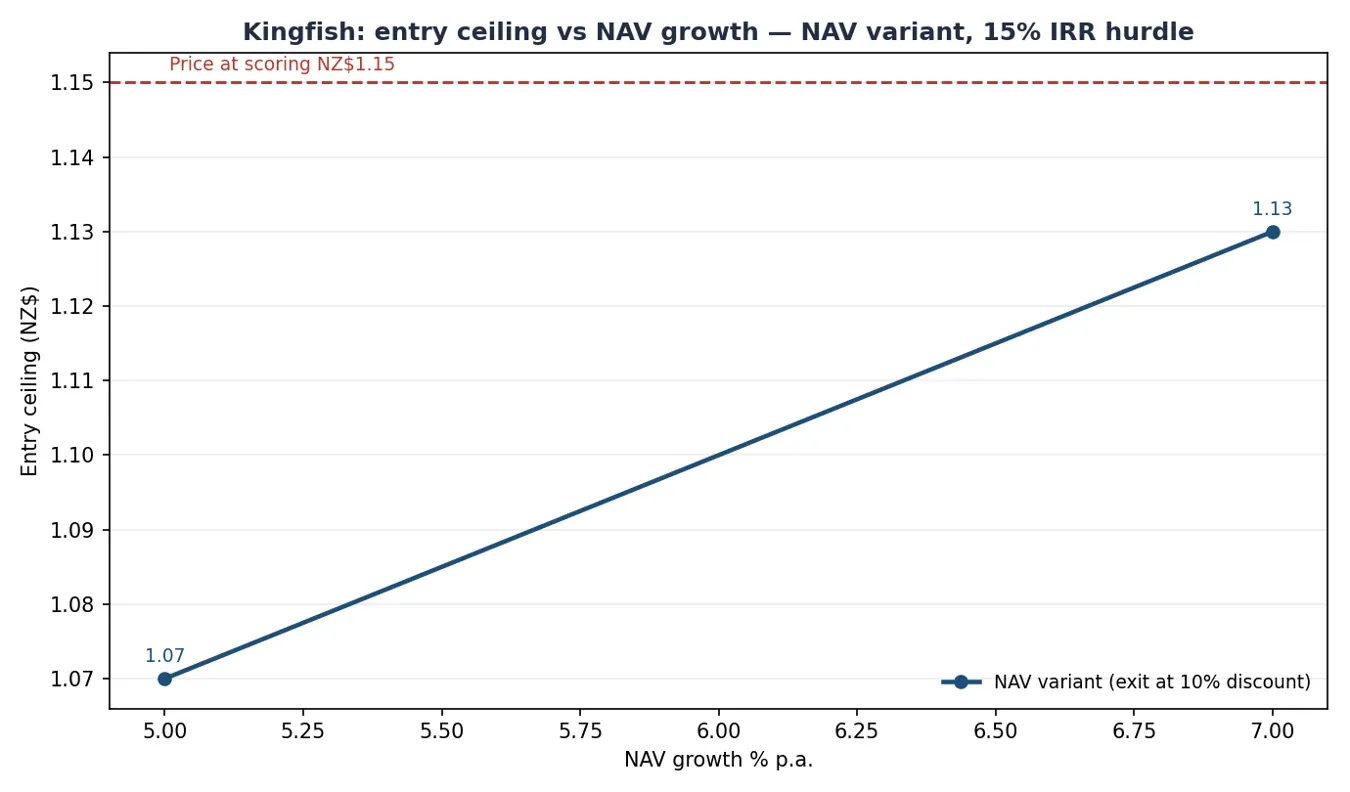
Kingfish: entry ceiling vs NAV growth — NAV variant, 15% IRR hurdle
Even the stronger case does not clear 15% at NZ$1.15 — because the starting yield is paid out of the NAV it is meant to compound, and the fee load takes its cut first. The 10% discount is not, on these numbers, a mispricing; it is roughly the present value of the fee stream and the five-year record. For reference, the mechanical EPS model the framework prescribes (year-3 EPS at the 3-year average of 4.67c, exit multiples of 12–20×) produces ceilings of NZ$0.62–0.87 — reported here only to show why the variant was necessary.
What would have to change
A framework LIC protocol (decision for James): score LICs on NAV total return vs benchmark, discount discipline, net share-count change and fee load — the four numbers that actually decide an LIC investment — instead of industrial earnings and R&D rows. Kingfish, and every LIC in the daily check's universe, will strand Tests 1–3 until that exists.
On the current framework: the earnings rule heals only with time (no loss year, and FY2022/FY2023 leaving the ten-year window in the 2030s); the share-count guard passes if buybacks at a double-digit discount exceed DRP issuance for three years, or the DRP is suspended while the discount persists.
The performance trigger: two successive years of NAV return trailing the NZX 50 by 5 points or more (the V3 analogue) — FY2026 was the first. The H1 FY2027 interim, due within days, is the next reading.
The discount trigger: a discount beyond about 16% at an unchanged NAV would put the price below the NZ$1.07 NAV-variant ceiling — the number to watch.
Verdict
NO ENTRY. Kingfish fails the earnings record (three loss years in ten), the P/E gate (24.6× on normal EPS) and the shareholder-yield guards (dividends paid from capital through a loss, share count drifting up), its disruption test cannot be scored as written, and its leadership test cannot be completed for an externally managed vehicle. The NAV variant says the 10% discount is roughly fair, not an opportunity. None of this says the underlying portfolio is poor — Fisher & Paykel, Infratil and Mainfreight are quality holdings — it says the vehicle, at this price and under this framework, does not clear the bar, and that the framework itself needs an LIC protocol before it can say much more than that.
Buy price: none.
What it would take to buy: an LIC protocol adopted, or on the current rules: no further loss years, NAV total return at or above benchmark over five years, the share count falling for three years, a completable leadership test, and a price at or below NZ$1.07 (a discount beyond about 16% at today's NAV).
Sell price: none.
---
Analyst consensus for reference (not part of LDV): none — no broker coverage was found (Simply Wall St records zero analysts covering KFL), which is itself typical for a NZ$416m LIC. Sources: Kingfish FY2026 annual report and results (NZX), monthly NAV and portfolio updates (October–November 2026), buyback notices (October–November 2026), board-change announcements (2026); NZX instrument data. Computed figures (normal EPS, P/E, discount, TSY inputs, ceiling and IRR figures) are arithmetic from filing figures.
Sources
Kingfish Annual Report 2026 (year ended 31 March 2026) — earnings, dividends, portfolio, fees, balance sheet; the same report was filed to NZX as Kingfish 2026 Annual Report, 24 June 2026
Kingfish weekly NAV update, 18 November 2026 (NZX) — NAV per share NZ$1.2847, discount, holdings
Kingfish share price, 20 November 2026 close (NZX) — NZ$1.15 close
> LDV Investing Framework research data — not investment advice. This scorecard is research being developed and tested under the LDV Investing Framework. It is not investment advice, not a recommendation to buy or sell any security, and not personal financial advice. The entry and exit prices are the framework's mechanical outputs — the ceiling at which the base case clears a 15% annual IRR hurdle, and year-3 EPS × exit P/E — not price targets or advice. Do your own research, and consider seeking advice from a licensed financial adviser before making any investment decision.