
Scored under the revised LDV framework, Module G (Insurers). Price: R259.30, close Friday 20 November 2026 (21–22 November was a weekend). Accounting basis: IFRS, including IFRS 17 (year ended 30 June 2026; FY2026 audited results published 3 September 2026). All figures from SENS results, the FY2026 annual financial statements and public aggregators, researched 23 November 2026. Not investment advice.
The company
Discovery is South Africa's largest diversified insurer and the inventor of the Vitality shared-value model: it administers the country's biggest open medical scheme business (Discovery Health, 3.91 million lives under administration), sells life and investment products (Discovery Life and Invest, assets under administration of R205bn), runs a short-term insurer (Discovery Insure) and a now-profitable digital bank (Discovery Bank, 1.57 million clients, first full profitable year in FY2026 at R370m), and exports Vitality to the UK (VitalityHealth and VitalityLife) and through partners worldwide. FY2026 was a strong operating year: normalised profit from operations of R17,750m, up 17%, normalised headline earnings of R11,795m, up 21%, and embedded value of R142,924m — R212.49 per share, up 12%. Value of new business rose 31% to R2,821m (computed from the four covered businesses in EV Table 7), return on embedded value was 14.1% against a South African risk discount rate of 11.625%, and every regulated entity sits comfortably above its solvency capital requirement — Discovery Life at 1.7× cover (down from 1.9×, a watch item), Discovery Insure at 2.1×, VitalityLife at about 2.0×, Discovery Bank CET1 at 16.29%. The founder, Adrian Gore, has run the company for 34 years and holds 6.48% of it. The business is excellent. The question, as with Capitec yesterday, is the price: at R259.30 the share trades at 17.8 times normal earnings and at a 22% premium to its own embedded value per share.
The headline
LDV gives Discovery no entry price — it fails Test 1 on price and shareholder yield. The insurer metrics all pass: no loss-making year in ten, solvency cover of 1.7–2.1× across the group, VNB up 31%, RoEV of 14.1% above the risk discount rate. What fails is Graham's arithmetic. Normal earnings (the three-year average of normalised HEPS) are R14.55, so the P/E is 17.8× against the 15× gate; book value gives 2.13× and a combined multiple of 38.0 against 22.5; and the shareholder return is dividends only — about 1.5% a year — because Discovery has never bought back shares and its share count is rising. Disruption passes at +0.5. Leadership is genuinely mixed — the strongest founder ownership in the programme so far, set against net insider selling, no named successor and restated comparatives — and cannot be completed on the items verified, so it cannot pass either. The valuation confirms the gate: even the base case at a 15× exit multiple gives a ceiling of R245.13 after rand stress, below today's price.
Recommendations
Buy price: none.
What it would take to buy: (1) the P/E gate passes — price at or below R218.21 on today's normal normalised HEPS of R14.55, or normal earnings rising to R17.29 at the current price (at FY2026's 20% normalised HEPS growth, the three-year average reaches that in about two years if growth holds); (2) the book-value leg passes — P/B at or below 1.5 (price about R183 on today's book value per share of R121.75) or the combined multiple below 22.5; (3) the three-year average shareholder yield reaches 3.0% — at the current 22% payout ratio that needs a much lower price, a materially higher payout, or a first buyback programme with the share count actually falling; (4) the leadership checklist becomes completable (≤5 unscored items) and passes, including a named successor for a 62-year-old founder-CEO and a clean five-year run with no restated comparatives; (5) the price at or below R245.13, the 15×-exit base-case ceiling after rand stress.
Sell price: none.
Test 1 — Financial strength, Module G: FAIL (price, book-value and yield legs; insurer legs pass)
Module G replaces the industrial rules: no current ratio, no debt/equity, no gross margin, no R&D or capex test. The legs below are the framework's insurer tests, with the two Graham price legs and the shareholder-yield rule retained.
Leg | Requirement (Module G / framework) | Discovery | Verdict |
P/E | ≤ 15 on normal earnings (3-yr avg normalised HEPS) | Normal normalised HEPS R14.55 (FY24 1,136.2c restated, FY25 1,470.4c, FY26 1,757.6c) → P/E 17.8× at R259.30 | FAIL |
Price / book | ≤ 1.5, or P/E × P/B < 22.5 | Book value per share R121.75 → P/B 2.13×; product 17.8 × 2.13 = 38.0. The insurer analogue agrees: price is 1.22× embedded value per share (R212.49) — a 22% premium to EV | FAIL |
Earnings record | Positive in each of the past 10 years | Positive in every year FY2017–FY2026, including FY2020 (profit of about R178m — thin, but positive) | Pass |
Solvency | Cover above the SCR with a buffer | Discovery Life 1.7× (was 1.9× — direction flagged), Insure 2.1×, VitalityLife ~2.0×, Bank CET1 16.29%, scheme solvency 31.3% vs 25% required | Pass |
Underwriting / new business | Combined ratio < 100% where applicable; VNB margin and RoEV for life | No group combined ratio is disclosed (predominantly life/health — open enquiry for Insure's ratio on a stated basis); insurance service result R8,741m (+18%); VNB R2,821m (+31%); Discovery Life CSM-based VNB margin 3.8% (was 2.1%); RoEV 14.1% vs 11.625% risk discount rate | Pass |
Shareholder return | 3-yr avg total shareholder yield ≥ 3.0% | Dividends only — DPS 217c → 288c → 384c; no buyback has ever been executed and the share count is rising (~657m in FY2019 to ~677m), so the share-count guard also fails. Yield about 1.5% a year on the prices of the period | FAIL |
The P/E gate price is R218.21 (15 × R14.55). Note the earnings quality point in Discovery's favour: FY2026 headline earnings (+34%) were flattered by the 1 Discovery Place lease-termination gain, which is exactly why this scorecard uses the normalised HEPS series (+20%) for the gate — and it still fails.
Test 2 — Disruption: PASS (+0.5, no veto)
Veto | Rule | Discovery | Verdict |
V1 — Research starved | Waived for insurers (Module G) | Technology and Vitality platform spend is not disclosed as R&D | Waived |
V2 — Margin collapse | Margin fall of 5 points over 3 years on the applicable margin | The applicable margins are improving: insurance service result +18%, Insure operating margin 11.9% → 14.8%, normalised ROE 13.5% → 16.5% | Not triggered |
V3 — Losing share | Revenue trailing industry by ≥5 pts for 2 years | Insurance revenue +6.5%, new business API +6% to R28,155m, Bank clients +26%, Invest net flows +97% — Discovery is taking share in its core markets | Not triggered |
V4 — Concentrated customers | Top-1 customer above 20% of revenue, or top-5 above 40% | Millions of policyholders and scheme members; no single-customer concentration exists or is disclosed | Not triggered |
Scored test: CEO tenure — Gore has served 34 years, above the 14-year line (+0.5). No R&D or capex row applies to an insurer (0). Revenue from products launched within five years (Discovery Bank at scale, Vitality expansions) is not disclosed as a share of group revenue, so no new-product credit is taken (0). Acquisitions: none material in the period scored (0). Scored total: +0.5 — a pass. The honest disruption question for Discovery is not in this score: it is whether a medical-scheme administrator's economics survive health-policy change in South Africa, and whether Vitality's data advantage compounds or is copied. Neither is a veto under the framework as written; both are revisit watch items.
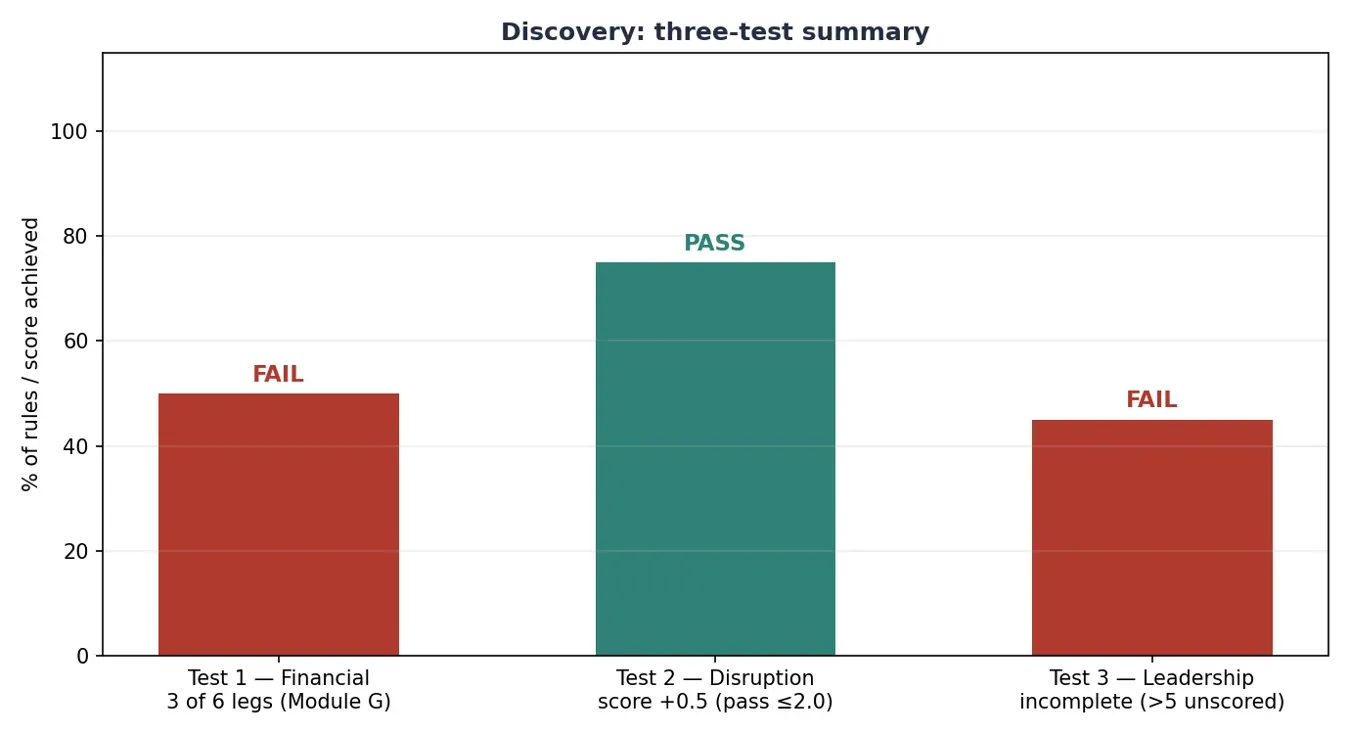
Discovery: three-test summary
Test 3 — Leadership: FAIL — test incomplete (and mixed on the items scored)
Cost-of-capital band set before scoring: 11–13% (top 13%) for the capital-allocation items, anchored to the 11.625% South African risk discount rate Discovery itself uses in its EV.
Key items, scored from the FY2026 results, AFS and SENS dealings announcements:
Capital allocation: RoEV of 14.1% (FY2025 15.7%) clears the top of the band (item 1, pass on the EV analogue — flagged, as ROIIC is not disclosed for an insurer, item 2 unscored). No qualifying goodwill impairment (item 3, pass). Item 5 fails: the share count has risen over five years and no buyback exists. Item 6 passes on the Module G substitute: financial leverage ratio 15.4% and falling, solvency cover 1.7–2.1×, no distress refinancing.
Ownership alignment — the strongest in the programme so far: Gore holds 43,934,307 shares, 6.48% (item 7 pass — founder above 5%); directors as a group, with co-founder Barry Swartzberg at about 3.15%, clear item 8. But item 9 fails: the SENS record of the last year is net selling and collar settlements by Gore entities, with no open-market purchases. Item 10 unscored (five-year pay-versus-TSR series not verified; FY2026 CEO pay was R37.48m).
Communication: item 11 fails on the letter of the rule — FY2025 corrected prior-period errors (FY2024 normalised headline earnings restated up 2.5%) and FY2026 corrected a banking-fee classification error. No earnings fraud or qualification is suggested; the rule says "no restatement", and the programme has applied it that way throughout (Momentum, Capitec). Items 12–13: Discovery guides by a five-year ambition rather than annual numeric guidance — the FY2025–29 ambition of 15–20% compound normalised operating profit growth is ahead of plan (FY2025 +29%, FY2026 +17%), but a guidance-error series cannot be computed, so item 12 is unscored and item 13 passes (no withdrawal or late lowering).
Succession: item 14 fails — no named internal successor or candidate list for a 62-year-old founder-CEO of 34 years' tenure was found in the sources read. Item 15 passes (internal promotions into the executive team, including the Bank build-out leadership). Item 16: tenure passes the 5-year leg outright, but with no disclosed succession timetable the underlying risk stands — scored pass on tenure, flagged.
Innovation culture: item 17 passes (RoEV and VNB growth above sector norms); item 18 passes (the Vitality and Bank claims are supported by the numbers: Bank profitable, VNB +31%).
Delivery: the five-year ambition is being beaten (item 19–20 scored provisionally on that single long-range commitment set — below the framework's minimum samples, so flagged provisional, not counted as a clean pass).
Total: the items that can be scored split roughly evenly, ownership and delivery strong, items 5, 9, 11 and 14 failing — and with at least six items unscored or provisional (2, 10, 12 and the delivery pair among them), the test is incomplete under the framework's rule that more than five unscored items means a company cannot pass. Leadership therefore fails, on completeness rather than on a verdict about Gore, who on ownership and delivery is the best-aligned chief executive scored so far. The two gaps are concrete and fixable by disclosure: a named succession plan, and a clean reporting run.
Step 4 — Valuation (run for information; the gate fails, so it does not govern)
Base case, Portfolio Manager method, with the framework's currency stress (rand −3% a year; hurdle measured in US dollars). EPS path: normalised HEPS growing at 15%, 15% and 13% — inside Discovery's own 15–20% operating-profit ambition and below FY2026's 20% — from R17.58 to R26.26 in year 3. Dividends over the three years estimated at about R15.20 in total, holding the FY2026 payout ratio of about 22%. Costs 0.15% at each end.
Exit P/E | Sell price (year-3 EPS × exit P/E) | Ceiling price (highest price clearing 15%, after rand stress) | IRR at R259.30 (USD terms) |
10× | R262.60 | R166.46 | −0.8% |
12× | R315.12 | R197.93 | 5.1% |
15× | R393.90 | R245.13 | 12.9% |
18× | R472.68 | R292.34 | 19.7% |
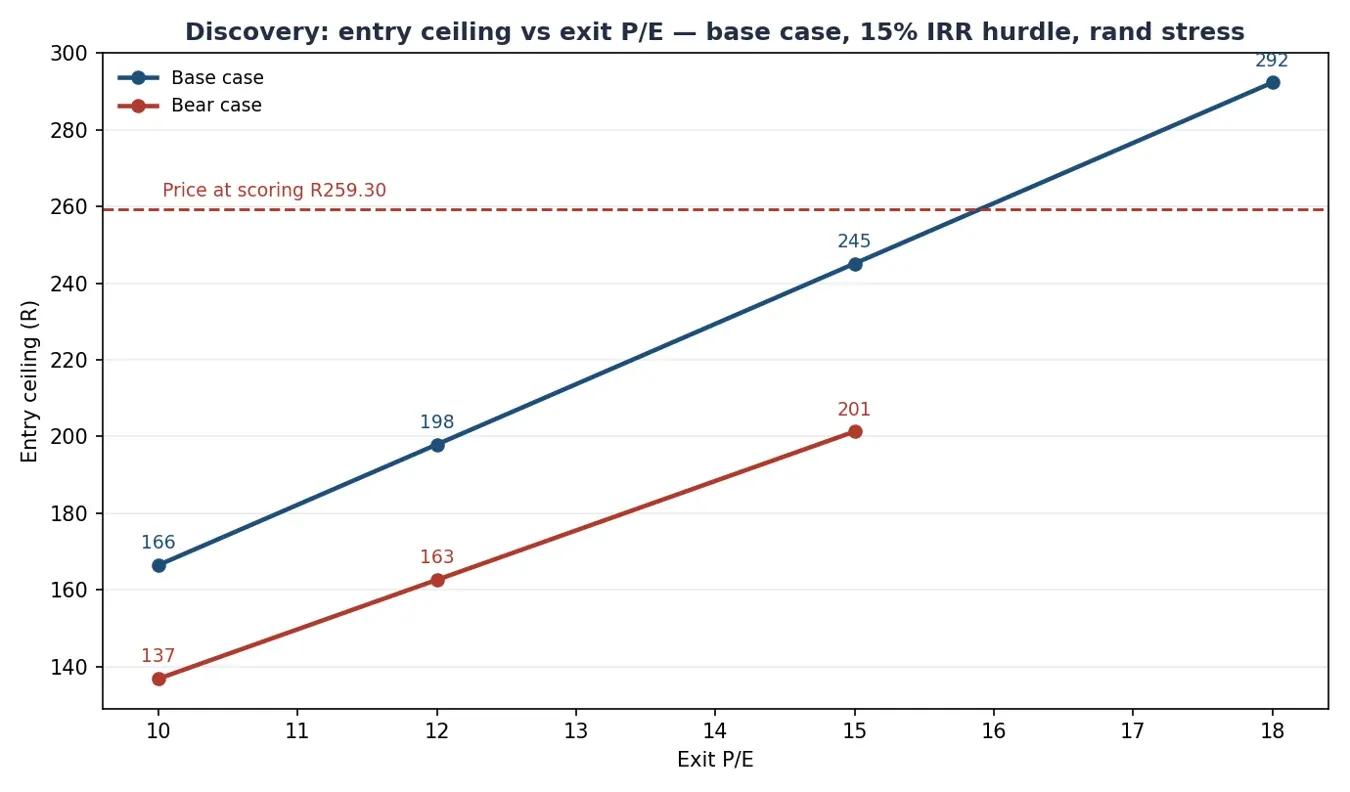
Discovery: entry ceiling vs exit P/E — base case, 15% IRR hurdle
Read this honestly: 15× is already the framework's entry gate used as an exit multiple for an insurer, and it still does not clear the hurdle at today's price after rand stress (12.9%). Only an 18× exit — paying in year 3 a multiple LDV would not pay today — makes R259.30 work. The market is pricing Discovery as a compounder that keeps its premium to embedded value; LDV does not underwrite the premium.
Bear case — growth halves (about 7% a year; year-3 normalised HEPS R21.53; dividends about R13.00):
Exit P/E | Sell price | Ceiling price | IRR at R259.30 |
10× | R215.30 | R136.80 | −7.1% |
12× | R258.36 | R162.60 | −1.6% |
15× | R322.95 | R201.30 | 5.7% |
What would have to change
Test 1's P/E leg needs the price at or below R218.21, or roughly two more years of FY2026-pace earnings growth delivered with the price standing still — plausible for this business, which is why the revisit matters.
Test 1's yield leg needs a capital-return decision: a buyback, or a payout ratio step-change. At 17.8× normal earnings, no dividend policy alone reaches 3%.
Test 3 needs a named succession plan for Gore and five clean years without restated comparatives (the clock restarts from FY2026), plus disclosure that lets items 2, 10 and 12 be scored.
The solvency watch item: Discovery Life cover fell from 1.9× to 1.7× in FY2026 on lower rates and reinsurance optimisation. A further fall toward 1.5× would change this scorecard's character from "expensive quality" to something weaker.
Framework finding (recorded, not applied): Module G's delivery and guidance items assume a guiding company. Like Capitec, Discovery guides by multi-year ambition, not annual numbers — the programme now has two JSE financials stranded by the same items. A no-guidance protocol for the delivery domain is a decision for James.
Verdict
NO ENTRY. Discovery is the best business scored today and one of the best in the programme: a founder holding 6.48%, solvency at 1.7–2.1×, new-business value up 31%, a bank built from nothing to profit, and a ten-year record without a loss. None of it is available at a price LDV can pay: 17.8× normal earnings, 2.13× book, a 22% premium to embedded value, a 1.5% shareholder yield with a rising share count, and a base case that clears 15% in dollars only at an 18× exit multiple. The leadership test also cannot be completed, for want of a succession plan and a clean reporting run.
Buy price: none.
What it would take to buy: P/E ≤15 (price ≤R218.21, or normal normalised HEPS ≥R17.29); the book-value leg passing (P/B ≤1.5 or combined multiple <22.5); three-year average shareholder yield ≥3.0% with the share count falling; a completable, passing leadership checklist including a named successor; and a price at or below R245.13, the 15×-exit ceiling after rand stress.
Sell price: none.
---
Analyst consensus for reference (not part of LDV): Buy — StockAnalysis, 7 analysts, average target R308.59 (+19.0% from R259.30), forward P/E 13.06. Sources: Discovery FY2026 audited results and SENS (3 September 2026), FY2026 annual financial statements, FY2025 and FY2024 results (restated series), AGM report of proceedings, SENS 20 November 2026; StockAnalysis; afx.kwayisi. Computed figures (normal normalised HEPS, P/E, P/B, price/EV, VNB total, ceiling and IRR figures) are arithmetic from filing figures, cross-checked where possible.
Sources
Discovery FY2026 audited results, 3 September 2026 — normalised operating profit, NHE, HEPS series, EV, VNB, RoEV, segments, dividends
Discovery FY2026 annual financial statements — solvency cover, SCR, balance sheet, restatements
Discovery share price, 20 November 2026 close (StockAnalysis) — R259.30 close, market capitalisation, BVPS, consensus target
Discovery investor relations — financial results library — Discovery's official results library; the FY2026 audited results and annual financial statements linked above are published there
Discovery AGM report of proceedings, SENS 20 November 2026 (AGM held 19 November 2026) — resolutions and voting at the 2026 annual general meeting
> LDV Investing Framework research data — not investment advice. This scorecard is research being developed and tested under the LDV Investing Framework. It is not investment advice, not a recommendation to buy or sell any security, and not personal financial advice. The entry and exit prices are the framework's mechanical outputs — the ceiling at which the base case clears a 15% annual IRR hurdle, and year-3 EPS × exit P/E — not price targets or advice. Do your own research, and consider seeking advice from a licensed financial adviser before making any investment decision.