
Scored under the revised LDV framework, Module A (Industrials — consumer). Price: A$6.47, ASX close Friday 20 November 2026 (the share fell about 11% at the 19 November AGM update). The company reports in New Zealand dollars; per-share figures below are NZ$ unless stated, and the NZ$ price used is NZ$7.85 — A$6.47 converted at the Reserve Bank of Australia's published rate for 20 November 2026 of 1.2127 NZD per AUD. Accounting basis: IFRS (NZ IFRS), year ended 30 June 2026; FY2026 results published 17 August 2026. All figures from ASX/NZX announcements, the FY2026 annual report and public aggregators, researched 23 November 2026. Not investment advice.
The company
a2 Milk sells infant formula and other dairy products built on one idea: milk containing only the A2 beta-casein protein. It is an asset-light brand business — it owns no herds and, until recently, almost no factories — selling mainly into China, which with "Other Asia" is 73% of revenue. FY2026 continuing revenue was NZ$1,974.9m, up 12.4%, with continuing net profit of NZ$207.5m and continuing basic EPS of 28.6c; reported profit was only about NZ$111m after a NZ$96.4m discontinued loss on the divestment of Mataura Valley Milk, the Southland plant it bought 75% of in 2021 and sold again in FY2026. Gross margin fell 3.4 points to 47.7%. The balance sheet is the strongest part: NZ$784.5m of net cash, no borrowings, and equity of NZ$1,073.1m. The year also brought two firsts — the company's first dividends (FY2025) followed by a NZ$300m special dividend in FY2026 — and a strategic reversal: a2 bought the Pōkeno manufacturing plant (formerly Yashili NZ) in August 2025 for about NZ$282m, with NZ$102.3m of goodwill and a further NZ$100m capex programme, taking control of its own China-label supply after its 19.8%-owned supplier Synlait's backlog caused China-label shortfalls in the fourth quarter — China-label revenue fell 14.0% while the market fell 0.2%. The 19 November AGM update then cut the FY2027 outlook: revenue growth of mid-single digits, first-half revenue slightly down, results weighted to the second half. The market took 11% off the price in a day. This scorecard scores what is left.
The headline
LDV gives a2 Milk no entry price — it fails Test 1 on four of six rules, and Test 2 on the V1 research veto as written. On normal continuing earnings of about NZ$0.274 the P/E is about 28.6× against the 15× gate; book value gives about 5.3× and a combined multiple far above 22.5; the current ratio is 1.61× against the 2× rule (2.50× if the NZ$300m special-dividend payable sitting in current liabilities is excluded — reported as found, and scored as reported); and the shareholder yield is about 1–1.5%, because dividends only began in FY2025, there has never been a buyback, and the share count is rising. Only debt (2.3% — net cash) and the ten-year earnings record (no loss year) pass. The V1 veto is the framework finding of the day: a2 expenses R&D of just NZ$4.2m — 0.21% of revenue, below half the roughly 2% consumer-sector median for two successive years — because its innovation spend sits in NZ$325m of marketing and in its supply chain, not in a laboratory. The veto stands as written; the finding is recorded below, not applied as a waiver.
Recommendations
Buy price: none.
What it would take to buy: (1) the P/E gate passes — NZ$ price at or below about NZ$4.11 on today's normal continuing EPS of NZ$0.274, or normal EPS rising to about NZ$0.52 at the current price; (2) the book-value leg passes — P/B at or below 1.5 (NZ$ price about NZ$2.22 on book value per share of NZ$1.48) or the combined multiple below 22.5; (3) the current ratio at or above 2 on the reported balance sheet — which happens mechanically once the special-dividend payable clears, and must then be held; (4) the three-year average shareholder yield reaches 3.0% on regular dividends and buybacks, with the diluted share count actually falling (special dividends are excluded by the framework); (5) the V1 question resolved — either R&D rising above 50% of the sector median for two years, or a framework decision by James on brand-led consumer companies whose research sits outside the R&D line; (6) the price at or below NZ$3.99 (about A$3.29 at the same RBA rate), the 15×-exit base-case ceiling after currency stress.
Sell price: none.
Test 1 — Financial strength: FAIL (2 of 6)
Rule | Requirement | a2 Milk | Verdict |
P/E | ≤ 15 on normal earnings (3-yr avg EPS, one-offs above 10% of pre-tax excluded) | Normal continuing EPS about NZ$0.274 (FY25 continuing 30.4c, FY26 continuing 28.6c, FY24 reported 23.2c; the FY26 Mataura disposal loss is excluded as a one-off above the threshold) → P/E about 28.6× at NZ$7.85 | FAIL |
P/B | ≤ 1.5, or P/E × P/B < 22.5 | Book value per share NZ$1.48 → P/B about 5.3×; product about 152 | FAIL |
Current ratio | ≥ 2 | Current assets NZ$1,350.4m / current liabilities NZ$839.8m = 1.61×. Excluding the NZ$300m special-dividend payable it is 2.50× — but the rule is scored on the reported balance sheet | FAIL |
Debt / equity | ≤ 50% | Borrowings nil; lease liabilities NZ$24.3m; equity NZ$1,073.1m → 2.3%; net cash NZ$784.5m | Pass |
Earnings record | Positive in each of the past 10 years | Positive every year FY2017–FY2026 (low point FY2021, NPAT NZ$80.7m) | Pass |
Shareholder return | 3-yr avg total shareholder yield ≥ 3.0% | Dividends began only in FY2025 (20.0c total) and FY2026 paid 21.0c ordinary — a yield of about 1–1.5% averaged over three years; the FY2026 special dividend of 41.355c is excluded by the framework's regular-dividends rule; no buyback has ever been executed and the share count rose (weighted 723.8m → 725.2m), so the share-count guard also fails | FAIL |
The P/E gate price is about NZ$4.11 (15 × NZ$0.274). This is a profitable, net-cash company failing on price and payout history — the screen is doing what Graham designed it to do, and the FY2025 start to dividends means the yield leg can pass by about FY2028 if the ordinary dividend holds and the price does not run away first.
Test 2 — Disruption: FAIL (V1 veto, as written)
Veto | Rule | a2 Milk | Verdict |
V1 — Research starved | R&D below 50% of the sector median for 2 successive years | R&D expensed was NZ$4.186m in FY2026 (0.21% of revenue) and NZ$5.76m in FY2025 (0.30%) — both far below 50% of the roughly 2% consumer/industrials median (about 1.0%) | VETO TRIGGERED |
V2 — Margin collapse | Gross margin −5 pts cumulative over 3 years, or operating margin down 2 years while revenue trails industry | Continuing gross margin fell 3.4 points in FY2026 to 47.7% — a large one-year fall, below the 5-point cumulative veto; revenue grew 12.4%, ahead of its market | Not triggered — flagged |
V3 — Losing share | Revenue trailing industry by ≥5 pts for 2 years | Group revenue +12.4% in FY2026 and a2 outgrew the China infant-formula market overall — but China-label revenue fell 14.0% against a market down 0.2% in the year, a share loss in its most important label, caused by Synlait supply failure rather than demand | Not triggered — flagged |
V4 — Concentrated customers | Top-1 customer above 20% of revenue, or top-5 above 40% | No customer at or above 10% is disclosed. The concentration is geographic, not by customer: China & Other Asia is 73% of revenue — outside the veto as written, recorded as the real concentration risk | Not triggered |
Scored test: gross margin down 3.4 points cumulatively scores +2.0 on its own. Capex is about 4× PPE depreciation in FY2026 (the Pōkeno build), so no capex point (0) — though FY2025 capex of NZ$3.7m was below depreciation, the two-successive-years condition is not met. Customer concentration (0). Chief executive tenure 5.8 years (0). New products drove more than half of FY2026 sales growth, but the revenue share from products launched within five years is not disclosed, so no credit is taken (0 — open enquiry). Acquisitions: Pōkeno scores zero — it is under two years old, and its goodwill of NZ$102.3m is 5.2% of total assets, just above the framework's 5% no-credit line. Scored total: +2.0, at the pass line — but the V1 veto fails the test regardless.
Framework finding (recorded, not applied): V1 was built for companies whose future is made in a laboratory or a design office. a2's product science is real but small; its NZ$325m of marketing and its supply-chain control are where it actually invests against disruption — and on the supply chain, FY2026 showed the risk is live: a supplier's backlog cost it China-label share, and it responded by buying a factory. A sector-median R&D test cannot see any of that. The veto stands in this scorecard; whether Module A needs a brand-led consumer variant — closer to the distributor logic of V1D, testing supply security and brand investment instead of R&D — is a decision for James.
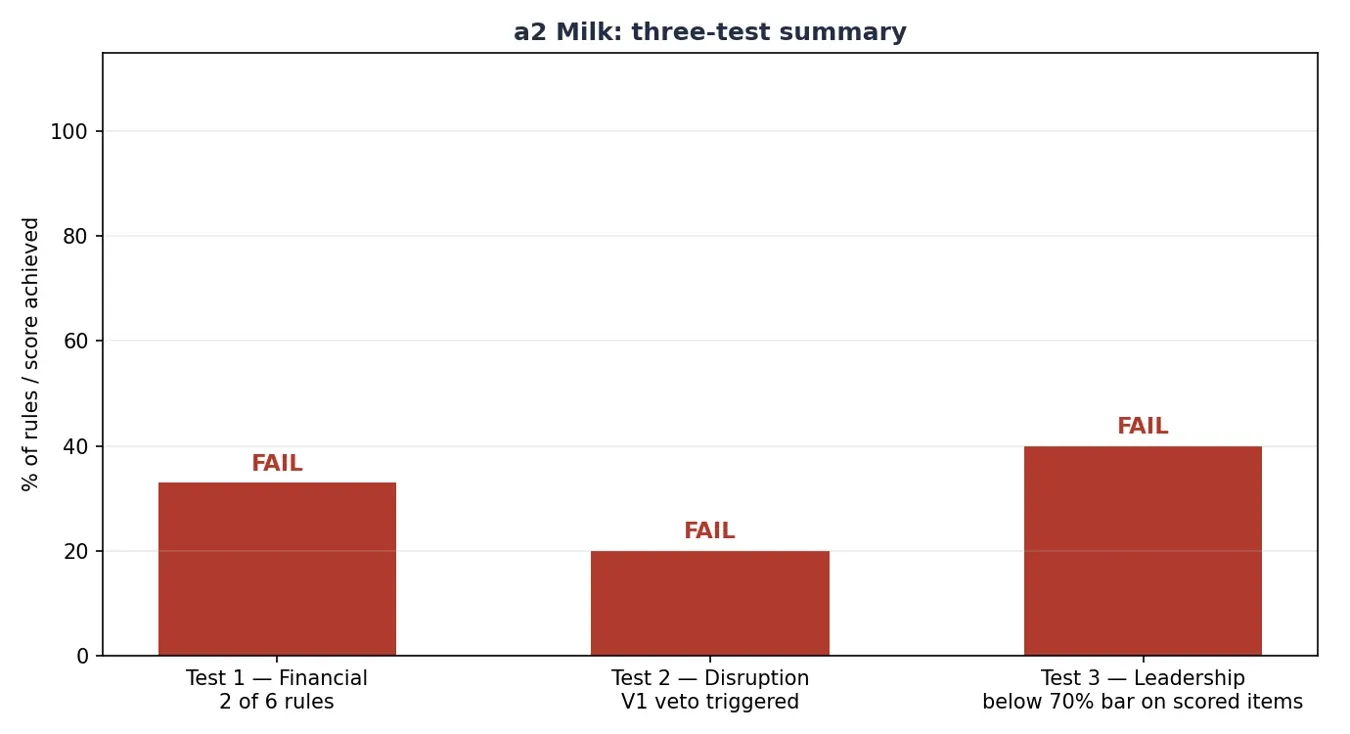
a2 Milk: three-test summary
Test 3 — Leadership: FAIL (on the items scored; several unscored)
Chief executive David Bortolussi has served since 8 February 2021 (5.8 years); chair is Pip Greenwood. Scored from the FY2026 annual report, NZX announcements and aggregator cross-checks:
Capital allocation: net cash and no distress (item 6, pass). Item 5 fails — the share count rose over five years; there has been no buyback. The Mataura Valley Milk round trip — 75% bought in 2021, divested in FY2026 at a loss of about NZ$96–130m — weighs on items 3–4: no goodwill impairment above the threshold was recorded, but a bought-and-sold-at-a-loss plant inside five years is the substance those items test; scored fail on item 4's post-deal return logic, flagged as judgement. ROIC and ROIIC against a set WACC band (items 1–2) unscored — not verified from the filings in this review.
Ownership alignment: Bortolussi holds about 0.21% (aggregator figure — item 7 fails the 1% leg and he is not a founder); item 8 unscored (full directors' total not verified); item 9 fails — the CEO sold 112,687 shares in August 2026 and no offsetting open-market purchases were found. Item 10 unscored (FY2026 remuneration-report figure not extracted; FY2025 total pay of about NZ$7.74m against a share price well below its highs points the wrong way — flagged).
Communication: item 11 passes (no restatement, late filing or qualified opinion found; the shareholder class action was settled in April 2026 for A$62m, fully insured, with no admission of liability — a litigation event, not a reporting failure). Items 12–13: FY2026's reported EBITDA margin of 14.4% missed the original 15–16% guidance after April and July 2026 updates — guidance was revised down in-year, more than 90 days before year-end, so item 13 passes on the letter, but item 12 (guidance error ≤10%) is scored fail on the margin miss against the original guide.
Succession: item 14 unscored (no named successor found in the sources read); item 15 unscored; item 16 passes (CEO tenure above 5 years).
Innovation culture: item 17 fails on the R&D measure (0.21% of revenue — the same fact as V1); item 18 passes (the new-product growth claims are supported by the revenue numbers).
Delivery: items 19–20 unscored — fewer than five quantified, dated objectives verified; the NZ$2bn revenue ambition was retained at the AGM but FY2027 guidance was cut, which is not a delivery pass on any reading.
Total: on the items scored, a2 is below the 70% bar, and the capital-allocation domain is below its 3-of-6 floor on scored items. Leadership fails. The pattern is consistent: a competent operating team, weakly aligned by ownership, with a capital-allocation record (Mataura in, Mataura out at a loss; Pōkeno bought at 5.2%-of-assets goodwill) that the checklist is right to question.
Step 4 — Valuation (run for information; the gate fails, so it does not govern)
Base case, Portfolio Manager method, in NZ$ with the framework's AUD currency stress of −1% a year applied as the trans-Tasman proxy (flagged — the framework specifies rand and AUD stress; NZD is unspecified, a minor finding). EPS path: continuing EPS of 28.6c growing to about NZ$0.37 by year 3 — FY2027 roughly flat on the AGM guidance (mid-single-digit revenue growth, ~15% underlying EBITDA margin, second-half weighted), then recovery as Pōkeno supply normalises. Ordinary dividends of about NZ$0.72 over the three years (special dividends excluded). Costs 0.15% at each end. Price NZ$7.85 (A$6.47 at the RBA's 20 November 2026 rate of 1.2127 NZD per AUD — see header).
Exit P/E | Sell price (year-3 EPS × exit P/E) | Ceiling price (highest price clearing 15%, after currency stress) | IRR at NZ$7.85 |
12× | NZ$4.44 | NZ$3.29 | −14.0% |
15× | NZ$5.55 | NZ$3.99 | −8.2% |
18× | NZ$6.66 | NZ$4.70 | −3.1% |
20× | NZ$7.40 | NZ$5.17 | 0.0% |
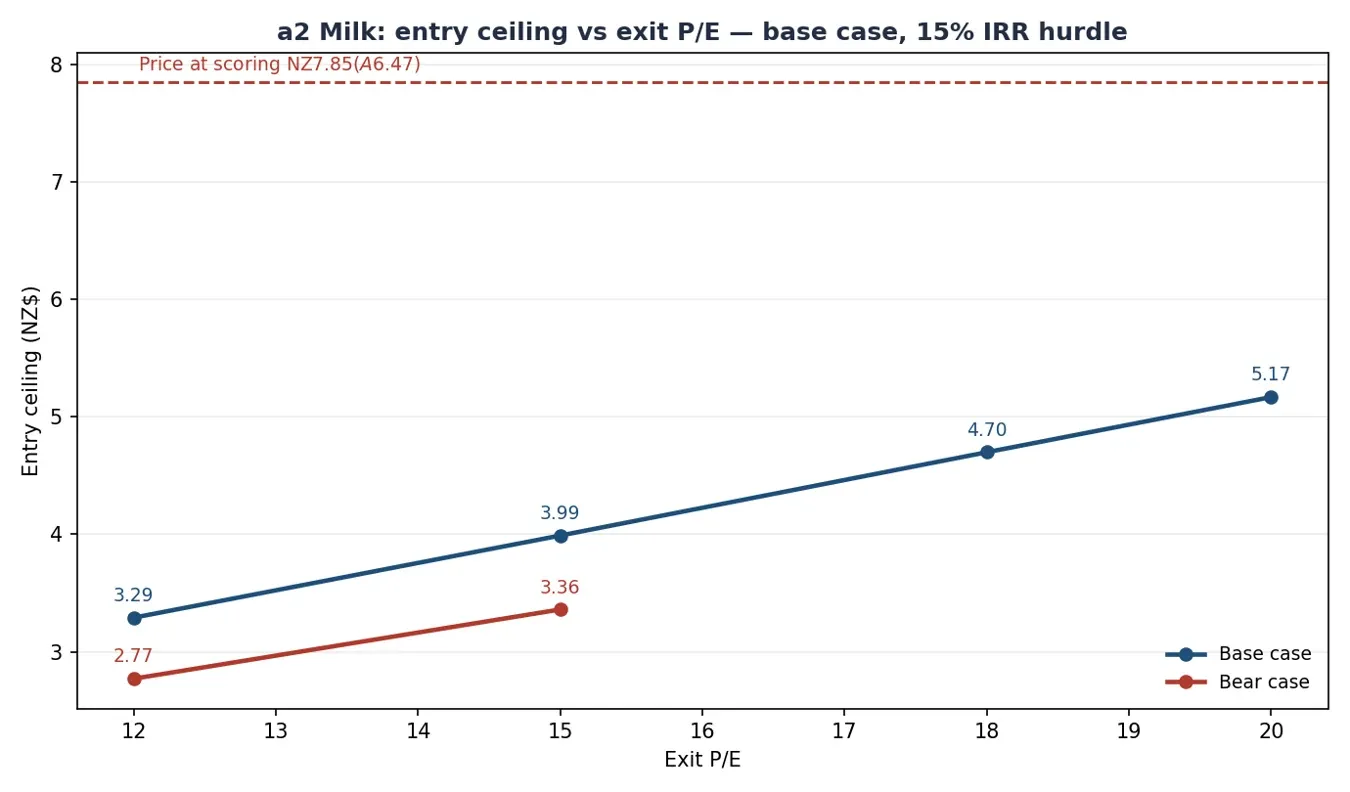
a2 Milk: entry ceiling vs exit P/E — base case, 15% IRR hurdle
Even a 20× exit multiple — for a dairy brand — produces an IRR of about 0% at today's price. The 19 November fall did not make a2 cheap under LDV; it made it less expensive. Bear case (China-label recovery stalls; year-3 EPS NZ$0.31; dividends NZ$0.63): ceiling NZ$2.77 at 12× and NZ$3.36 at 15×, IRR −18.8% and −13.3% respectively at NZ$7.85.
What would have to change
Test 1: price to about NZ$4.11 for the P/E gate; the current-ratio leg clears mechanically when the special-dividend payable is paid, and must then be held at or above 2; the yield leg needs three years of ordinary dividends (and ideally a buyback with a falling share count) — earliest realistic pass FY2028.
Test 2: R&D above 50% of the sector median for two years, or a framework decision on brand-led consumer companies (the finding above); gross margin stabilising — a further 1.6-point cumulative fall triggers the V2 veto outright.
Test 3: insider buying rather than CEO selling; a named successor; Pōkeno earning its goodwill — its three-year post-deal return is the item-4 test at the revisit.
The supply watch item: China-label offtake was about 50% of pre-disruption levels at the AGM (up from 40%). Recovery from there is the single operational fact that decides whether the FY2027 downgrade was a supply accident or a share loss.
Verdict
NO ENTRY. a2 Milk is a profitable, net-cash brand with a genuine product idea, priced at about 28.6 times normal earnings with a 1–1.5% shareholder yield, a reported current ratio of 1.61×, a research veto triggered on the framework as written, and a leadership score below the bar. The business may well recover from the Synlait year — the balance sheet gives it time — but LDV buys the numbers in front of it, and these numbers fail three tests.
Buy price: none.
What it would take to buy: P/E ≤15 (NZ$ price ≤ about NZ$4.11, or normal continuing EPS ≥ about NZ$0.52); P/B leg passing; reported current ratio ≥2 and held; three-year average shareholder yield ≥3.0% with the share count falling; the V1 question resolved by spending or by a framework decision; leadership at or above 70% with the capital-allocation floor met; and a price at or below NZ$3.99, the 15×-exit ceiling after currency stress.
Sell price: none.
---
Analyst consensus for reference (not part of LDV): Strong Buy — TipRanks, 8 analysts, average target A$7.73 (19 November 2026); one sell-side Buy target of A$8.20 (17 November). The year-by-year EPS forecasts found in aggregators are dated 1 February 2026 — stale, pre-dating both the FY2026 results and the AGM downgrade — and were not used in the valuation, which is built from company guidance instead. Sources: a2 Milk FY2026 results and annual report (ASX/NZX, 17 August 2026), Pōkeno acquisition announcement (August 2025), class-action settlement announcement (April 2026), AGM update (19 November 2026); StockAnalysis; TipRanks. Computed figures (normal EPS, ratios, ceiling and IRR figures) are arithmetic from filing figures.
Sources
a2 Milk FY2026 results announcement (NZX) — revenue, NPAT, EPS, dividends, balance sheet
a2 Milk Pōkeno (Yashili NZ) acquisition announcement (NZX) — NZ$282m acquisition, China-label registrations
a2 Milk class-action settlement announcement (NZX) — A$62m settlement, fully insured, no admission
a2 Milk AGM update, 19 November 2026 (NZX) — FY2027 outlook, China-label offtake recovery
a2 Milk share price, 20 November 2026 close (StockAnalysis) — A$6.47 close
Reserve Bank of Australia, daily exchange rates — 1.2127 NZD per AUD on 20 November 2026; the A$6.47 close converts to the NZ$7.85 scoring price
> LDV Investing Framework research data — not investment advice. This scorecard is research being developed and tested under the LDV Investing Framework. It is not investment advice, not a recommendation to buy or sell any security, and not personal financial advice. The entry and exit prices are the framework's mechanical outputs — the ceiling at which the base case clears a 15% annual IRR hurdle, and year-3 EPS × exit P/E — not price targets or advice. Do your own research, and consider seeking advice from a licensed financial adviser before making any investment decision.