

Scored under the revised LDV framework, Module E by analogy (a retirement-village operator and developer, not a REIT — the company's own non-GAAP "underlying profit" is used in place of FFO, and the V1 research veto is waived as it is for Module E). Price: NZ$5.98, NZX close Wednesday 25 November 2026. Accounting basis: NZ IFRS, year ended 31 December 2025 (FY2025 results 27 February 2026; half-year report to 30 June 2026). Market capitalisation ≈ NZ$1,456m on 243,483,000 shares. All figures from NZX/ASX filings, researched 26 November 2026. Not investment advice.
The company
Summerset builds and operates retirement villages in New Zealand and, increasingly, Victoria, Australia: 41 villages completed or in development in New Zealand and four in development in Australia, more than 10,000 residents, occupancy of 95% in its villages and 94% in its care centres at FY2025. The economics are property economics. Residents pay a refundable occupation-right loan when they move in; Summerset earns deferred management fees, care and village fees, resale gains when a unit turns over, and a development margin on new builds. FY2025 was a record sales year — 1,560 occupation rights sold — and underlying profit rose 13% to NZ$234.2m, while reported IFRS profit fell to NZ$259.7m because it is dominated by fair-value movements on the NZ$8.2bn investment-property portfolio. The first half of 2026 was softer: underlying profit fell 3%, the development margin dropped from 27.8% to 20.0% on sales mix, the interim dividend was cut to 3.8c under a new payout policy, and the medium-term build rate was held down to 600–700 homes a year. The share price has halved in twelve months, from a 52-week high near NZ$12.72 to NZ$5.98 — about 0.41× net tangible assets of NZ$14.41 a share. Scott Scoullar, CFO from 2014, has been CEO since March 2021.
The headline
LDV gives Summerset no entry price — but this is the closest miss the programme has produced, and the reason is not price. Summerset is the first company scored that passes both of Test 1's price gates: on normal earnings (NZ$0.89, the three-year average of underlying EPS) the shares trade at 6.7× against a 15× gate, and at 0.41× book value the combined multiple is 2.7 against a 22.5 limit. The Step 4 base case clears the 15% hurdle at today's price with room to spare — a ceiling of NZ$8.96 at a 12× exit multiple against a NZ$5.98 price. What stops it is the rest of Test 1 and Test 3. Borrowings including leases are 59% of equity, above the 50% rule as written (and that is before NZ$3,646m of refundable residents' loans, which take total funding to 1.63× equity). The shareholder-yield rule fails, on two separate measures that should not be run together. The trailing dividend yield is 2.84% — 17.0c of cash dividends actually paid in the last twelve months, after the policy reset cut the interim; it is a trailing yield only, and it is not the three-year figure. The three-year shareholder yield is computed on FY2023–FY2025 inputs on both sides: declared dividends were 24.5c in each of FY2023, FY2024 and FY2025 (11.3c interim + 13.2c final each year), an average dividend yield of 4.10% at NZ$5.98; over the same three years the weighted share count rose from about 233m (FY2023) to about 236m (FY2024) to 240.2m (FY2025) — issuance of about 1.5% a year annualised across that window, with no buyback in any year to offset it (shares on issue then rose further, to 241.7m at December 2025 and 243.5m at June 2026). Netting the period-matched issuance against the period-matched dividend yield gives 4.10% − ~1.5% ≈ 2.6% — below the 3.0% the rule needs, and the rising count fails the rule's share-count guard on any basis: the count must fall, and it rose in every year of the window. The current ratio cannot be scored at all, because Summerset's statements present an unclassified balance sheet. And the leadership test is incomplete: 11 of 20 items are unscored, the capital-allocation floor is not met on the scored items, and the CEO sold 50,000 shares in May 2025 at about NZ$11 — roughly double today's price.
Recommendations
Buy price: none.
What it would take to buy: (1) debt/equity at or below 50% on the framework's definition — borrowings including leases of NZ$2,080m against equity of NZ$3,511m is 59% today; net debt below the company's own end-2027 target of NZ$1.9bn would be the visible step; (2) a three-year shareholder yield at or above 3.0% with the diluted share count actually falling — buybacks outweighing DRP and employee-plan issuance, at a dividend at least held at the new policy's rate; (3) a classifiable balance sheet or the notes' liquidity analysis published in a form that lets the current-ratio rule be scored; (4) a completable leadership test — at most 5 unscored items, the capital-allocation floor met, directors' aggregate holdings and the 2026 ongoing-disclosure notices on the record, and no net insider selling; (5) the price staying at or below the NZ$8.96 base-case ceiling while those conditions are met — at NZ$5.98 the valuation is not the obstacle.
Sell price: none.
Test 1 — Financial strength, Module E by analogy: FAIL (2 of 5 scored rules pass, 1 unscored)
Rule | Requirement | Summerset | Verdict |
P/E | ≤ 15 on normal earnings (3-yr avg EPS) | Underlying EPS: FY2023 ~81.7c, FY2024 ~87.5c, FY2025 97.5c → normal EPS NZ$0.89 → P/E 6.7× at NZ$5.98. Underlying EPS is used because reported EPS (FY2025: 108.12c) is driven by investment-property fair-value movements — the framework's normal-earnings definition excludes exactly that distortion. Gate price: NZ$13.34 | Pass |
P/B | ≤ 1.5, or P/E × P/B < 22.5 | Book value per share NZ$14.42 at 30 June 2026 (equity NZ$3,511.2m / 243.483m shares); NTA per share NZ$14.41 → P/B 0.41×; P/E × P/B = 2.7 | Pass |
Current ratio | ≥ 2 | Unscored — open enquiry. Summerset's primary statements present an unclassified balance sheet with no current/non-current split, so no ratio can be computed from the filing. Cash is small (NZ$14.1m at June 2026) against NZ$178.7m of payables, but liquidity in this model runs on occupation-right receipts (NZ$911m in FY2025) and termed facilities (NZ$626.8m undrawn at FY2025) — recorded as a disclosure gap, not estimated from an aggregator | Not scored |
Debt / equity | ≤ 50%, debt including lease liabilities | Borrowings NZ$2,074.8m + leases NZ$5.7m = NZ$2,080.5m / equity NZ$3,511.2m = 59% at 30 June 2026 (the same at December 2025). Including refundable residents' loans of NZ$3,646.5m — interest-free resident funding repayable on exit — total funding is 1.63× equity. The company's own gearing measure is 36.9%, inside its 30–40% band, but the framework's rule is scored as written | FAIL |
Earnings record | Positive in each of the past 10 years | No loss year in FY2015–FY2025 on either basis. Underlying profit rose in 10 of 11 years (the only dip was FY2020); reported profit is volatile through revaluations (NZ$543.7m in FY2021, NZ$259.7m in FY2025) but never negative | Pass |
Shareholder return | 3-yr avg total shareholder yield ≥ 3.0%, with the diluted share count falling and the payout inside FCFE | The two measures are kept separate. Trailing dividend yield: 2.84% — cash dividends paid in the last twelve months were 17.0c (the FY2025 final of 13.2c plus the FY2026 interim of 3.8c, cut under the reset policy of 20–60% of cash flow from existing operations). Three-year shareholder yield (FY2023–FY2025 inputs on both sides): declared dividends were flat at 24.5c in each of FY2023, FY2024 and FY2025 (11.3c interim + 13.2c final each year) — an average dividend yield of 4.10% at NZ$5.98. Over the same three years the weighted share count rose in each year — ~233m (FY2023) → ~236m (FY2024) → 240.2m (FY2025) — issuance of about 1.5% a year annualised across the window (DRP and employee plans), with no buyback in any year; shares on issue then rose further to 241.7m at December 2025 and 243.5m at June 2026. Netting the period-matched issuance: 4.10% − ~1.5% ≈ 2.6%. The 2.84% figure above is the trailing dividend yield only and is not used in this three-year calculation. The level fails (2.6% < 3.0%), and the share-count guard fails on any basis — the count rose in every year of the window | FAIL |
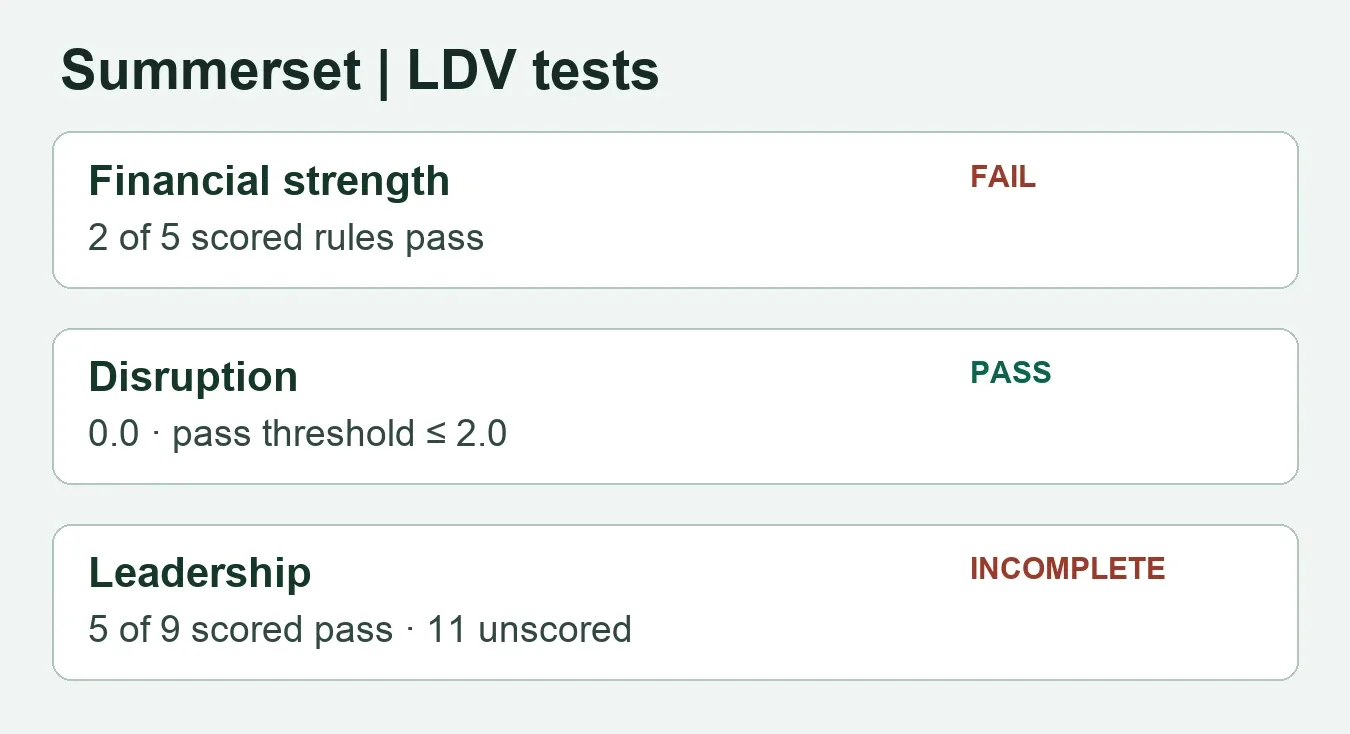
Summerset: three-test summary
The P/E gate price deserves one line of its own: at NZ$13.34, the price could more than double and still pass the earnings gate on today's normal EPS. That is what a halved share price does to a Graham screen — and it is also the warning. The market is not pricing Summerset on its underlying earnings; it is pricing the balance sheet, the development margin and the dividend cut. LDV's other rules exist for exactly that case.
Test 2 — Disruption, Module E by analogy: PASS, score 0.0 — with two items unscored
Veto | Rule | Summerset | Verdict |
V1 — Research starved | R&D below 50% of sector median for 2 successive years | Waived under Module E, and waived by analogy here: a village operator's product investment is development capex, not R&D. Summerset delivered 693 homes in FY2025 and 481 in 1H26 against a held FY2026 target of 700–800 | Not applicable |
V2 — Margin collapse | Gross-margin fall of 5 points over 3 years, or operating margin down 2 years while revenue trails the industry | Not triggered on the annual figures: development margin 28.9% (FY2024) → 27.8% (FY2025), annuity EBITDA rising NZ$112.5m → NZ$133.4m → NZ$137.6m, revenue +18% then +13%. Flagged, not scored as a veto: the 1H26 development margin fell to 20.0% on sales mix and 1H26 underlying profit fell 3% — one more half like that, confirmed in the FY2026 annual figures, puts this veto in play | Not triggered |
V3 — Losing share | Revenue trailing the industry by ≥ 5 points for 2 successive years | Unscored — open enquiry. No primary-source industry comparator was verified. The company's own record points the other way (record FY2025 sales of 1,560 occupation rights, +26%; 3Q26 resales +36% year on year, though 3Q26 new sales fell to 175 from 244) — a claim and a sales count, not a measured market share | Not scored |
V4 — Concentrated customers | Top-1 above 20% of revenue, or top-5 above 40% (Module E: tenant concentration) | Not applicable in its customer form: revenue comes from more than 10,000 residents across 45 villages, with occupancy of 95% (villages) and 94% (care) at FY2025 and resale stock at 2.2% of the portfolio at 1H26, the lowest since 1H22. No single resident, village contract or funder approaches the threshold on the disclosures read | Not triggered |
Tier 2 scored test: no row triggers on the verified annual figures. The margin row (a fall of 3 points or more over three years) does not trigger on development margin across FY2023–FY2025; the capex row runs the other way for a developer (investment property rose to NZ$8,625m and PPE to NZ$1,000m at June 2026); CEO tenure is 5.7 years, below the 14-year flag. The embedded-value record is the positive evidence: embedded value of NZ$1,991m at 1H26, about NZ$8.18 a share — above the share price on its own — and up 9% year on year. Score 0.0 — pass, with V3 unscored and the 1H26 margin fall carried as the item the revisit checks first.
Test 3 — Leadership: FAIL — test incomplete (11 items unscored)
Scored from the FY2025 release and audited statements, the Half Year Report 2026, NZX/ASX announcements and the May 2025 ongoing disclosure notice:
Capital allocation (1 of 3 scored): item 3 passes — goodwill is not recognised on Summerset's balance sheet at all (the valuer attributes any residual to goodwill, which the statements do not carry), intangibles are NZ$1.8m, and impairments are trivial (a NZ$1.875m reversal in FY2025; a NZ$2.256m loss in 1H26); there is no qualifying deal to impair. Item 5 fails — the diluted share count has risen, not fallen, over five years, and there have been no buybacks to average a price on. Item 6 fails as written — net debt of about NZ$2.1bn is roughly 7× FY2025 underlying EBITDA of NZ$292.5m, well above the 3× line; the company's own gearing (36.9%, in its 30–40% band, with an end-2027 net-debt target below NZ$1.9bn) is the mitigant, recorded here, not a rescoring. Items 1 (ROIC vs WACC), 2 (ROIIC) and 4 (post-deal ROIC — Summerset buys land, not companies) are unscored: no Mauboussin-basis ROIC is disclosed. The 3-of-6 floor is not met on the scored items.
Ownership alignment (0 of 2 scored, both scored items fail): item 7 fails — CEO Scott Scoullar held 437,118 shares at May 2025, about 0.18% of the company, below the 1% item (he is not a founder). Item 9 fails on the verified record — the one primary-source insider transaction verified in this pass is Scoullar's on-market sale of 50,000 shares on 2 and 5 May 2025 (NZ$548,133 in total, at about NZ$11 a share), reducing his holding from 487,118; no officer purchase was verified against it. Items 8 (directors' aggregate holding) and 10 (pay growth vs TSR) are unscored — the FY2025 annual report's directors' holdings table and the contents of the four 2026 ongoing disclosure notices (17 March, 2 June, 24 July, 6 October 2026) were not read in this pass, and are listed as open enquiries rather than filled from an aggregator.
Communication (2 of 3 scored): item 11 passes with a flag — no late filing or qualified opinion was found; FY2023/FY2024 reported profit was restated in the company's 10-year summary for an investment-property fair-value presentation change (NZ$436.3m to NZ$408.3m; NZ$339.8m to NZ$332.0m), a presentation restatement of comparatives, recorded here as Contact's was. Item 13 passes as written, with the substance recorded — no guidance was withdrawn or lowered within 90 days of a due date; but the medium-term build ambition was lowered at 1H26 (600–700 homes a year, against about 950 a year combined in the FY2025 presentation) and the dividend policy was reset to a lower payout basis in the same half. Item 12 is unscored — Summerset gives build guidance, not a profit-guidance series a mean absolute error can be measured on.
Succession (1 of 3 scored): item 16 passes — Scoullar's tenure is 5.7 years, and his own path (CFO 2014, Deputy CEO 2018, CEO 2021) is the internal-succession pattern the checklist rewards. Items 14 (a named successor for the next transition) and 15 (an internal promotion to the executive team in the last three years) are unscored — neither was verified from a primary source in this pass. Board succession is active and disclosed (two appointments in late 2026, one retirement dated to April 2027), which is evidence about the board, not the CEO item.
Innovation culture (1 of 2 scored): item 18 passes — the growth claims are backed by delivered numbers (Australia: Cranbourne North and Chirnside Park opened, Torquay and Oakleigh South in development; the Craigieburn site is being sold after a project-economics review — a stopped project judged on its economics, as the framework asks). Item 17 is unscored (no sector-median comparator verified).
Delivery (0 of 2 scored): both items unscored — the verified quantified objectives (FY2025 build guidance met at 637 NZ + 56 Australian homes against 600–650 + 50–80; FY2026 guidance of 700–800 held at the half with 481 delivered) are two, below the framework's minimum sample of five. The FY2025 corporate-overheads jump — NZ$68.1m to NZ$88.6m, +30% in a year — and the cost programme that followed (about NZ$26m of a NZ$30–40m target delivered by 1H26) are recorded here as the delivery fact the sample cannot yet score.
Total: 5 of 9 scored items pass, but 11 of 20 items are unscored — more than the 5 the framework allows — so the test is incomplete and cannot pass, and the capital-allocation floor is not met on the scored items. Unlike most incomplete tests in this programme, this one is not mainly a disclosure verdict: the items that could be scored on ownership and capital allocation failed on their facts (a rising share count, a CEO sale, leverage above the written line).
Step 4 — Valuation (run for information; the gate fails, so it does not govern)
Base case: underlying EPS growing 5% a year from FY2025's 97.5c — a recovery path that assumes the 1H26 development-margin fall is mix, not trend, and no more than the held 600–700 build rate — giving year-3 EPS of NZ$1.13; dividends of 17c, 18c and 19c (NZ$0.54 over three years, on the new policy's basis); transaction costs of 0.15% at each end; the framework's AUD currency stress of −1% a year applied as the NZD proxy (flagged — the framework specifies rand and AUD only).
Exit P/E | Exit price | Ceiling price (clearing 15%) |
8× | NZ$9.03 | NZ$6.09 |
10× | NZ$11.29 | NZ$7.52 |
12× (base) | NZ$13.54 | NZ$8.96 |
15× | NZ$16.93 | NZ$11.11 |
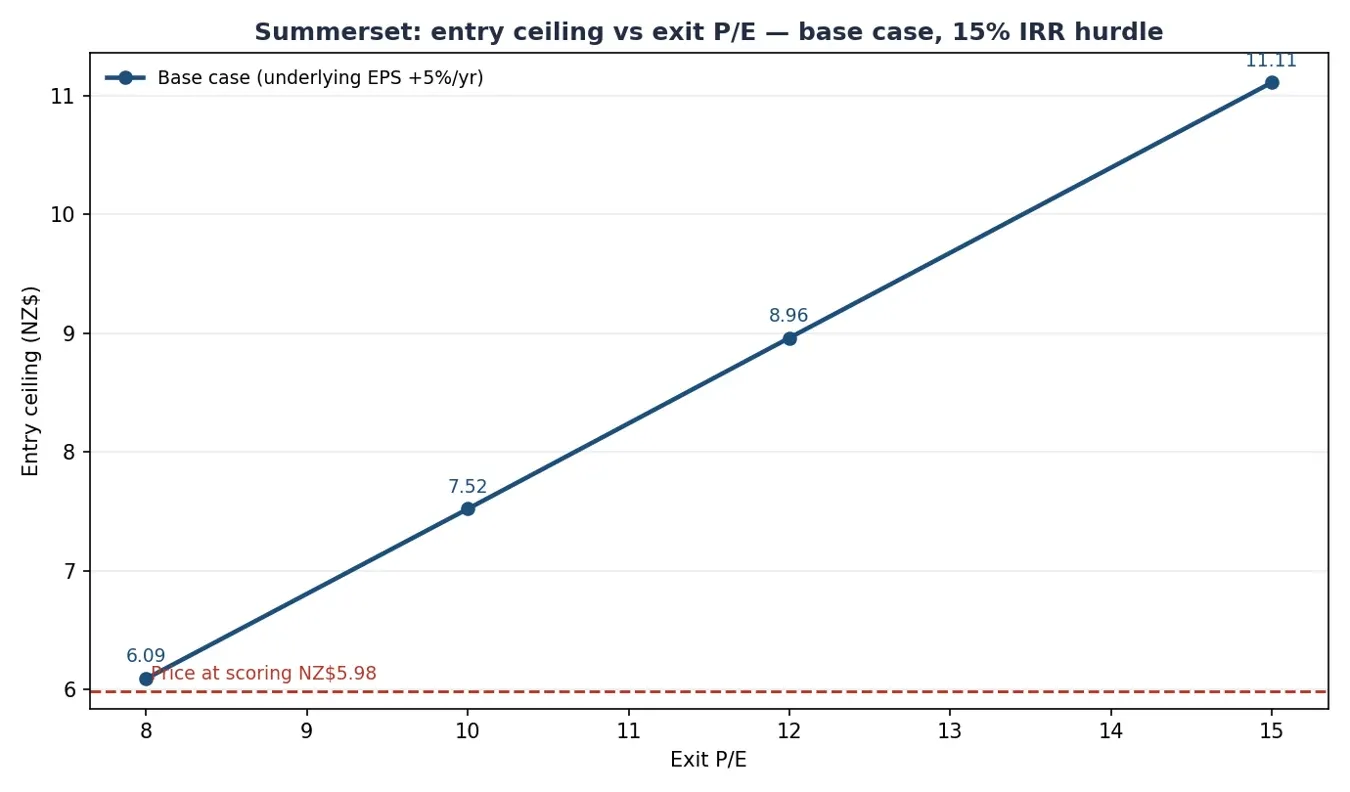
Summerset: entry ceiling vs exit P/E — base case, 15% IRR hurdle
At NZ$5.98 the base case returns about 31.6% a year — the only scorecard in the programme so far where the current price sits below every ceiling in the table, including the 8× bear multiple. That is the mechanical output, and it is stated plainly because the framework requires it. It does not make Summerset a buy: the valuation assumes the earnings the balance sheet and the shareholder-return rule are questioning. If the development margin stays at 20% and underlying EPS stalls, year-3 EPS nearer NZ$0.95 at an 8× exit gives a ceiling of about NZ$5.15 — below today's price. The gap between those two ceilings is the whole investment question, and LDV answers it by refusing entry until the gates that failed are the ones that clear.
What would have to change
Leverage: borrowings including leases at or below 50% of equity as written (59% today), or a framework decision on retirement-village funding that states how refundable residents' loans (NZ$3,646m, 1.04× equity on their own) are treated — recorded as a finding, not bent inside this scorecard. The company's end-2027 targets (net debt below NZ$1.9bn, gearing 33%) are the checkable path.
Shareholder return: a three-year yield at or above 3.0% with the count falling. That means buybacks outweighing roughly 2% a year of DRP and plan issuance, at a dividend held under the new CFEO policy.
The margin question: FY2026 annual figures (expected late February 2027) showing the development margin recovering from 20.0% and underlying profit growing again — or the V2 flag hardening into a scored problem.
Disclosure: a classifiable balance sheet (or the liquidity notes in ratio form), directors' aggregate holdings, and the 2026 disclosure notices read — which together would cut the unscored count from 11 toward the 5 the test allows.
The revisit trigger: the FY2026 full-year result, expected late February 2027. The revisit is set for 27 February 2027.
Verdict
NO ENTRY. Summerset passes the two price gates no other company in this programme has passed together — P/E 6.7× on normal underlying earnings, P/B 0.41× — and its base-case ceiling of NZ$8.96 sits half as much again above the NZ$5.98 price. It fails Test 1 anyway: borrowings including leases at 59% of equity against a 50% rule, a three-year shareholder yield of about 2.6% on FY2023–FY2025 inputs (declared dividends of 24.5c a year, a 4.10% average yield at NZ$5.98, less about 1.5% a year of share issuance across the same years, with the weighted count rising from about 233m to 240.2m; the separate trailing dividend yield is 2.84%), and a current-ratio rule its unclassified balance sheet leaves unscored. Its disruption test passes at 0.0 with the sector-share veto unscored and a first-half margin fall flagged. Its leadership test is incomplete — 11 items unscored, the capital-allocation floor unmet, a CEO who sold at NZ$11 in May 2025. A halved price has made the earnings arithmetic work; LDV's remaining rules are the ones asking whether the earnings and the balance sheet underneath them hold.
Buy price: none.
What it would take to buy: debt/equity at or below 50% as written; a ≥3.0% three-year shareholder yield with a falling share count; a scoreable current ratio; a completable leadership test with the capital-allocation floor met and no net insider selling; the price at or below NZ$8.96 while those conditions hold.
Sell price: none.
---
Analyst consensus for reference (not part of LDV): no consensus series was verified from a primary or broker source in this pass, and none is quoted — the aggregator price history used for the close and the FY2023/FY2024 weighted share counts behind the period-matched issuance rate (~1.5% a year, FY2023–FY2025) are the only aggregator inputs. Sources: Summerset FY2025 results release (NZX, 27 February 2026), Half Year Report 2026 financial statements and notes, Summerset's dividend history page, FY2024 and FY2023 results releases, 3Q26 sales metrics (12 October 2026), board appointment release (22 October 2026), ongoing disclosure notice (7 May 2025), company 10-year metric summary. Computed figures (normal EPS, P/E, P/B, debt/equity, TSY, ceiling and IRR) are arithmetic from filing figures; FY2023/FY2024 underlying EPS is derived with aggregator weighted share counts and is flagged as such in the research file.
Sources
Summerset FY2025 results announcement (NZX) — underlying profit NZ$234.2m, IFRS profit NZ$259.7m, revenue NZ$361.8m, record sales
Summerset Half Year Report 2026 (ASX filing) — financial statements, EPS, the half-year balance sheet (unclassified statement of financial position; equity NZ$3,511.2m, borrowings NZ$2,074.8m, residents' loans NZ$3,646.5m at 30 June 2026), NTA, dividend policy reset, embedded value
Summerset dividend history (company investor centre) — declared dividends of 24.5c in each of FY2023, FY2024 and FY2025 (11.3c interim + 13.2c final each year), the FY2025 final of 13.2c and the FY2026 interim of 3.8c behind the 2.84% trailing dividend yield, and DRP applied in each year
Summerset FY2024 results release — FY2024 underlying profit NZ$206.4m, IFRS profit NZ$339.8m
Summerset FY2023 results announcement (NZX) — FY2023 underlying profit NZ$190.3m
Summerset 3Q26 sales metrics (ASX filing, 12 October 2026) — 415 sales in the quarter, resales +36%
Summerset board appointment (ASX filing, 22 October 2026) — Sue Matthews appointment
Ongoing disclosure notice — Scoullar sale (NZX, 7 May 2025) — 50,000 shares sold, holding 487,118 → 437,118
Summerset 10-year metric summary — NPAT and underlying series FY2015–FY2025, NTA per share
Summerset price history, StockAnalysis (market data via aggregator; the NZ$5.98 close is corroborated by StockInvest)
> LDV Investing Framework research data — not investment advice. This scorecard is research being developed and tested under the LDV Investing Framework. It is not investment advice, not a recommendation to buy or sell any security, and not personal financial advice. The entry and exit prices are the framework's mechanical outputs — the ceiling at which the base case clears a 15% annual IRR hurdle, and year-3 EPS × exit P/E — not price targets or advice. Do your own research, and consider seeking advice from a licensed financial adviser before making any investment decision.