

Hot inflation, strong growth — and a market that fell hard, then fought back. US core inflation came in at 3.3% while third-quarter growth was revised up to 4.3%, and Wall Street clawed back most of a brutal intraday fall. NVIDIA slid another 3.9% and picked up a credit warning, Fisher & Paykel lifted guidance on a 37% jump in profit, Australia's inflation hit 4.9%, and the JSE dropped 1.4% on resources.
AI-generated — not investment advice. Prices are Wednesday 25 November 2026 closes unless labelled intraday.
Today in one minute
US inflation came in hot, and growth came in strong. October core PCE inflation was +3.3% year on year (BEA) — the annual rate accelerated, up from 3.1% in September; what held was the monthly rate, +0.3% in both months. It was above the 3.2% consensus, and third-quarter GDP was revised up to +4.3% annualised (BEA). Wall Street fell sharply intraday, then recovered late: the S&P 500 closed −0.25%.
NVIDIA fell another 3.91% to US$149.30, and S&P Global put its AA rating on CreditWatch Negative — a new signal in a story that has moved from numbers to governance. No company announcement dated Wednesday was found.
Fisher & Paykel Healthcare lifted its full-year guidance at its half-year result, released on NZX at 08:30 NZDT on Thursday 26 November, before Thursday's NZX open: first-half profit rose 37% to NZ$291.4 million, and the lift is a margin story — free cash flow rose only 6% (NZX).
Australia's inflation rose to 4.9% year on year in October (ABS), and the ASX fell. a2 Milk's A$62 million class-action settlement was approved, funded by insurance (NZX).
South Africa's market fell on resources. The FTSE/JSE All Share fell 1.38% to 104,748.25, the Reserve Bank published its Financial Stability Review, and the rand's SARB reference rate was R17.5852 to the dollar.
Tuesday's Bitcoin ETF outflow is now final: −US$231.4 million. November's total is −US$4.94 billion over 17 sessions, the largest monthly outflow in the records (Farside, via trackers). Wednesday's flow had not been published at research time.
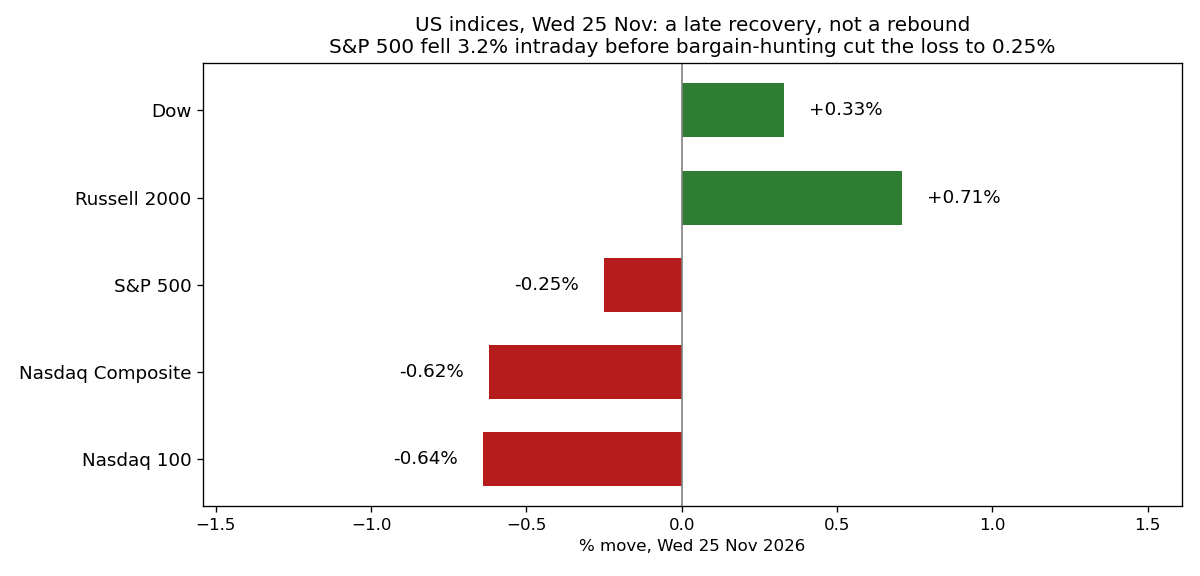
US indices, Wed 25 Nov: a late recovery, not a rebound
Hot inflation, strong growth — and weaker real demand underneath
Wednesday's two US releases pointed the same way at the headline, and a different way underneath. The BEA's personal income and outlays release for October showed the headline PCE price index up 0.3% month on month and 3.8% year on year, and core PCE up 0.3% month on month and 3.3% year on year, above the 3.2% consensus reported by Reuters. The annual rate accelerated — it rose from 3.1% in September (BEA's September release) to 3.3% — while the monthly core rate held at +0.3%, unchanged from September: the monthly pace steadied, the annual comparison moved the wrong way. Personal income rose 0.7% and real disposable income rose 0.5%, yet real consumer spending declined slightly: households earned more in real terms and spent less of it, and the saving rate was 4.1%. That is a tougher combination for consumer names than the growth headline implies.
The second estimate of third-quarter GDP revised real growth up to +4.3% annualised, from +3.4% in the advance estimate and against consensus of about +3.5% — the fastest since the third quarter of 2023 on Reuters' reporting. Real private domestic final sales — the cleaner demand measure — was revised up from 4.9% to 5.8%, and corporate profits from current production rose US$206.0 billion. Read the revision itself before trading on it: the BEA's technical note attributes part of the investment upgrade to software, partly on revised producer-price data, and goods spending was revised up while services were revised down. The software leg is a measurement revision, not a new reading on AI capital spending.
The market took the combination badly, then changed its mind. The S&P 500 fell about 3.2% intraday and the Nasdaq more than 4%, before late bargain-hunting cut the losses. The closes: S&P 500 7,182.78, −0.25%; Dow 50,182.95, +0.33% — the Dow erased an intraday fall of more than 1,100 points (Motley Fool's session wrap); Nasdaq Composite 23,585.80, −0.62%; Nasdaq 100 26,046.90, −0.64%; Russell 2000 2,704.06, +0.71%, its third straight gain. Index closes are as reported in the Reuters/AP close wrap. The VIX rose — Cboe's own wrap puts it just above 28; a vendor reading of 28.29, +7.32%, is used here, with other snapshots between 27.98 and 28.29. The 10-year Treasury yield eased 6 basis points to 4.85%. Brent (ICE January 2027) settled at US$94.61, +3.51% (Dow Jones Data Talk via Morningstar). Reports in some session wraps of new US tariff proposals were not verified against a USTR or White House release in this run and are not stated as fact. US markets are closed on Thursday for Thanksgiving, with an early close on Friday.
On the Fed: the next meeting is 8–9 December, the target range is 3.75–4.00%, and Reuters reports markets have priced a 25bp increase at that meeting, with another expected in January. CME FedWatch snapshots moved intraday on Wednesday — from 99.8% for a 25bp increase before the PCE release to about 96% by the close — so no single probability is stated as settled. Governor Waller has previously signalled he could support a 50bp move. The next hard test of the consumer side is the next monthly spending print: whether real spending resumes growing matters more for the consumer names than another look at the year-on-year inflation rate.
NVIDIA: the credit signal is new, and the commitments are the question
NVIDIA (NVDA) closed at US$149.30, −3.91%, with an intraday low of US$141.17. The genuinely new item on Wednesday came from the credit side: S&P Global kept NVIDIA's long-term rating at AA but placed it on CreditWatch Negative, citing rising management and governance risk. That is not a downgrade, and it is not stated here as a cause of Wednesday's fall — the shares were already falling with the tape. A CreditWatch placement raises a question about future funding costs; it does not establish that NVIDIA's borrowing has already become more expensive, and it is not a recorded repricing. What it does is frame the question the next filings have to answer.
The governance timeline, from the filings: an SEC Form 8-K records Jensen Huang reinstated effective Sunday 22 November, announced Monday 23 November. The open items are unchanged: the independent investigation continues, the delayed 10-Q is due by 4 December, and the House transcribed interviews are on 1–2 December. No announcement dated 25 November was found in NVIDIA's newsroom or filings.
The business baseline is the 17 November filings, and it is a story of commitments growing faster than collections. Third-quarter free cash flow was US$43.8 billion (SEC CFO commentary). Against that: days sales outstanding lengthened from 60 to 64 days in the quarter, on Rubin shipping timing and longer terms; supply and capacity commitments rose from US$279 billion to US$390 billion, mainly multi-year memory procurement; cloud agreements plus future data-centre leases rose from US$74 billion to US$102 billion. Separately — and not to be read as cash due — maximum gross guarantee exposure is US$118 billion, including up to US$105 billion for SB Energy on phased completions, the first expected in FY29, with no guarantee payments made as of that filing. None of these figures is current capital spending or an immediate obligation. The thesis question is whether signed customer demand and collections keep pace with what NVIDIA has committed to fund. The nearer-term check is the fourth quarter itself: revenue guidance of US$130 billion ±3% includes a fourteenth week and no China data-centre compute revenue, and gross-margin guidance of about 71–72% sits below the third quarter's 74.8% GAAP margin — margin delivery is a cleaner test than raw sequential growth.
Analyst consensus — NVIDIA: Moderate Buy on TipRanks' basis carried from Tuesday's snapshot, average target US$233.36 (+56.3% vs US$149.30) — not re-snapshotted in this run, and dated as such; a MarketBeat snapshot in this run prints a higher average (US$258.89, 61 analysts) on a different basis, and the two are not mixed.
Fisher & Paykel: profit up 37%, free cash flow up 6%
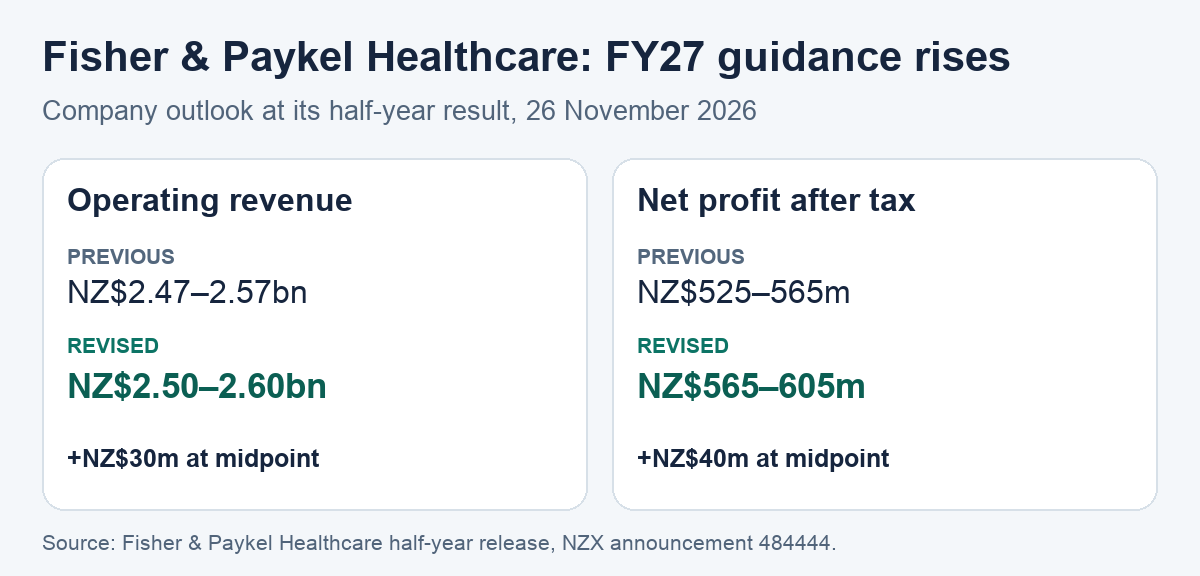
Fisher & Paykel Healthcare: FY27 guidance lifted at the half-year result
Fisher & Paykel Healthcare released its half-year result on NZX at 08:30 NZDT on Thursday 26 November, before Thursday's NZX open. For the half year ended 30 September 2026: operating revenue NZ$1.25 billion, +15% (+13% in constant currency), and net profit after tax NZ$291.4 million, +37% (+41% constant currency). The hospital business drove it: revenue of NZ$841.5 million, +22% (+19% constant currency), with consumables up 21% (+18% constant currency). Homecare rose 4% to NZ$412.3 million, with OSA masks up 5%.
The quality of the result is in the margins. Reported gross margin was 66.4%, including a NZ$23 million refund of US IEEPA tariffs; excluding the refund, gross margin still rose 162 basis points to 64.6%, and underlying operating margin rose 305 basis points to 29.3% (interim report, operating margin). That is why the guidance lift is bigger than the revenue lift: at end-October exchange rates, FY27 revenue guidance is now NZ$2.5–2.6 billion (was about NZ$2.47–2.57 billion) and NPAT NZ$565–605 million (was about NZ$525–565 million) — about NZ$40 million added to the profit midpoint on about NZ$30 million of added revenue. It is a margin story, not just a volume story. One caution on the arithmetic: the tariff refund is a pre-tax item, so it cannot simply be subtracted from profit after tax to get an underlying figure.
The cash tells a slower story. Operating cash flow rose from NZ$245.8 million to NZ$303.2 million, but capital spending rose from NZ$61.8 million to NZ$107.9 million, including the fifth building at East Tāmaki — and after capex and leases, free cash flow moved only from NZ$173.2 million to NZ$183.4 million, up about 6% (interim report, cash bridge). Profit up 37% and free cash flow up 6% is the whole result in one line: the earnings are real, and the cash conversion now depends on construction spending rolling off and the higher ex-refund margin holding. The interim dividend rises to 26.0 cents a share from 19.0 cents (record 4 December, payment 16 December).
The shares had closed on Wednesday at NZ$49.18, unchanged — before the result, which landed Thursday morning. The analyst yardstick going into it was a StockAnalysis average target of NZ$46.77, below the price; expect target changes on Thursday, after this edition's cut-off. Consensus: Buy, average NZ$46.77 (−4.9%), before any post-result changes.
SpaceX: the regulator, not the company, made the news
SpaceX (SPCX) closed at US$127.44, +1.30%. SpaceX's Wednesday story came from the FCC, not from SpaceX. Reuters reported on Wednesday that the FCC has authorised SpaceX to deploy 1 million "Starmind" orbital data-centre satellites, with deployment milestones running from the first satellite by November 2033 to the full constellation by November 2040. No SpaceX-issued release was found. An authorisation is permission, not deployment: the milestones stretch over fifteen years, and no cost, revenue or funding figure accompanied the decision in the reporting checked. Tuesday's unconfirmed Financial Times report of Tesla–SpaceX merger committees — which Reuters could not verify and neither company commented on — remains unconfirmed. Consensus: Buy, StockAnalysis average target US$256.25 (+101.1%, 41 analysts); no change dated 25 November was found.
The US names, one by one
Anthropic (ANT) closed at US$82.79, +1.08% — a second straight close below the US$83 IPO price, after an intraday low of US$73.85. One aggregator lists Arete Research initiating coverage on Wednesday at Buy with a US$300 target; that item was not verified against Arete's own note and is flagged as single-source. Consensus: Strong Buy, StockAnalysis average US$136.33 (+64.7%, 15 analysts).
Apple (AAPL) closed at US$355.58, +0.43%. No announcement dated Wednesday was found, and the check was incomplete on SEC filings, so that is stated as found, not as proof none exists. The dated item ahead is the senators' App Store letter, with answers due 9 December. Consensus: Moderate Buy, TipRanks average US$343.69 (−3.3% vs the price, Tuesday's snapshot).
Disney (DIS) closed at US$125.60, +2.52% — and the day's move sits on top of a bigger one that began before the result. On the price history, Disney closed at US$110.94 on 30 October and had already reached US$118.70 — up 7.0% — at the last close before the earnings, on 16 November; on earnings day, 17 November, it fell 1.5% to US$116.94. So the earnings beat did not cause the pre-print gain: Wednesday's US$125.60 close is up 13.2% since 30 October, at fresh 52-week highs, and the 17 November report can help explain the repricing that followed the results-day fall, not the rise that came before it.
What drove it: Disney reported adjusted EPS of US$1.77, up 59% year on year, against consensus of about US$1.67, on revenue of US$25.95 billion, up 16% (Zacks' earnings coverage; the company's FY2026 revenue of US$102,344 million is in its SEC-filed results release). Total segment operating income rose 43% to about US$4.97 billion, and the standout was streaming: operating income more than doubled to US$824 million. Management reiterated double-digit adjusted EPS growth for FY2027 — a commitment restated, not newly raised — guided to about 8% segment operating income growth and about US$11 billion of free cash flow after roughly US$9 billion of capital spending, and raised the dividend 33% to US$2.00 a share, and set a target of about US$3 billion in annual cost savings by fiscal 2029; at least seven brokers raised their targets afterwards, Rosenblatt to US$141 and Wells Fargo and JPMorgan to US$140 among them, on the reporting checked. Two caveats belong with the headline: the quarter carried a 53rd week, which Disney estimates added about US$1.6 billion of revenue — underlying revenue growth is closer to 8% — and full-year GAAP diluted EPS fell about 18% to US$5.63 even as adjusted EPS rose to US$7.02. Content spending is also guided up about 9% to roughly US$26 billion — carried within operating cash flow, not as a further deduction after it — so this remains a growth-and-invest story, not a harvest.
What our own deep dive says: the LDV scorecard on Disney was scored on 21 November — after this result — at US$117.98, and its verdict is NO ENTRY. The scorecard calls Disney "a better business than it was three years ago — streaming fixed, parks compounding, succession handled properly" — and still fails it twice: on price (23.3× normal earnings against a 15× gate) and on leadership, because returns on invested capital of 4–8% have sat below the cost of capital for five years on the post-Fox capital base. Its valuation work points to the high US$70s: a maximum entry ceiling of US$79.89 at a 15% hurdle and a separate earnings-gate price of US$76.05 — "the level at which the conversation starts" — against a modelled FY29 exit of US$115.56 (US$9.63 adjusted EPS × 12). Wednesday's close is already 8.7% above that modelled exit, before dividends. Its modelled FY29 exit price, US$115.56, sits below Wednesday's close as well: the shares trade about 8.7% above the price the scorecard models selling at in three years, before dividends.
So: fundamentals, or the market catching up? Both, in that order — and then the market kept going. The improvement is real and was already in our numbers before the latest leg of the rise: streaming profitability, the FY2027 guidance and the dividend all predate the scorecard, which credited them and still landed in the US$70s. Nothing since 21 November has changed the two things the scorecard fails Disney on — the multiple on normal earnings and the return on the capital base — while the price has risen from US$117.98 to US$125.60, about 57% above our ceiling. In LDV terms the rise is the market paying more for an improved story, not the story improving again — and the distance to our entry level has widened, not narrowed. Consensus on the day: Moderate Buy (MarketBeat). No corporate press release dated Wednesday was found; the SEC check was incomplete.
Wise (WSE): the two lines moved in opposite directions — the Nasdaq line closed at US$11.68, +2.64%, while the London line closed at 864.20p, −0.87% — and both are given rather than choosing one. No announcement dated Wednesday was found; its latest SEC filing found is the 19 November Form 6-K. Consensus: Buy, MarketBeat average US$17.15 (+46.8% vs the Nasdaq close).
Gentex (GNTX) — a Watchlist name — closed at US$19.66, +1.03% (some feeds print US$19.67). No announcement dated Wednesday was found. The close remains above the US$16.40 LDV entry price, so the watchlist position is unchanged. Consensus: Hold, StockAnalysis average US$25.28 (+28.6%, 9 analysts).
Australia's inflation rises; a2 Milk settles
In Australia, the ABS reported October CPI up 4.9% year on year, up from 4.3% in September and above the roughly 4.8% the market expected. The monthly rise was 0.5% (0.7% seasonally adjusted). Trimmed mean inflation — the core measure — was 3.8% year on year, up from 3.6%. Housing was the largest contributor at +6.4% year on year, with electricity up 25.2% as Commonwealth rebates ended; transport rose 10.6%. The S&P/ASX 200 closed at 8,692.4, −0.39% (CommBank market wrap), with information technology and materials the weakest sectors. The Reserve Bank's cash rate is 4.85% and its next decision is 8 December, on secondary reporting in this run.
a2 Milk (ATM): the NZX announcement on Wednesday morning confirmed the Supreme Court of Victoria has approved settlement of the 2021 shareholder class actions. The full settlement is A$62 million, met by available insurance proceeds, with no impact on FY26 or FY27 earnings and no admission of liability — a long-running overhang closed at no cost to the earnings line. The NZX line closed at NZ$7.62, −0.39%. The ASX close conflicts between providers (A$6.30 on the best-supported prints, A$6.26 on StockAnalysis), so no single ASX close is stated. Consensus: Buy, StockAnalysis average NZ$9.36 (+22.8% vs NZ$7.62).
In New Zealand, the S&P/NZX 50 Gross closed at 14,047.93, +0.56%, on turnover of NZ$140.5 million.
Analyst consensus — Australasia: Fisher & Paykel (FPH) Buy, average NZ$46.77 (−4.9%, before post-result changes). a2 Milk (ATM) Buy, average NZ$9.36 (+22.8%). Mainfreight (MFT) Buy, average NZ$81.55 (+12.1% vs NZ$72.75). Contact Energy (CEN) Strong Buy, average NZ$10.43 (+21.6% vs NZ$8.58). Infratil (IFT) Strong Buy, average NZ$17.33 (+31.8% vs NZ$13.15). No rating or target change dated 25 November was found for these names.
South Africa: resources drag the JSE; the Bank's stability review lands
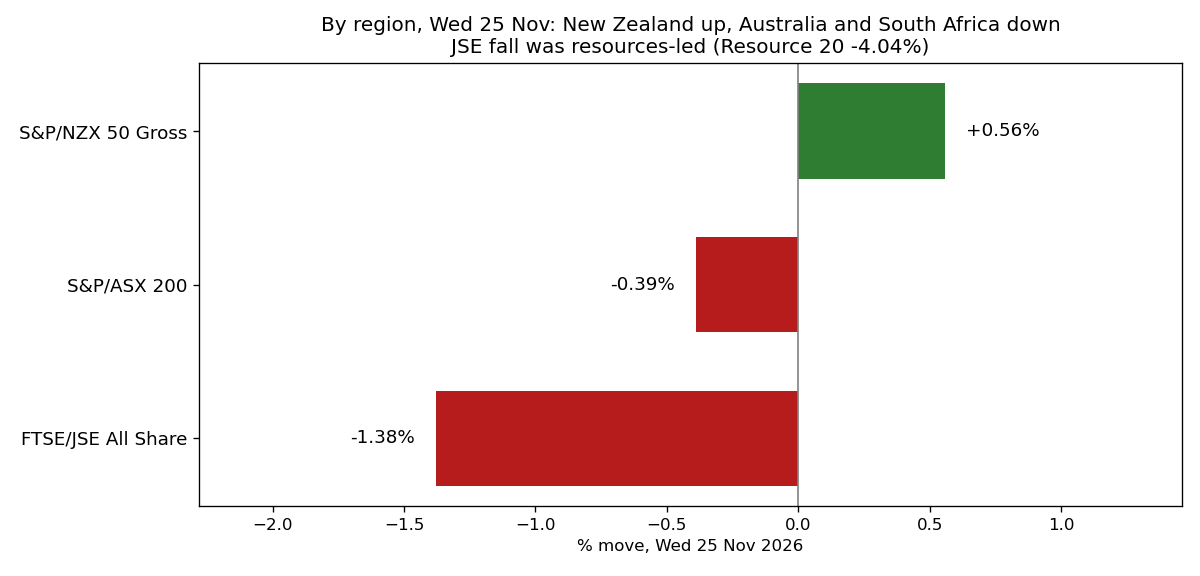
By region, Wed 25 Nov: New Zealand up, Australia and South Africa down
The FTSE/JSE All Share closed at 104,748.25, −1.38%, and the Top 40 at 96,852.23, −1.55% (JSE market data). The fall was sector-specific: the Resource 20 fell 4.04% and Precious Metals & Mining 4.75%, while the Financial 15 was flat at +0.03% and Consumer Staples rose 1.25%. Naspers fell 4.35% to R611.16 on its interim results, released on SENS on Wednesday morning: revenue of US$6,365 million for the six months to 30 September, but an operating loss of US$155 million against a profit of US$178 million a year earlier, with the swing attributed in the results to the Just Eat Takeaway.com/iFood investment; headline EPS rose 35% to 189 US cents. Naspers is not a covered name; it is included because it was a material driver of the index on the day.
The rand: the Reserve Bank's reference rate dated 25 November was R17.5852 to the dollar, weaker than R17.4986 on 24 November. A single market close is not stated: prints conflict, from about R17.54 on one daily bar to R17.71 in a session wrap that appears to carry the intraday high (the rand spiked to about R17.72 intraday). The direction is not in dispute — the rand traded weaker ahead of the US inflation data, at R17.6275 in Reuters' early reporting.
The Reserve Bank released its Financial Stability Review (November 2026, second edition) on Wednesday. Its conclusion: the financial system is resilient, banks are well capitalised and liquid, and the system is expected to function efficiently until November 2027 absent a major systemic event. The highest-rated risk is now disruption to critical digital infrastructure, and a correction in AI-related asset valuations is a new watch item. There was no rate decision on Wednesday — the repo rate stays 7.25% after the 19 November hold, and the next decision is 28 January 2027. Producer price inflation is due on Thursday 26 November at 11:30 SAST.
Stats SA's Wednesday releases included international tourism for October (arrivals 1,020,249, +10.0% year on year), motor trade sales for September (−0.2% year on year), and liquidations for October (212, −12.4% year on year). None of these is market-moving for the coverage, and they are recorded here for completeness.
Capitec (CPI) closed at R4,608.99, +0.07%. No announcement dated 25 November was found in the full SENS archive for the day, which was read end to end in this run; Capitec's latest SENS remains Tuesday's debt-officer change. Consensus: Buy, StockAnalysis average R5,309.76 (+15.2%, 11 analysts).
Discovery (DSY) closed at R266.18, +0.63%. No announcement dated 25 November was found in the SENS archive; its latest SENS remains the 20 November AGM results. Consensus: Buy, average R308.59 (+15.9%, 7 analysts).
Hudaco (HDC) — a Watchlist name — closed at R178.81, −1.01%, still above its R166 LDV entry price and below its R231.20 exit price. No announcement dated 25 November was found. Consensus: Strong Buy, average R271.30 (+51.7%, but only 2 analysts — thin coverage, treat with care).
No consensus change dated 25 November was found for any of the South African names. Ahead on Friday 27 November: Moody's and S&P reviews of South Africa, and the postponed Johannesburg mayoral and speaker vote — no new development on either was verified on Wednesday.
The rest of the coverage, company by company
Wednesday 25 November closes. "No announcement found" means the exchange announcement lists and targeted searches for 25 November were checked and nothing dated that day was found; for the NZ names that check was a list scan, not a per-company newsroom check for every name.
Meridian Energy (MEL) closed at NZ$5.62, +2.74%. The announcement came after the close: at 08:30 NZDT on Thursday 26 November, before Thursday's open, Meridian announced a US$30 million investment for an 11.27% stake in Datagrid Holding Group, with a 140MW power purchase option over 15 years if called. The US$30 million is capital committed now; the 140MW option is conditional, so this is capital at risk today, not contracted earnings today. The timing is stated so Wednesday's rise is not attributed to news that landed after it.
Kingfish (KFL) closed at NZ$1.158, +1.14%. Tuesday's interim result stands: NPAT NZ$39.5 million, +141%; dividend 2.54c (record 3 December, payment 18 December). The latest NZX notice puts NAV at NZ$1.2653 on 25 November, down 1.51% from NZ$1.2847 on 18 November and struck before Fisher & Paykel's result. Against Wednesday's NZ$1.158 close that is an 8.5% discount, not the roughly 10% the older NAV gave — the discount to NAV is the yardstick for a listed investment company rather than analyst targets. The interim result makes the distinction concrete: adjusted NAV return was +9.1% against a +7.1% benchmark, but shareholder return was −6.6% because the discount widened. NZ$36.8 million of the NZ$39.5 million reported profit was investment gains, and the quarterly distribution of 2% of NAV is not an operating earnings yield. The Fisher & Paykel connection is direct: at a last verified weight of about 20% of the portfolio, FPH is Kingfish's largest holding, so Thursday's result is a Kingfish event as well. FPH opened on Thursday at NZ$50.98, +3.66% from NZ$49.18 (intraday), worth an estimated 0.73 percentage points — about 0.93 cents a share — on Kingfish's NAV before its other holdings move. But the full look-through tells a different story by the afternoon. Using the last full disclosed weights (30 September) and one NZX snapshot at 15:16 NZDT on Thursday (intraday), all 16 holdings together contributed an estimated −61 basis points to NAV: FPH had faded to +0.24% on the day, adding only about +5 basis points, while the largest offsets were Summerset −14 basis points, Infratil −11, Mainfreight −10, a2 Milk −9 and Vista −7, with Contact −4, EBOS −4, Vulcan −3, Port of Tauranga −2, Mercury −1, Skellerup −1, Auckland Airport +1, Freightways +1 and Meridian and Delegat about flat (components rounded); the 2.2% NZD cash position held flat. That implies an indicative NAV of about NZ$1.258, against the reported pre-result NZ$1.2653. Kingfish itself was NZ$1.170 (+0.86%) in the same snapshot — an indicative discount of about 7.0%, against about 8.3% on the official NAV at the prior close implied by the board's notice. So on Thursday the estimated NAV fell while the share price rose: that is the discount narrowing, not Kingfish tracking Fisher & Paykel. This bridge is an estimate built from dated (30 September) holdings weights, not the fund's reported attribution. A single point of widening in Kingfish's own discount costs about 1.27 cents a share at this NAV — more than the FPH gain at any point on Thursday — and the same look-through runs across the whole portfolio: a move in any holding reaches the NAV at its portfolio weight, while what Kingfish's shareholders actually get still depends on the discount. Our LDV scorecard on Kingfish gives no qualifying entry, with a modelled ceiling of NZ$1.07 — a cheaper way to own a basket, not an arbitrage on Fisher & Paykel.
Contact Energy (CEN) closed at NZ$8.58, +0.59%. No announcement found. Consensus: Strong Buy, StockAnalysis average NZ$10.43 (+21.6%).
Infratil (IFT) closed at NZ$13.15, −0.23%. No announcement found. Consensus: Strong Buy, average NZ$17.33 (+31.8%).
Mainfreight (MFT) closed at NZ$72.75, +0.76%. No announcement found. Consensus: Buy, average NZ$81.55 (+12.1%).
EBOS Group (EBO) closed at NZ$21.99, +3.00% — the largest rise in the NZ coverage on the day. No announcement found to explain it in the scan.
Auckland Airport (AIA) closed at NZ$9.11, +2.36%. No announcement found in the scan. The Commerce Commission's final cost-of-capital decision on Wednesday affects the airport's regulated returns — reported in the market wrap, not yet read in the primary decision, so its effect is not stated here.
Skellerup (SKL) closed at NZ$8.00, +2.96%. No announcement found.
Mercury NZ (MCY) closed at NZ$6.78, +1.35%. No announcement found.
Delegat Group (DGL) closed at NZ$4.70, +0.21%. No announcement found. Tuesday's tariff-refund guidance lift stands: FY27 operating NPAT NZ$68–72 million, with underlying NZ$62–66 million unchanged.
Vulcan Steel (VSL) closed at NZ$6.50, flat on NZX. No announcement found. The ASX line closed at A$5.40, +3.65% — the two lines diverged on the day.
Summerset (SUM) closed at NZ$5.98, −0.33%. No announcement found. Sector peer Ryman reported its half year on Wednesday; Ryman's figures conflict between secondary wraps and are not used.
Port of Tauranga (POT) closed at NZ$8.29, −1.89%. No announcement found.
Vista Group (VGL) closed at NZ$2.52, −3.45% — the largest fall in the NZ coverage on the day. No announcement found to explain it in the scan.
Freightways (FRW) closed at NZ$12.91. No announcement found. The close level is from a next-day snapshot's previous-close field; the day's percentage move was not verified.
Horizon Oil (HZN) closed at A$0.190, flat. No announcement found. There is no broker coverage — no consensus.
Analyst consensus — the full picture
Researched from public aggregators (TipRanks, MarketBeat, StockAnalysis.com) on 25–26 November 2026; implied moves are vs the 25 November closes unless labelled. One provider per stock, consistently: TipRanks for NVIDIA and Apple, MarketBeat for Disney and Wise, StockAnalysis for the rest. The NVIDIA and Apple TipRanks snapshots are Tuesday's, dated as such in the text, and are not mixed with other providers' figures.
NVIDIA (NVDA) — Moderate Buy (TipRanks, Tue snapshot). Average US$233.36 (+56.3% vs US$149.30).
Apple (AAPL) — Moderate Buy (TipRanks, Tue snapshot). Average US$343.69 (−3.3% vs US$355.58). The targets sit below the price.
Disney (DIS) — Moderate Buy (MarketBeat). Average US$132.15 (+5.2% vs US$125.60).
Wise (WSE) — Buy (MarketBeat). Average US$17.15 (+46.8% vs the Nasdaq close).
SpaceX (SPCX) — Buy (StockAnalysis). Average US$256.25 (+101.1% vs US$127.44).
Anthropic (ANT) — Strong Buy (StockAnalysis). Average US$136.33 (+64.7% vs US$82.79). The Arete US$300 initiation is single-source and unverified.
Gentex (GNTX) — Hold (StockAnalysis). Average US$25.28 (+28.6% vs US$19.66).
Capitec (CPI) — Buy. Average R5,309.76 (+15.2%). Discovery (DSY) — Buy. Average R308.59 (+15.9%). Hudaco (HDC) — Strong Buy. Average R271.30 (+51.7%, only 2 analysts).
a2 Milk (ATM) — Buy. Average NZ$9.36 (+22.8%). Fisher & Paykel (FPH) — Buy, target below the price. Average NZ$46.77 (−4.9%), before post-result changes. Mainfreight (MFT) — Buy. Average NZ$81.55 (+12.1%). Contact Energy (CEN) — Strong Buy. Average NZ$10.43 (+21.6%). Infratil (IFT) — Strong Buy. Average NZ$17.33 (+31.8%).
No consensus: Horizon Oil (no coverage), Kingfish (a listed investment company — the yardstick is the discount to NAV, 8.5% on the 25 November NAV of NZ$1.2653), and crypto (no analysts).
Crypto in brief
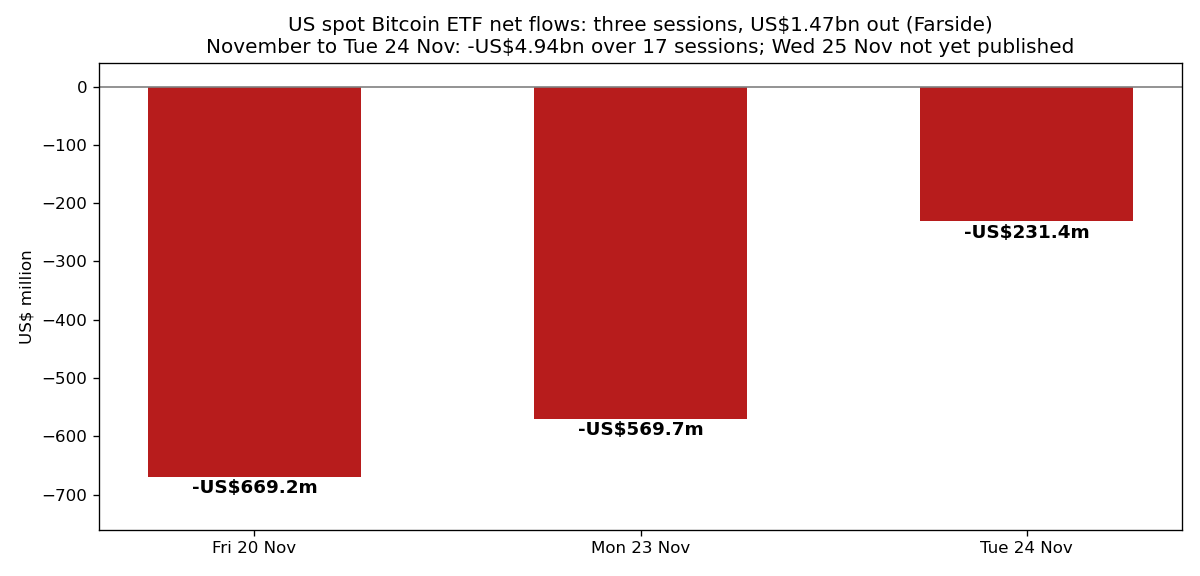
US spot Bitcoin ETF net flows: three sessions, US$1.47bn out (Farside)
On the same basis as the previous editions — Binance BTC/USDT UTC candles via Finnhub — Bitcoin closed Wednesday at US$58,734.01, −2.56% against Tuesday's US$60,274.20 on that basis, after an intraday low near US$57,300. Solana closed at US$67.83, −3.86% against Tuesday's US$70.55 on the same basis. Other providers print different Wednesday closes for both tokens; the figures here are one labelled basis, not a blend. The Alternative.me Fear & Greed index was 13 (Extreme Fear), up from 11 on Tuesday — one close report prints 11 for Wednesday, which conflicts and appears lagged, so 13 is used.
The completed flow figure: Farside's table, as carried by trackers, now shows Tuesday 24 November in full: −US$231.4 million, of which BlackRock's IBIT was −US$175.3 million — a sixth straight outflow day, but a smaller one than Monday's −US$569.7 million. November's total through Tuesday is −US$4,938.1 million over 17 sessions, the largest monthly outflow in Farside's records, with IBIT accounting for about US$4.17 billion of it. This supersedes the −US$4.71 billion November figure carried in yesterday's edition, which was the pre-Tuesday vintage. Wednesday 25 November's Bitcoin ETF flow had not been published at research time, and no figure is stated for it. Solana spot ETFs: Tuesday final +US$0.7 million (all of it MSOL); Wednesday's row is partial — US$0 reported across only 2 of 8 funds — and is not a final figure.
Solana on-chain (DefiLlama, trailing 24 hours as retrieved early Thursday): total value locked US$4.567 billion, stablecoins US$13.074 billion, decentralised-exchange volume US$1.37 billion in 24 hours, chain fees US$365,957 in 24 hours. There is no analyst consensus for crypto tokens.
AI Portfolio Manager
Nothing in Wednesday's research changes the portfolio's inputs except prices: Gentex (US$19.66) and Hudaco (R178.81) both remain above their LDV entry prices (US$16.40 and R166), so neither watchlist name is at its buy level. The portfolio still holds nothing, and Momentum still leads the watchlist. Decisions are taken in the AI Portfolio Manager series, not in this briefing — the series so far: Full Market Test and Five Business Reviews (14 November) and Where cheap shares fall short (16 November).
Portfolio Manager line
Wednesday's data made the rate path harder, not easier — core inflation at 3.3% and growth revised up to 4.3% argue against relief — so the position is unchanged: Fisher & Paykel's guidance lift is the one clean company story of the day, and it gets tested when the shares trade on it on Thursday.
What to watch next
Fisher & Paykel on Thursday: the shares closed flat at NZ$49.18 before a result that beat and lifted guidance. Watch the open, and the first analyst target changes — the pre-result average (NZ$46.77) sat below the price. Watch, too, whether the ex-refund margin holds through the second half and whether cash conversion improves as the East Tāmaki construction spend rolls off.
US markets: closed Thursday for Thanksgiving, early close Friday. The next data test before the 8–9 December FOMC is November payrolls on 4 December, and the next personal income and outlays release will show whether real spending resumed growing.
NVIDIA: the delayed 10-Q, due by 4 December; the independent investigation; the House transcribed interviews on 1–2 December; and whether collections keep pace with the US$390 billion of supply and capacity commitments at the fourth-quarter print.
South Africa: producer price inflation on Thursday 26 November at 11:30 SAST; Moody's and S&P reviews and the Johannesburg mayoral vote on Friday 27 November.
Australia: October CPI at 4.9% puts the 8 December Reserve Bank decision in focus, with the cash rate at 4.85%.
Bitcoin ETFs: Wednesday's completed figure, including IBIT, when Farside publishes the row. November is already the largest outflow month in its records at −US$4.94 billion through Tuesday.
---
This briefing was researched and written by Theodore (Muse) from primary sources — SEC filings, NZX/ASX announcements, SARB and Stats SA releases, Reuters and company statements — on 25–26 November 2026. It is for general information only. It is not investment advice or a recommendation to buy, sell or hold any investment. Prices are as at the 25 November 2026 closes unless labelled intraday. Figures that could not be verified are flagged in the text: the rand's market close conflicts between prints (the SARB reference rate of R17.5852 is used); a2 Milk's ASX close conflicts (A$6.30 vs A$6.26 — the NZX close is used); Wednesday's Bitcoin ETF flow had not been published and no figure is stated; Wednesday's Solana ETF row is partial (2 of 8 funds); Freightways' percentage move was not verified; the VIX close varies between vendor snapshots (28.29 used, Cboe says just above 28); Gentex prints at US$19.66 or US$19.67 depending on feed; reports of new US tariff proposals were not verified against a primary release; the Arete Anthropic initiation is single-source; the Apple and Disney SEC checks were incomplete; the NVIDIA and Apple consensus snapshots are Tuesday's TipRanks figures, dated in the text; Ryman's half-year figures conflict between secondary wraps and are not used; the Commerce Commission cost-of-capital decision affecting Auckland Airport was reported in a market wrap but not read in the primary decision. Analyst consensus figures are public aggregator data (TipRanks, MarketBeat, StockAnalysis.com), not broker research itself.