

Scored under the revised LDV framework, Module D (Utilities). Price: NZ$8.75, NZX close Friday 20 November 2026 (StockAnalysis price history — aggregator cross-check; NZX publishes no historical close table in a directly readable form, so the scoring price is the one decisive input not taken from a primary source, and is labelled as such wherever it matters). Accounting basis: NZ IFRS, year ended 30 June 2026 (FY2026 results announced 10 August 2026 — Contact Energy FY26 Result, NZX announcement 477524). Market capitalisation ≈ NZ$9.4bn (approximate: the share count moved after balance date on DRP/KCE issuance; the cap is used nowhere in the scoring). All figures from NZX announcements, Contact's FY2026 financial statements and results presentations, researched 24 November 2026. Sources are linked at the material claims and listed in full at the end. Not investment advice.
The company
Contact is one of New Zealand's largest generator-retailers: about 98% renewable generation in FY2026, more than 690,000 customer connections at June 2026 (716,000 by October), and a large geothermal build programme. FY2026 was the first year including Manawa Energy, acquired on 11 July 2025 — so FY2026's growth, share count (+27% on a diluted weighted basis, after Manawa consideration shares and a NZ$575m February 2026 equity raise), assets and debt are not like-for-like with FY2024–25, and this scorecard says so wherever it matters. FY2026 delivered reported EBITDAF of NZ$1,011m and statutory profit of NZ$423m (EPS 41.5c), helped by hydro inflows at 118% of mean (FY2026 results announcement, NZX 477524). Dividends declared rose to 40c (37c, 39c, 40c over three years), with 42c guided for FY2027. Leverage is comfortable for a utility — S&P-adjusted net debt/EBITDAF of 2.1× against Contact's own sub-3.0× anchor — but average ROIC was only 5.9%, and the chair changed in September 2026: Rob McDonald retired at the annual meeting and Jon Macdonald, a director since 2018, succeeded him. Mike Fuge has been CEO since February 2020.
The headline
LDV gives Contact Energy no entry price — it fails Test 1 on price, book value, the current ratio as written, and the shareholder-yield guards, and its leadership test cannot be completed. The business itself is sound and improving: no loss year in the ten to FY2026, margins expanding, guidance beaten two years running, leverage at 2.1× on the measure that matters for a utility. None of that cures the price. On normal earnings (the three-year average of underlying EPS, 34.4c — underlying because the FY2025 reported figure carries a NZ$71m Ahuroa provision release, an item the framework excludes) the shares trade at 25.4× against a 15× gate, and at 1.79× book. The shareholder-yield rule fails its own guard: dividends are real (a 4.6% cash yield at the scoring price), but the share count rose about 27% in a single year — cash reached shareholders with one hand while a quarter more shares were printed with the other. The Step 4 base case, run for information, gives a ceiling of NZ$4.51 at a 12× exit multiple — barely half the price — and even the P/E gate price (NZ$5.17) sits above it. This is a good utility at a price LDV cannot pay.
One correction to how the NZ$4.51–NZ$5.17 range should be read anywhere in this scorecard: it is a price band only, not a Watchlist band. A WATCHLIST verdict requires all three tests to pass, and Contact fails three gates that no price can cure — the shareholder-yield count guard, the current ratio (1.91×, below 2× at every price) and the leadership test. There is no price at which Contact is a WATCHLIST today; the reconciliation is set out in full under "What would have to change".
Recommendations
Buy price: none.
What it would take to buy: (1) P/E ≤ 15 on normal earnings — a price at or below NZ$5.17 on today's normal EPS of 34.4c, or normal EPS rising to at least 58.3c at NZ$8.75; (2) the P/B leg passing — price below about NZ$7.33 at 1.5× book, or the combined P/E × P/B below 22.5 (inside the NZ$4.51–NZ$5.17 band this leg already passes: at NZ$5.17 the P/B is 1.06× and the combined multiple 15.9); (3) the current ratio at or above 2 — a balance-sheet condition (1.91× in FY2026) that no price change affects; (4) the shareholder-yield rule passing in full — a three-year average total shareholder yield of at least 3.0% (the level is met today at about 4.6%) with the diluted share count falling over the three years and the payout inside FCFE: the count rose 27% in FY2026 (diluted weighted count 798.5m in FY2025 → 1,014.3m in FY2026). When a three-year window with a falling count could first clear is unknown: that single-year increase does not establish it, and the opening and closing diluted counts for earlier rolling windows have not been verified for this scorecard, so no earliest window is claimed. What any clearing window requires is a net fall — buybacks retiring more shares than DRP and every other form of issuance adds in that window. Further issuance is not an automatic bar: if net repurchases still bring the count down over the three years, the guard passes; (5) a completable leadership test — no more than 5 of 20 items unscored (12 today), at least 70% of scored items passing, and the capital-allocation floor met (three of the six capital-allocation items passing; one today): CEO shareholding and insider transactions scored from the primary NZX notices, a disclosed CEO succession path, and at least five scoreable delivery objectives; (6) on the valuation, a price at or below the NZ$4.51 base-case ceiling, or an earnings case strong enough to lift it.
Sell price: none.
Test 1 — Financial strength, Module D: FAIL
Rule | Requirement | Contact Energy | Verdict |
P/E | ≤ 15 on normal earnings (3-yr avg EPS) | Underlying EPS: FY2024 29.1c, FY2025 32.7c, FY2026 41.5c → normal EPS 34.4c → P/E 25.4× at NZ$8.75. (Reported EPS averages 37.7c — P/E 23.2× — because FY2025 includes the NZ$71m Ahuroa provision release; the framework excludes items above 10% of pre-tax profit, so underlying is used.) Gate price: NZ$5.17 | FAIL |
P/B | ≤ 1.5, or P/E × P/B < 22.5 | Book value per share NZ$4.88 (equity NZ$5,229m / 1,070.6m shares — FY2026 financial statements) → P/B 1.79×; P/E × P/B = 45.5 | FAIL |
Current ratio | ≥ 2 | 1.91× (current assets NZ$1,441m / current liabilities NZ$753m) — improved from 0.71× in FY2024 and 1.11× in FY2025, still short of 2 as written. A generator-retailer's working capital is structurally thin; recorded as written, with the trend noted | FAIL |
Debt / equity | ≤ 50% (Module D replaces this with net debt / EBITDAF: 4.0–5.0× safe, above 5.5× a flag) | As written: borrowings NZ$3,051m / equity NZ$5,229m = 58% — fail. On the Module D measure: S&P-adjusted net debt/EBITDAF 2.1× (FY2025: 2.3×), carrying net debt NZ$2,285m = 2.26× reported EBITDAF — comfortably inside the safe zone, and Contact's own anchor is below 3.0× | FAIL as written; PASS on the module measure |
Earnings record | Positive in each of the past 10 years | Statutory profit positive every year FY2017–FY2026 (NZ$151m, 132m, 345m, 125m, 187m, 182m, 127m, 235m, 331m, 423m). Note the honesty point: FY2016, one year outside the window, was a −NZ$66m loss | Pass |
Shareholder return | 3-yr avg total shareholder yield ≥ 3.0%, with the diluted share count falling and the payout inside FCFE | The rule's four conditions, in order: (1) 3-yr average TSY ≥ 3.0% — met (dividends declared 37c / 39c / 40c; about 4.6% cash yield at the scoring price); (2) TSY positive in at least 2 of 3 years including the most recent — met (dividends paid in all three years); (3) the diluted share count must have fallen over the three years — failed: the diluted weighted count rose from 798.5m (FY2025) to 1,014.3m (FY2026), +27%, on Manawa scrip and the NZ$575m raise, and there were no buybacks; (4) cumulative payout inside cumulative FCFE — not yet evidenced on the framework's cumulative basis; as a single-year indicator, FY2026 dividends paid of NZ$387m (NZ$267m cash + NZ$121m DRP) sat inside operating free cash flow of NZ$648m. The count must fall; it rose by a quarter | FAIL (guards) |
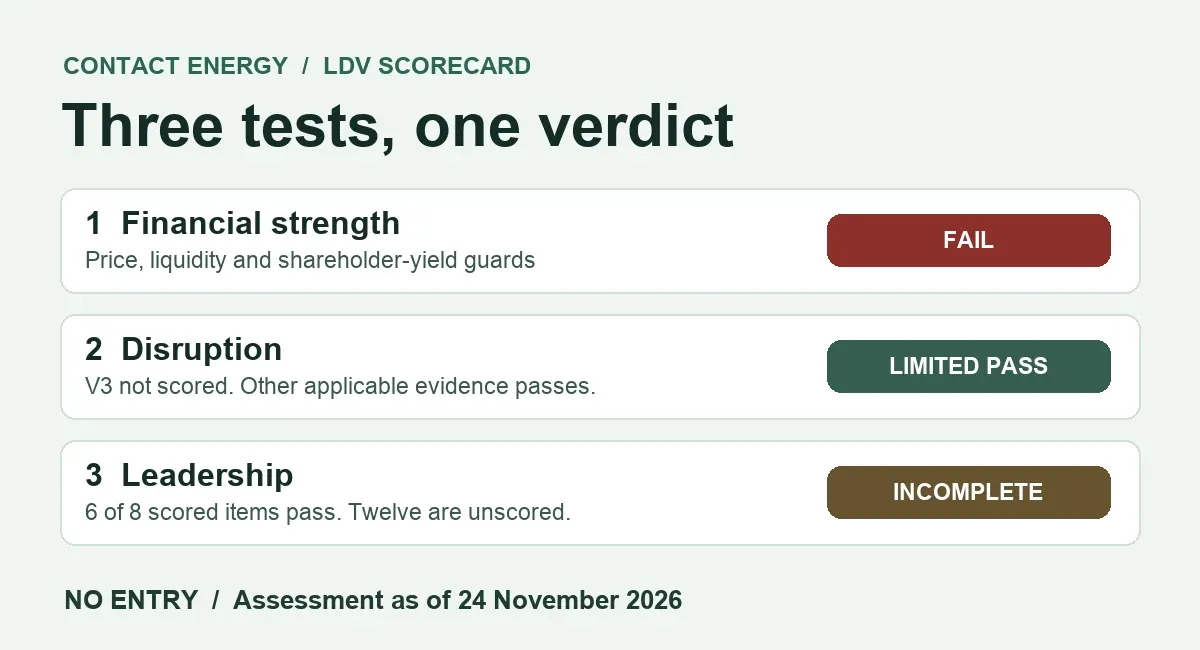
Contact Energy: three-test summary
Test 2 — Disruption, Module D: PASS, score 0.0 — with two items unscored
Veto | Rule | Contact Energy | Verdict |
V1 — Research starved | R&D below 50% of sector median for 2 years | Does not apply under Module D (utilities R&D ≈ 0.2% of revenue). Contact discloses no R&D line — recorded as undisclosed, not zero, and not scored | Not applicable |
V2 — Margin collapse | Gross-margin fall of 5 points over 3 years, or operating margin down 2 years while revenue trails the industry | The opposite: EBITDAF margin (reported, on statutory revenue) rose 23.6% → 25.4% → 31.2%; net margin 8.2% → 9.6% → 13.0%. FY2026 is flattered by 118%-of-mean hydro inflows — flagged, but there is no collapse in any direction of measurement | Not triggered |
V3 — Losing share | Revenue trailing the industry by ≥ 5 points for 2 successive years | Unscored — open enquiry. No primary-source sector revenue comparator was verified. Directional evidence points the other way (connections +50,000 in FY2026 to >690,000, and 716,000 by October 2026; generation scale up materially via Manawa and new geothermal), and statutory revenue fell 5.7% in FY2026 only because wholesale prices normalised ($157 → $140/MWh) despite the Manawa consolidation. Not scored either way | Not scored |
V4 — Concentrated customers | Top-1 above 20% of revenue, or top-5 above 40% | Not applicable to a mass-market retailer with >690,000 connections; no single-customer revenue share is disclosed. Large industrial PPAs (NZAS/Tiwai the historic example) are wholesale contracts, not retail concentration | Not applicable |
Tier 2 scored test: the capex row runs the utility way — capex well above depreciation is the model under Module D (FY2026 cash capex NZ$520m including capitalised interest, NZ$284m contracted at balance date, Te Mihi Stage 2 and batteries under construction), so no point. CEO tenure 6.7 years is below the 14-year flag. Module D's margin replacement — allowed vs actual return — does not apply: Contact is an unregulated generator-retailer, and its disclosed average ROIC (3.7% → 4.9% → 5.9%) is a leadership question, scored in Test 3, not a disruption point. Score 0.0 — pass, with V3 recorded as an open enquiry rather than assumed away.
Test 3 — Leadership: FAIL — test incomplete (12 items unscored)
Scored from the FY2026 statements, results releases and NZX announcements (sources linked at the material claims and in full at the end):
Capital allocation (1 of 3 scored): item 1 fails — average ROIC of 3.7% / 4.9% / 5.9% over FY2024–26 does not clear the top of any plausible WACC band in 4 of 5 years; the enlarged post-Manawa capital base is still earning modest returns. Item 5 fails — the share count rose, not fell, over five years. Item 6 passes — net debt/EBITDAF of 2.1× (S&P-adjusted) is at or below 3× and falling, with no distress refinancing. Items 2 (ROIIC), 3 (deal impairments) and 4 (post-deal ROIC — Manawa is under three years old and untestable) are unscored. On the items that can be scored, the capital-allocation floor of 3 of 6 is not met (1 of 3).
Ownership alignment (0 of 4 scored): all four items are unscored. The CEO's shareholding and insider transactions exist in NZX ongoing-disclosure notices (filed October 2026) but were verified only through an aggregator in this pass (≈0.005% for the CEO — which, if confirmed from the primary notices, would fail items 7 and 8 outright). Verify-or-cut: they are listed as open enquiries, not scored on an aggregator's snapshot.
Communication (3 of 3): item 11 passes (no restatement, late filing or qualified opinion found in five years — the FY2024 operating-free-cash-flow figure was restated between presentation vintages, NZ$470m to NZ$424m, which is a non-GAAP presentation change, recorded here, not a restatement of profit). Item 12 passes, provisionally — guidance was beaten in both verified years: FY2025 delivered NZ$792m on the ex-Manawa-costs basis against upgraded guidance of NZ$790m, and FY2026 delivered NZ$1,011m against guidance vintages of NZ$945–980m (part execution, part hydrology); the FY2024 vintage is unverified, so the sample is 2 of 3 years. Item 13 passes — guidance was only ever raised, never withdrawn or lowered.
Succession (1 of 3 scored): item 16 passes (CEO tenure 6.7 years, above the 5-year bar). Item 14 unscored — the chair succession was internal and pre-announced (a director since 2018 succeeding), but no CEO successor or candidate is disclosed. Item 15 unscored — the one internal promotion verified (Deputy CEO, 2020) is too dated to score.
Innovation culture (1 of 2 scored): item 18 passes — the renewal claims are backed by the numbers: 98% renewable generation in FY2026, Tauhara (174MW) and Te Huka 3 completed, Te Mihi Stage 2, Glenbrook batteries and Glorit solar in build, an 11TWh development pipeline. Item 17 unscored (no sector-median ROIIC comparator verified).
Delivery (0 of 2 scored): both items unscored — only two quantified EBITDAF objectives could be verified against their original guidance, below the framework's minimum sample of five. The two that exist were both beaten, which is recorded under item 12, not converted into a delivery score the sample cannot support.
Total: 6 of 8 scored items pass (75%), but 12 of 20 items are unscored — more than the 5 the framework allows — so the test is incomplete and cannot pass, and the capital-allocation floor is not met on the scored items. As with Capitec, Discovery and Kingfish, this is partly a disclosure verdict: Contact does not publish what the checklist needs on ownership and succession. It changes nothing today — Test 1 already fails — but it is the binding constraint if the price ever reaches the gate.
Step 4 — Valuation (run for information; the gate fails, so it does not govern)
Base case: EPS growing 5% a year from FY2026's 41.5c (in line with FY2027 normalised EBITDAF guidance of NZ$1,045m at mean hydrology — deliberately not the wet-year growth rate), dividends of 42c / 44c / 46c (42c is guided), an exit P/E of 12×, transaction costs of 0.15% at each end, and the framework's AUD currency stress of −1% a year applied as the NZD proxy (flagged — the framework specifies rand and AUD only). Year-3 EPS is 48.0c.
Exit P/E | Exit price | Ceiling price (clearing 15%) |
10× | NZ$4.80 | NZ$3.90 |
12× (base) | NZ$5.76 | NZ$4.51 |
14× | NZ$6.73 | NZ$5.12 |
16× | NZ$7.69 | NZ$5.73 |
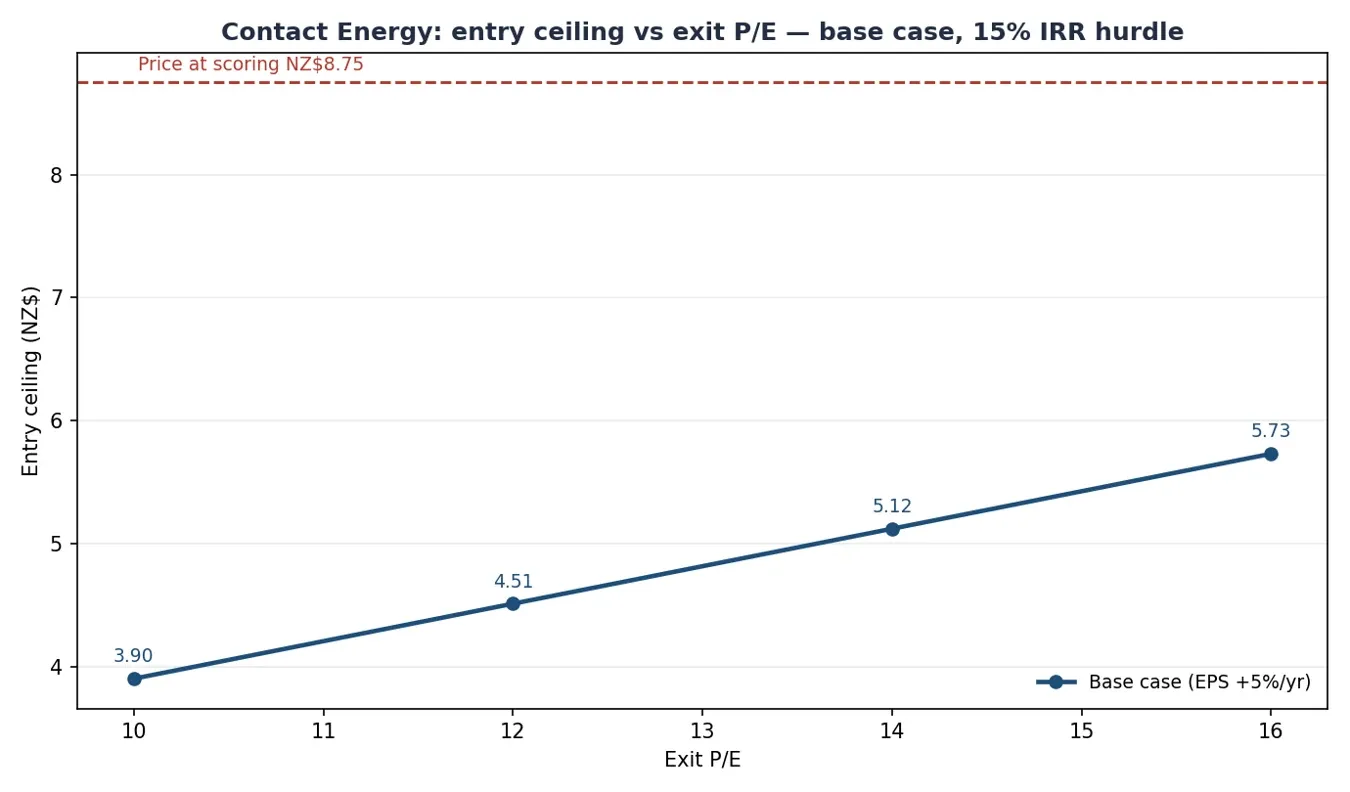
Contact Energy: entry ceiling vs exit P/E — base case, 15% IRR hurdle
At NZ$8.75 the base case returns about −7.7% a year. Even a 16× exit — a multiple Contact has not earned on through-cycle earnings — leaves the ceiling at NZ$5.73, a third below the price. Note also that the ceiling sits below the Test 1 gate price of NZ$5.17 at the base multiple: on these earnings, passing the P/E gate would still not make Contact a buy.
What would have to change
Price — the band, reconciled with the gates: at or below NZ$5.17 the P/E gate passes on today's normal earnings; at or below NZ$4.51 the base case clears 15%. An earlier draft of this scorecard said that between the two, Contact "would be a WATCHLIST, not a buy" — that sentence was wrong and is cut. A WATCHLIST verdict requires all three tests to pass, and Contact fails the shareholder-yield guard, the current-ratio gate and the leadership test at any price, because none of those failures is price-dependent: a lower price does not reduce the share count, does not disclose a succession plan, and does not change the balance sheet — the current ratio stays at 1.91×, below 2×, at every price. The verdict by price zone, on today's gate evidence: above NZ$5.17 — NO ENTRY. NZ$4.51–NZ$5.17 — still NO ENTRY (the P/E and P/B legs pass; the current ratio is still 1.91×, and the yield guard and the leadership test still fail). At or below NZ$4.51 — still NO ENTRY until every gate passes, including a current ratio of at least 2, which no price in any zone delivers; then WATCHLIST above the ceiling, or a buy at or below it. There is no price at which Contact is a WATCHLIST today, and NZ$4.51–NZ$5.17 is a price band only.
Earnings: normal EPS of 58.3c (from 34.4c) would pass the P/E gate at NZ$8.75 — that requires the Manawa earnings and the build programme to land without further equity issuance diluting them away.
What clears each failing gate
Shareholder yield (Test 1): the rule's four conditions are: a three-year average total shareholder yield of at least 3.0%; TSY positive in at least 2 of 3 years including the most recent; the diluted share count fallen over the three years; and the cumulative payout inside cumulative FCFE (FCFE positive in aggregate after any net-debt increase). Today's position: conditions 1–2 are met (dividends of about 4.6% at NZ$8.75, paid in all three years); condition 3 is failed (798.5m → 1,014.3m, +27%); condition 4 is not yet evidenced on the cumulative basis. When the gate could first clear is unknown. The FY2025→FY2026 increase (798.5m → 1,014.3m) shows the current three-year window fails; it does not show that FY2027–FY2029 is the earliest window that could pass, because the opening and closing diluted counts for earlier rolling windows have not been verified here and the net repurchases those windows would require have therefore not been computed — so no earliest window is stated. What a clearing window requires, whenever it occurs: the diluted count lower at the end of the three years than at the start, i.e. buybacks retiring more than DRP issuance (13.9m shares in FY2026) plus everything else issued in the window, and the cumulative payout evidenced inside cumulative FCFE. Issuance inside the window is not an automatic bar — a raise or scrip issue offset by larger repurchases still leaves a falling net count, and the guard tests the net count, not the existence of issuance.
Leadership (Test 3): the test passes only when three conditions hold at once — no more than 5 of 20 items unscored; at least 70% of scored items passing; and the capital-allocation floor met (three of the six capital-allocation items passing). Today: 12 unscored; 6 of 8 scored items pass (75%, so the rate condition is met on scored items); capital allocation has one passing item of three scored. What clears it, itemised: items 7–10 scored from the primary NZX ongoing-disclosure notices (filed October 2026) — with the sensitivity stated plainly: if the aggregator's ≈0.005% CEO holding is confirmed from those notices, items 7 and 8 fail and the scored pass rate falls to 6 of 10 (60%), below the bar, so scoring the notices could move the test further from passing, not closer; item 14 — a named successor or two named candidates with at least three years' tenure (not disclosed); item 15 — an evidenced internal promotion to the executive team within three years (the 2020 Deputy CEO promotion is too dated); items 19–20 — at least five quantified objectives and three long-range commitments verified against first-published guidance (two verified today). The floor is met via two of items 2, 3 and 4 passing once they are scoreable (item 4 is not scoreable until Manawa is three years old, in July 2028), or items 1 and 5 turning — item 1 needs average ROIC above the top of the WACC band in at least four of five years (5.9% clears no plausible top of band), and item 5 needs the diluted count down over five years.
Remaining Test 1 legs: the P/B leg clears at or below about NZ$7.33 (1.5 × book value per share of NZ$4.88), so it is not binding inside the band; the current ratio is a balance-sheet condition (current assets / current liabilities of at least 2; FY2026 1.91×) that no price change affects; leverage already passes on the Module D measure (2.1×).
The revisit trigger: H1 FY2027 (February 2027) — the first half on a clean post-Manawa base, and the first reading on whether FY2026's wet-year margins hold at mean hydrology.
Verdict
NO ENTRY. Contact Energy fails Test 1 — P/E 25.4× on normal earnings against a 15× gate, P/B 1.79× with a combined multiple of 45.5, a current ratio of 1.91× as written, and a shareholder-yield rule whose share-count guard was overwhelmed by a 27% issuance year — while passing the Module D leverage measure (2.1×) and the ten-year earnings record comfortably. Its disruption test passes at 0.0 with the sector-share veto unscored, and its leadership test is incomplete: 12 items unscored, the capital-allocation floor unmet, against a genuinely good guidance record. The valuation, run for information, puts the ceiling at NZ$4.51 — about half the NZ$8.75 price. A sound, well-run utility; the wrong price, and a disclosure file too thin to complete the leadership test.
Buy price: none.
What it would take to buy: price at or below NZ$5.17 (P/E gate) and ultimately NZ$4.51 (base-case ceiling), or normal EPS at 58.3c; the P/B leg (it clears below about NZ$7.33, and inside the band); a current ratio of at least 2; the shareholder-yield rule passing in full — timing unknown: a three-year window in which the diluted count falls on a net basis, with buybacks retiring more than DRP and all other issuance adds (issuance alone is not a bar if the net count still falls); and a completable leadership test — no more than 5 items unscored, and the capital-allocation floor met.
Sell price: none.
Analyst consensus for reference (not part of LDV): average price target NZ$10.43 from 5 analysts ("Strong Buy" label, StockAnalysis); one aggregator's EPS series (February 2026 vintage, pre-FY2026 results) put FY2027–29 EPS at NZ$0.47 / 0.49 / 0.51 — the consensus series is inconsistent across aggregators and is recorded as colour only. Sources: Contact Energy FY2026 results announcement and presentation (NZX, 10 August 2026), FY2026 financial statements (Companies Office), FY2025 and FY2024 results releases, chair-succession announcement (NZX, 1 May 2026), CEO appointment announcement (NZX, 17 January 2020), October 2026 operating report. Computed figures (normal EPS, P/E, P/B, current ratio, margins, ceiling and IRR) are arithmetic from filing figures.
Sources
Contact Energy FY2026 results announcement (NZX) — EBITDAF, profit, Manawa completion, connections, FY2027 guidance
Contact Energy FY2026 results presentation (filed with announcement 477524) — FY2027 guidance detail, average ROIC, S&P-adjusted leverage, historic performance table
Contact Energy October 2026 operating report (ASX mirror) — October connections of 716,000 (read via the ASX-announcement mirror, not the NZX page)
Contact Energy price history (StockAnalysis) — NZ$8.75 close, Friday 20 November 2026 (aggregator cross-check; see the header flag)
Contact Energy FY2026 financial statements (Companies Office) — EPS, share count, balance sheet, dividends paid
Contact Energy FY2025 results announcement (NZX) — FY2025 figures, Ahuroa provision release
Chair succession announcement (NZX, 1 May 2026) — McDonald retirement, Macdonald succession
LDV Investing Framework research data — not investment advice. This scorecard is research being developed and tested under the LDV Investing Framework. It is not investment advice, not a recommendation to buy or sell any security, and not personal financial advice. The entry and exit prices are the framework's mechanical outputs — the ceiling at which the base case clears a 15% annual IRR hurdle, and year-3 EPS × exit P/E — not price targets or advice. Do your own research, and consider seeking advice from a licensed financial adviser before making any investment decision.