

Scored under the revised LDV framework, Module A applied with the schedule's standing note: Infratil is an infrastructure investor, externally managed by Morrison & Co, not an operating business — where a ratio has no meaning for an investor, this scorecard says so rather than forcing a number, as with Kingfish (23 November 2026). Price: NZ$12.70, NZX close Monday 23 November 2026 — the latest close before scoring, standardised throughout this scorecard (the Friday 20 November close was NZ$13.27, superseded; price history: StockAnalysis NZX: IFT, verified against NZX price history 25 November 2026). Accounting basis: NZ IFRS, year ended 31 March 2026 (FY2026), plus the H1 FY2027 interim result (half year ended 30 September 2026), which had landed — released 18 November 2026 (NZDT) — and is used. Net asset value per share: NZ$17.94 at 30 September 2026 (post-fees, company-published, HY27 results presentation) — a discount of 29.2% at the scoring price. All figures from NZX announcements, the FY2026 annual report and detailed financial information, and the HY27 interim report and presentation, researched 24 November 2026. Sources are linked at the relevant figures and listed in full at the end. Not investment advice.
The company
Infratil owns a portfolio of infrastructure assets, managed day-to-day by Morrison & Co under a long-term management agreement: at 30 September 2026 the portfolio was worth NZ$22,266m, and it is now, in substance, a CDC Data Centres vehicle with satellites — CDC alone is 51.0% of portfolio value (NZ$11,348m, up from 43.3% in six months on revaluation), followed by One NZ (15.2%), Longroad Energy (10.6%), Wellington Airport (4.8%) and Kao Data (4.0%); the top five are 85.5%. The operating story is strong: HY27 proportionate operational EBITDAF rose 28% to NZ$711m, FY2027 guidance was raised for the second time since May (to NZ$1,370–1,440m), and CDC's guidance was raised three times in 2026. The accounting story is violent in both directions: HY27 produced a net parent loss of NZ$248m because CDC's valuation rise triggered a NZ$256m incentive-fee provision to Morrison; FY2025 lost NZ$294.8m (restated) largely on a NZ$346.9m incentive-fee accrual; FY2026 made NZ$549.8m, of which NZ$280.2m came from discontinued operations. NAV per share has compounded NZ$13.03 → NZ$15.48 → NZ$16.26 → NZ$17.94 across FY2024 to HY27 — but the share count rose about 20% in two and a half years on two large equity raises (NZ$935m at NZ$9.20 in 2023; NZ$1,275m at NZ$10.15 in 2024) plus DRP and fee scrip, and cash fees to Morrison in FY2026 were NZ$244.8m (management NZ$122.8m + incentive NZ$122.0m).
The headline
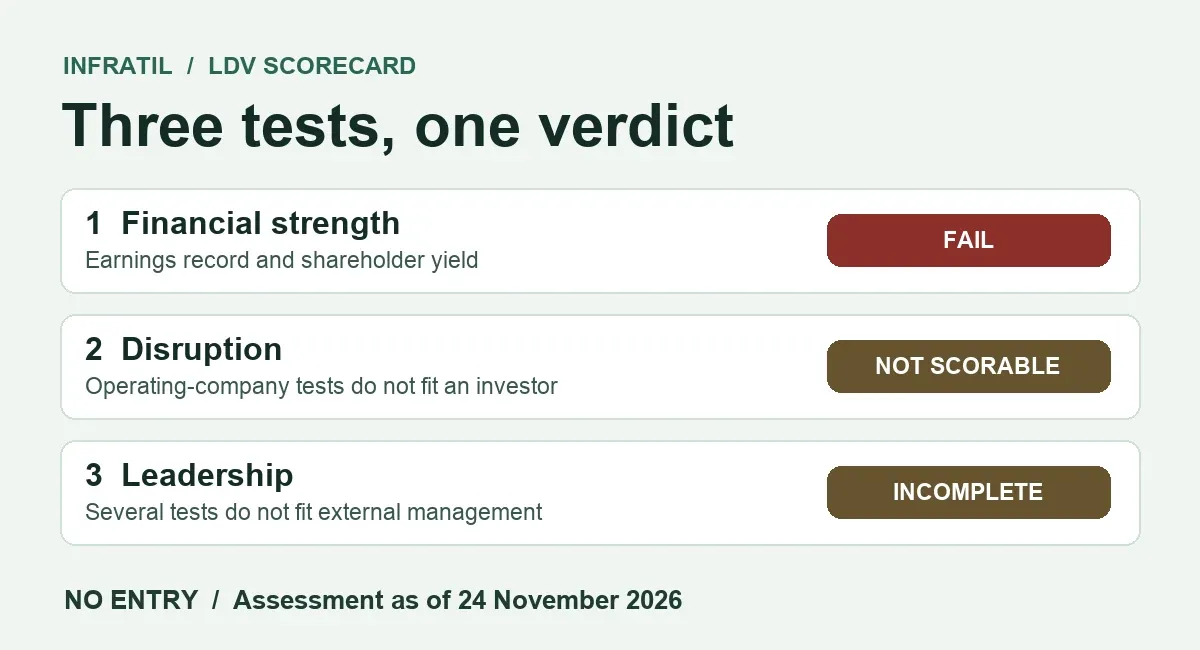
LDV gives Infratil no entry price — it fails Test 1 on the earnings record and the shareholder-yield rule, its disruption test cannot be scored as written for an externally managed investor, and its leadership test cannot be completed. The earnings record is decisive on the verified primary record: loss years in FY2021 (−NZ$49.2m) and FY2025 (−NZ$294.8m), and a loss half just reported in HY27 — an investor whose reported earnings are revaluations and fee accruals cannot pass a ten-year positive-earnings rule, and FY2017–19 could not be verified from primary sources at all, so no cleaner record can be asserted. The shareholder-yield rule fails on level and guards: the FY2026 dividend of 20.9c is a 1.65% yield, there is no verified buyback execution in FY2025–HY27 despite a standing programme, and the share count is up 20%, not down. On the NAV variant this scorecard runs for information (the Kingfish treatment), the base case gives a ceiling of NZ$11.18 — below the NZ$12.70 price: the 29.2% discount to NAV is wide, but the fee load (a NZ$1,226.8m present value of the management agreement is deducted in arriving at that NAV) and a 51% single-asset concentration argue it is not obviously mispriced. Brokers, valuing off the same NAV, have targets of NZ$17.50–18.00; LDV's three-year, 15%-hurdle arithmetic cannot get there.
Recommendations
Buy price: none.
What it would take to buy: (1) a framework investor protocol (decision for James, as with Kingfish's LIC protocol) scoring investors on NAV total return, discount discipline, net share-count change and fee load instead of industrial earnings rows — on the current rules the earnings record cannot heal before FY2021 and FY2025 leave the ten-year window in the 2030s; (2) the shareholder-yield guards passing — a three-year average yield of at least 3.0% (1.65% today) with the share count falling, which needs buybacks actually executed at a discount exceeding DRP, fee-scrip and any new raises; (3) a completable leadership test — a named succession path for the Morrison mandate and a run of accounts without restated comparatives; (4) on the NAV variant, a price at or below NZ$11.18, equivalently a discount of about 38% to the current NZ$17.94 NAV at an unchanged NAV; (5) concentration addressed — CDC at or below about 40% of portfolio value, or the discount widening to compensate for a single-asset portfolio.
Sell price: none.
Test 1 — Financial strength, Module A applied to an investor: FAIL
Rule | Requirement | Infratil | Verdict |
P/E | ≤ 15 on normal earnings (3-yr avg EPS) | Not meaningful, and recorded as such. EPS: FY2025 −31.5c, FY2026 +55.8c (only +27.4c from continuing operations), HY27 −24.8c. A three-year average of revaluation-and-fee-driven EPS describes the valuation cycle, not earning power. No P/E is scored | Not meaningful |
P/B | ≤ 1.5, or P/E × P/B < 22.5 | The investor analogue is price/NAV: NZ$12.70 / NZ$17.94 = 0.71× — the one leg where the vehicle is genuinely cheap, as with Kingfish | Pass (on NAV) |
Current ratio | ≥ 2 | Not meaningful for a holding company whose assets are portfolio investments and whose parent loan-to-value is 14.2% — recorded, not forced | Not meaningful |
Debt / equity | ≤ 50% | Not meaningful on consolidated accounts (asset-level debt sits inside CDC, One NZ and others). Parent level: net debt NZ$3,058.7m against NZ$22,266m of portfolio assets — LTV 14.2%, liquidity about NZ$1.4bn, S&P BBB+ (stable). Leverage at the parent is modest; at CDC it is about 9.4× net debt/EBITDAF on the company's run-rate metric — flagged, not scored here | Not meaningful (parent LTV noted) |
Earnings record | Positive in each of the past 10 years | Verified loss years: FY2021 (−NZ$49.2m) and FY2025 (−NZ$294.8m, restated); HY27 was also a loss half (−NZ$247.8m). FY2017–FY2019 parent figures could not be verified from primary sources in this pass — listed as open enquiries, and no clean record is asserted. Two verified losses inside the window are enough | FAIL |
Shareholder return | 3-yr avg total shareholder yield ≥ 3.0%, with the diluted share count falling and the payout inside FCFE | Dividends declared 20.0c / 20.50c / 20.9c — a 1.65% yield at the scoring price, below the 3.0% floor. Buybacks: a programme is authorised and renewed annually, but no execution was found in the FY2025–HY27 cash flows — not credited. The share count rose from 832.6m (March 2024) to 1,002.1m (September 2026), +20.4%, on the 2023 and 2024 raises, DRP at a 2% discount and Morrison fee scrip (NZ$80m of shares in May 2025). Every guard points the wrong way | FAIL |
Infratil: three-test summary
Test 2 — Disruption: NOT SCORABLE as written — recorded as a framework finding
Veto | Rule | Infratil | Verdict |
V1 / V1D | R&D starved / supplier franchise lost | An investor has no R&D. The analogue risk is single-manager dependence: the entire portfolio is one Morrison team, and the manager is also the fee counterparty. No manager-loss event has occurred; the dependence is total and structural | Not applicable |
V2 — Margin collapse | Gross-margin fall of 5 points over 3 years | No gross margin exists. The cost analogue is the fee load, and it is moving the wrong way: cash fees paid rose NZ$189.0m (FY2024) → NZ$216.1m (FY2025) → NZ$244.8m (FY2026), against NZ$336.8m of distributions received from portfolio companies in FY2026 — fees consumed about 73% of wholly-owned distributions received. Recorded as the investor's margin problem; no industrial score is manufactured | Not applicable — fee load flagged |
V3 — Losing share | Revenue trailing industry by ≥ 5 points for 2 years | The analogue is portfolio operational performance vs plan: HY27 proportionate operational EBITDAF +28%, FY2027 guidance raised twice since May 2026, CDC guidance raised three times in 2026. One pocket moved the other way — Longroad's independent valuation was cut US$455m (−11.3%) at September 2026, and Qscan's guidance was cut (it is for sale). On the analogue, not triggered | Not triggered (analogue) |
V4 — Concentrated customers | Top-1 above 20% of revenue, or top-5 above 40% | No customers. The portfolio analogue is stark: top-1 holding (CDC) 51.0% of portfolio value, top-3 76.7%, top-5 85.5% — far beyond the levels that would veto an operating company, and rising (CDC was 43.3% six months earlier). Concentration is the strategy, disclosed and deliberate, and CDC's own revenue is over 90% investment-grade counterparties on 28.7-year weighted leases — but a framework investor protocol would have to decide what concentration limit, if any, replaces V4. Recorded, not scored | Not applicable — concentration flagged |
As with Kingfish, no Tier 2 score is manufactured from rows that do not describe an investor's economics. Test 2 is recorded as not scorable for an externally managed investor — and the two risks that are real (manager dependence, and a portfolio that is now majority one asset) are named here rather than hidden inside a pass.
Test 3 — Leadership: FAIL — test incomplete for an externally managed vehicle
Infratil's executives are Morrison personnel: CEO Jason Boyes (a Morrison partner, in role since 1 April 2021), chair Alison Gerry (director since 2014). Scored as far as the disclosure allows:
Capital allocation (the manager's, in substance): the portfolio record is genuinely two-sided. Asset IRRs are company-stated and strong where it matters most (CDC 37.1% since 2016; Longroad 39.3%; Wellington Airport 17.4% since 1998) and poor where it does not (RetireAustralia 0.1% over 11 years, realised; Galileo 7.0%). The checklist's ROIC/ROIIC items have no investor analogue computable from the accounts (items 1–2 unscored). Item 5 fails — the share count rose 20% in two and a half years; the raises were at NZ$9.20 and NZ$10.15, below today's price and below NAV, which softens the dilution judgement but does not change the item as written. Item 6 passes at parent level (LTV 14.2%, liquidity NZ$1.4bn, BBB+). Items 3–4 are not applicable at vehicle level (no acquisitions by the vehicle itself; the portfolio deals are the manager's, judged above).
Ownership alignment: items 7–10 unscored — the CEO is a Morrison partner whose economics sit in the partnership and the fee stream, not in a disclosed Infratil shareholding that this pass could verify. The alignment instrument that does exist is the incentive fee itself: a 12% p.a. hurdle on non-NZ assets only, paid over three instalments that shrink if valuations fall — a genuinely performance-linked structure the checklist has no row for, and one whose cost is now the single largest line in the accounts (NZ$346.9m earned in FY2025; NZ$256m provided in HY27).
Communication: item 11 fails as written — comparatives have been restated in three successive reporting cycles (FY2025 parent loss restated from −NZ$286.3m to −NZ$294.8m; HY26 parent surplus restated from NZ$605.7m to NZ$572.8m; FY2024 restated in the detailed series). These are discontinued-operations reclassifications following the Manawa transaction, not errors or qualifications, and disclosure around them is full — but the item says "no restatement", and there have been restatements. Items 12–13: guidance has been raised, not withdrawn (item 13 passes); a consistent-basis three-year guidance-error series could not be reconstructed (item 12 unscored — FY2024 beat guidance, FY2027 has been raised twice).
Succession: items 14–16 substantially unscored — Boyes's tenure is 5.6 years (item 16 passes), but succession for the mandate is a Morrison partnership question with no named successor in any primary source. For a vehicle whose entire management is one external firm, that is the central governance open enquiry.
Innovation culture and delivery: items 17–20 unscored at vehicle level — the "innovation" is the portfolio's (CDC's 1.1GW contracted capacity, 810MW under construction), not the vehicle's, and the delivery record that can be checked (guidance) is credited under communication.
Total: fewer than half the items can be scored, so the test is incomplete and cannot pass. As with Kingfish, this is recorded as a framework finding: the checklist was built for operating companies with their own executives, and an externally managed investor strands it in the same places.
Step 4 — Valuation (NAV variant, run for information; the gate fails, so it does not govern)
The framework's EPS model has no meaning here — year-3 EPS is whatever CDC's valuers and the incentive-fee accrual do in FY2029. This scorecard therefore runs the investor variant, labelled as such: NAV per share of NZ$17.94 (30 September 2026, post-fees) growing at 10% a year in the base case (below the FY2024–HY27 pace of about 13% a year, and at the low end of Infratil's own 11–15% target range), an exit at the same 29.2% discount to NAV, dividends of about NZ$0.67 over three years at the current ~21c rate growing slowly, the framework's AUD stress of −1% a year as the NZD proxy (flagged), and costs of 0.15% at each end.
NAV growth | Year-3 NAV | Exit price (at 29.2% discount) | Ceiling price (clearing 15%) | IRR at NZ$12.70 |
6% a year | NZ$21.37 | NZ$15.13 | NZ$10.05 | — |
8% a year | NZ$22.60 | NZ$16.00 | NZ$10.60 | — |
10% a year (base) | NZ$23.88 | NZ$16.91 | NZ$11.18 | 10.2% |
12% a year | NZ$25.20 | NZ$17.84 | NZ$11.78 | 12.1% |
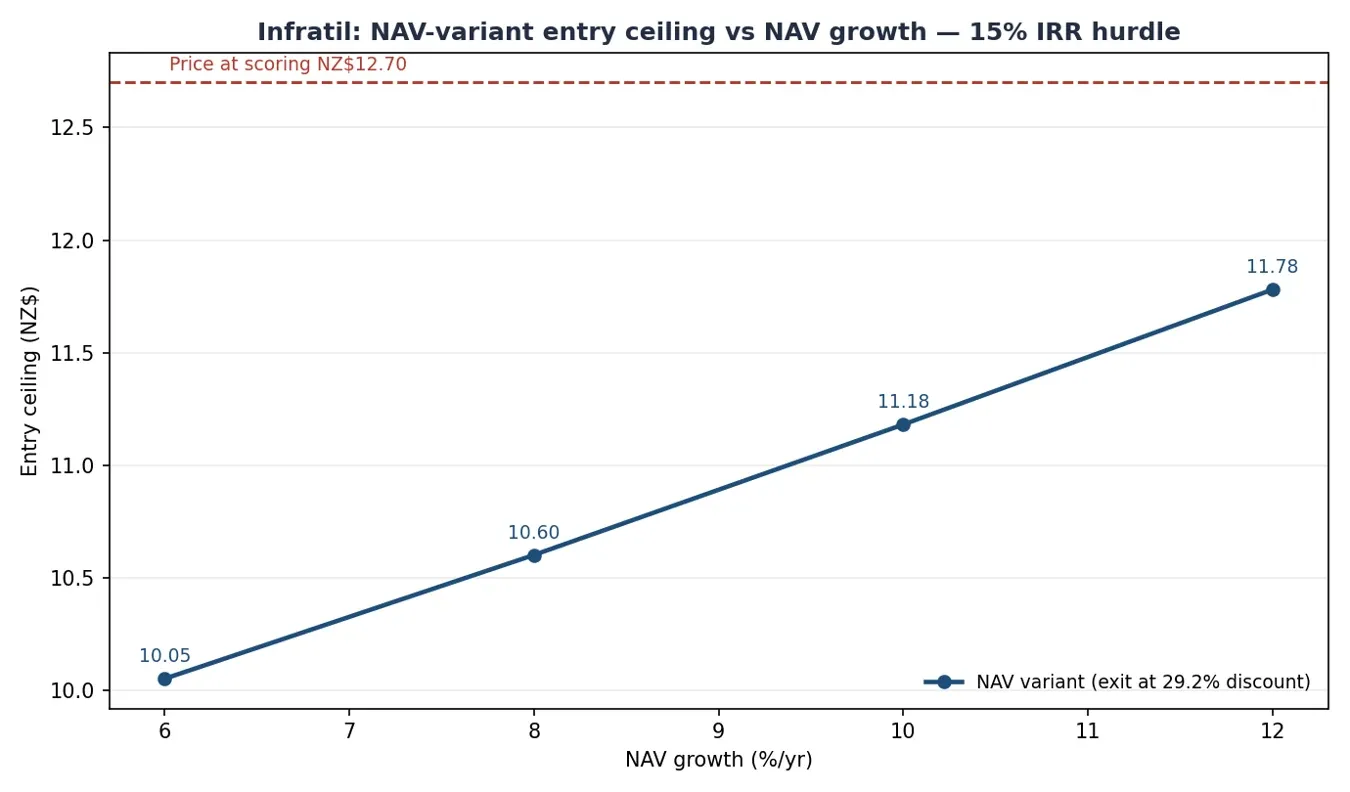
Infratil: NAV-variant entry ceiling vs NAV growth — 15% IRR hurdle
Even at 12% NAV growth — above the low end of the company's own target range, sustained for three years — the ceiling is NZ$11.78, below the NZ$12.70 price. The discount would need to widen to about 38% at today's NAV, or NAV growth would need to run well above the target range, for LDV's arithmetic to engage. The brokers' NZ$17.50–18.00 targets are, in effect, a bet that the discount closes toward NAV; LDV does not pay for discount closure in advance.
What would have to change
A framework investor protocol (decision for James): the same decision Kingfish raised, now with a second, larger case behind it — score investors on NAV total return vs their target, discount discipline, net share-count change and fee load. Infratil would score well on the first, poorly on the third and fourth. Until that protocol exists, Tests 1–3 can say little about this vehicle beyond the earnings record, and this scorecard does not pretend otherwise.
The discount trigger: a price at or below NZ$11.18 — about a 38% discount to the September NAV — is the NAV-variant ceiling. The scoring price, the 23 November close of NZ$12.70, sits above it.
The fee question: incentive fees earned of NZ$346.9m in a loss year (FY2025) and a NZ$256m provision in a loss half (HY27) are the mechanism by which CDC's success leaves the parent accounts — watch whether the FY2027 year-end valuation confirms the HY27 provision, and whether fee reform (the PwC benchmarking of August 2026 called the structure more complex than peers) follows.
Concentration: CDC above half the portfolio and rising is the risk the next scorecard checks first — any CDC valuation reversal now moves NAV, the incentive fee and the share price together.
Verdict
NO ENTRY. Infratil fails the ten-year earnings record on verified primary figures (loss years FY2021 and FY2025, and a loss half just reported), fails the shareholder-yield rule on level (1.65%), on buybacks (authorised, not executed) and on the share-count guard (+20% in two and a half years), has a disruption test that cannot be scored as written — with a 51% single-asset concentration recorded in its place — and a leadership test that cannot be completed for an externally managed vehicle whose comparatives have been restated three cycles running. The NAV variant says the 29.2% discount is wide but not, after the fee load and concentration, a clear mispricing: the base-case ceiling is NZ$11.18 against a NZ$12.70 price. The underlying portfolio, CDC above all, may be excellent. The vehicle, at this price and under this framework, does not clear the bar.
Buy price: none.
What it would take to buy: an investor protocol adopted, or on the current rules: the earnings window healed (the 2030s on the current record), a 3.0% shareholder yield with a falling share count, a completable leadership test, and a price at or below NZ$11.18 (a discount of about 38% at today's NAV).
Sell price: none.
---
Analyst consensus for reference (not part of LDV): Morgans upgraded to Buy after HY27 with an A$13.80 target; Forsyth Barr cut its target to NZ$17.50 post-HY27 (from NZ$18.00); TipRanks' ASX average is A$13.38. Consensus EPS coverage is 1–2 analysts and is not quoted. Sources: Infratil HY27 interim results, presentation and interim report (NZX, 18 November 2026, NZDT); FY2026 annual report, results announcement and detailed financial information; Infratil management and incentive fees explainer (September 2024); PwC management-fee benchmarking (August 2026); Notices of Meeting 2024–2026. Computed figures (discount, concentration, TSY, ceiling and IRR) are arithmetic from filing figures; sources are linked at the relevant figures and in the Sources list below.
Sources
Infratil interim results release, period ended 30 September 2026 — issuer's release, dated 18 November 2026; HY27 EBITDAF, parent loss, incentive-fee provision, guidance raise
Infratil FY27 interim results presentation — NAV source: net portfolio asset value (post management fees) of NZ$17.94 per share at 30 September 2026 (net portfolio assets NZ$17,980.6m = portfolio assets NZ$22,266.1m less wholly-owned group net debt NZ$3,058.7m less NZ$1,226.8m present value of the management agreement; 1,002.1m shares on issue)
Infratil interim results, period ended 30 September 2026 (NZX) — NZX announcement of the same release
Infratil FY2026 full-year results (NZX) — FY2026 parent surplus, dividends, portfolio
Infratil FY26 Detailed Financial Information — EPS, share count, fees paid, NAV history, restated comparatives
StockAnalysis — NZX: IFT price history — NZ$12.70 close, Monday 23 November 2026 (verified against NZX price history, 25 November 2026)
> LDV Investing Framework research data — not investment advice. This scorecard is research being developed and tested under the LDV Investing Framework. It is not investment advice, not a recommendation to buy or sell any security, and not personal financial advice. The entry and exit prices are the framework's mechanical outputs — the ceiling at which the base case clears a 15% annual IRR hurdle, and year-3 EPS × exit P/E — not price targets or advice. Do your own research, and consider seeking advice from a licensed financial adviser before making any investment decision.