

TL;DR: Airbnb's updated Terms of Service (dated 5 February 2026) require hosts under its main terms — including US hosts — to carry their own primary liability insurance for guest stays. AirCover for Hosts still exists and still helps: up to US$3 million in host damage protection and US$1 million in host liability insurance per eligible stay. But the damage protection is not an insurance policy, the liability cover has real exclusions, and neither replaces your own short-term rental policy. If you don't have primary liability cover for paying guests, getting it is now a term of hosting.
The change most hosts missed
While everyone was arguing about house rules and checkout chores, Airbnb quietly changed the insurance deal. In its updated Terms of Service, dated 5 February 2026, Airbnb added a new section — Section 5.7, "Your Insurance Obligations" — that didn't exist in the previous version. The old terms already made hosts responsible for appropriate insurance. What's new is the explicit requirement for primary liability cover.
For hosts covered by Airbnb's main Terms of Service, including those in the US, it says you agree to obtain and maintain, at your own expense, primary insurance covering your liability — and that of any employees or agents working for you — for third-party bodily injury and property damage arising from a guest's stay.
"Primary" is the word that matters. Primary insurance is cover that can respond without waiting for another policy to be exhausted. Which insurer actually pays first depends on the policies, especially if you have six or more active listings.
One timing detail worth knowing: the updated terms took effect on 5 February 2026 for new accounts, but existing hosts had to accept them starting 20 April 2026 to keep using the platform. So if you've been hosting for a while, this already applies to you. Also note this is the position under Airbnb's main Terms of Service — the same obligation is in §5.7 of the Australian terms and §5.6 of the European terms. Check the version for your country of residence or establishment.
Book my Airbnb services
What AirCover actually is
AirCover for Hosts is still included free on eligible Airbnb home stays, and it's still worth having. But the two protections we're looking at share a name, and they work very differently. Confusing them is how hosts get caught out.
Host damage protection — up to $3 million per stay. This covers damage a guest causes to your home or belongings during an Airbnb stay — the broken TV, the stained sofa, the hole in the wall. But here's the part most hosts don't know: it is not an insurance policy. It's a contractual reimbursement promise from Airbnb. In Washington state, Airbnb buys an insurance policy to secure that promise; Japan has a separate programme. It usually pays depreciated value, not replacement cost, and it excludes wear and tear, most stained linens and most consumables. And it only applies to stays booked through Airbnb.
It also has strict clocks, which I covered in my earlier article on damage claims: ask the guest to pay via the Resolution Center within 14 days of checkout, and file the formal payment request with your evidence within 30 days. Airbnb's Help Centre also says to involve Support and send documentation within 14 days of the damage or loss. Miss a deadline and Airbnb may decline reimbursement. Since the April 2026 terms update, your evidence must be original and unaltered — including not AI-enhanced or AI-altered.
Host liability insurance — up to $1 million per stay. This one is real insurance, underwritten by third-party insurers. It covers your legal liability if a guest is hurt, or their belongings are damaged or stolen, during a stay — plus investigation and defence costs where the claim applies.
But it has gaps that matter. It only covers stays booked through Airbnb, from check-in to checkout. It excludes things that genuinely happen at rentals, including assault or battery by the insured, mould and communicable disease. There are vehicle and watercraft exclusions, with exceptions such as a docked boat used as the accommodation. Hosts with six or more active listings face a carve-out in the programme — since March 2025, the liability cover may share costs with your own insurance or sit on top of it as excess, depending on your policy wording. And Airbnb notes in the US the programme can be written by a non-admitted insurer, without state guaranty-fund protection.
What AirCover isn't
Let me put it bluntly, because this is the sentence that could save you thousands:
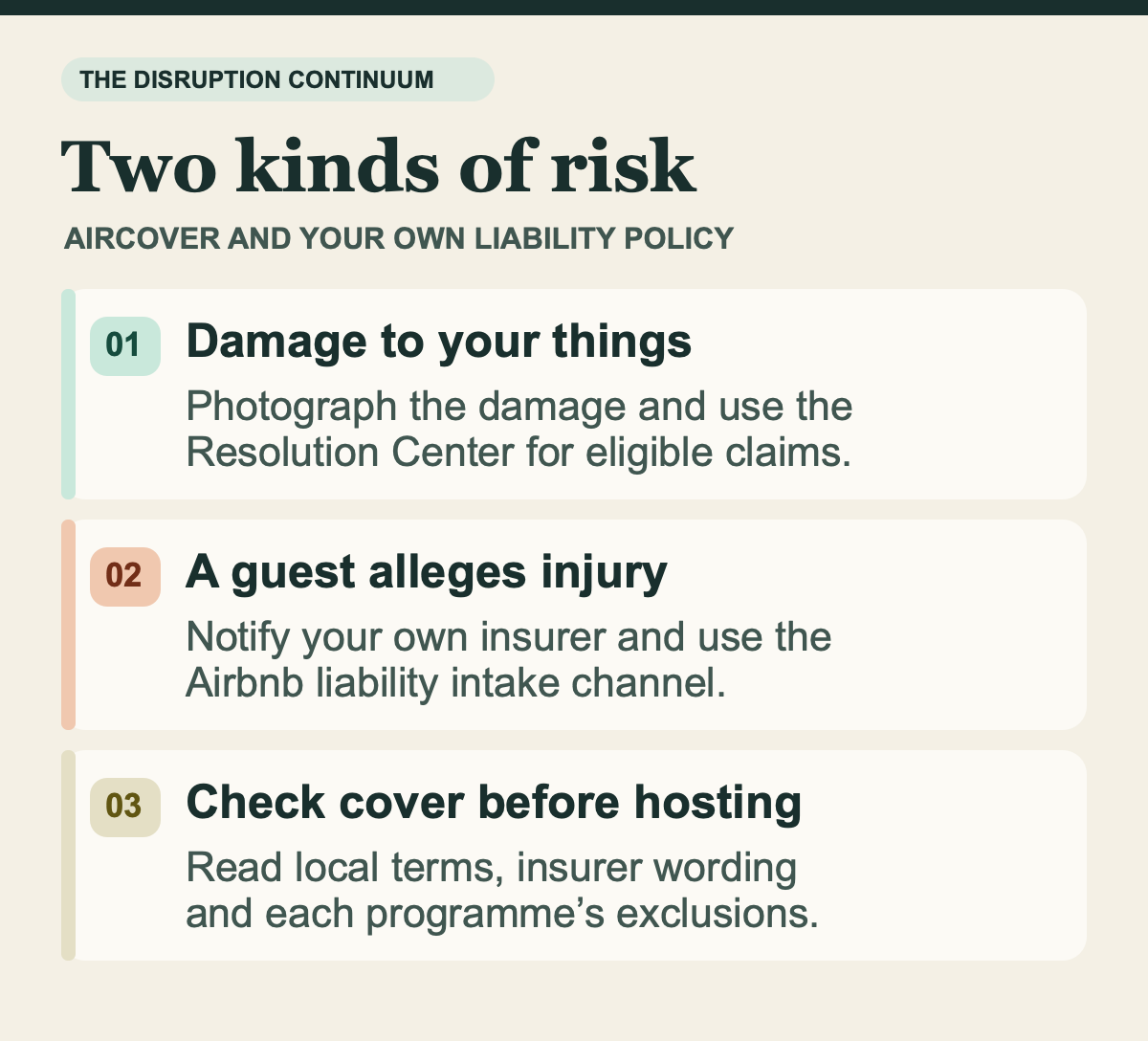
- AirCover is not a substitute for your own insurance. Airbnb says so itself, and suggests you ask your insurer whether your policy overlaps with it.
- Host damage protection is not an insurance policy at all. It's a reimbursement programme with its own rules, deadlines and exclusions.
- AirCover only covers Airbnb bookings. A guest who books you direct, or through another platform, has no AirCover behind them. Ask whether your own policy covers direct bookings and your other platforms.
- AirCover isn't general cover for your building, belongings or lost income. Eligible guest damage and confirmed Airbnb bookings lost because that damage makes the place uninhabitable can qualify. If a burst pipe floods the flat between guests, that's your problem, not Airbnb's.
I used to think of AirCover as my insurance. It isn't. It's a useful backstop for guest-caused damage on Airbnb bookings — and a liability cushion with holes in it. The main event is your own policy.
What a proper policy looks like
I'm not an insurance broker, and this isn't advice on which policy to buy — talk to a broker who actually understands short-term rentals, because a standard homeowner's policy often excludes paying guests entirely, and finding that out after a claim is the worst possible time to learn it. When you're shopping, check that the policy:
- It covers short-term rental activity explicitly. Not "guests", not "lodgers" — short-term paying guests, by name, in the policy wording.
- It includes liability cover for guest injury and property damage. This is the part Airbnb's terms now require you to carry as primary cover.
- It covers your building and contents for the risks AirCover doesn't — fire, flood, storm, theft between stays, and the things that happen when no guest is there.
- It covers loss of income if damage takes the listing offline for weeks.
- Check how it interacts with AirCover. Ask your broker directly: if a guest damages something, which policy responds first, and does claiming on one affect the other? Get the answer in writing.
What to do this week
- Check your current policy. Read it — actually read it — and find the clause about paying guests or short-term letting. If it excludes them, or doesn't mention them, you may effectively be uninsured right now.
- Get a short-term rental quote from a broker who does this every day. Compare what it covers against what AirCover covers and look at the gaps, not just the premium.
- Tell your insurer about Airbnb. If you haven't disclosed that you host, do it now. Non-disclosure is the classic reason claims get refused.
- File your policy details somewhere you can find them. If a guest is ever hurt, you'll need the policy number, the insurer and the claims line in a hurry.
- Keep your AirCover evidence habits sharp anyway. Photograph the changeover, keep receipts, and know the 14-day and 30-day clocks.
The bottom line
Airbnb changed the deal in February 2026: your own primary liability insurance is now an explicit term of hosting. AirCover isn't a plan on its own. The $3 million damage protection and $1 million liability cover are real and useful, but the damage side isn't insurance, the liability side has exclusions, and neither covers a direct booking or a burst pipe on a Tuesday with no guest in the house. Get a proper short-term rental policy, disclose your hosting, and treat AirCover as a backstop, not the foundation of your insurance plan.
Sources
- Airbnb Resource Center, "How AirCover for Hosts works" — https://www.airbnb.com/resources/hosting-homes/a/how-aircover-for-hosts-works-469 ($1 million host liability insurance; $3 million host damage protection)
- Airbnb, Terms of Service — https://www.airbnb.com/help/article/2908 — and the May 2025 archive: https://www.airbnb.com/help/article/2857
- Airbnb, terms update and effective dates — https://www.airbnb.com/help/article/2877
- Airbnb, Host Liability Insurance Program Summary — https://www.airbnb.com/help/article/3145
- Airbnb, Host damage protection and Terms — https://www.airbnb.com/help/article/279 and https://www.airbnb.com/help/article/2869
- Safely, "Airbnb Liability Insurance: What the New Host Rules Mean" — https://safely.com/articles/airbnb-liability-insurance-requirements/ (Section 5.7, "Your Insurance Obligations"; 5 February 2026 terms; existing hosts from 20 April 2026; six-or-more-listings carve-out)
- Milepost Insurance, "Short-Term Rental Insurance: What Airbnb and Vrbo Require" — https://www.milepostinsurance.com/articles/short-term-rental-insurance.html (Section 5.7 wording; AirCover not a substitute for personal insurance)
This is a host's practical guide, not legal advice. Insurance terms vary by country, insurer and policy — read your own policy and Airbnb's Terms of Service for your region, and speak to a qualified insurance broker before you rely on any cover. Airbnb's Help Centre is the final word on AirCover.