

By James Hinton — 19 November 2026
TL;DR: Airbnb starts reviewing listings against the new house rules policy on 20 November 2026, with initial reviews running through March 2027, then ongoing. If a rule on your listing does not meet the policy, Airbnb tells you by email and in the app, and you get at least 20 days to update it or appeal. You can only appeal once, so get your evidence together before you submit.
Nobody likes being told their listing is wrong. But the part of Airbnb's November changes that most hosts have not read properly is not the new rules themselves — it is what happens when Airbnb decides one of your rules breaks them.
There is a process, there is a clock, and there is an appeal. Knowing how it works before you get the email is the difference between a quick fix and a guest-facing notice on your listing.
This is not legal advice, and Airbnb's Help Centre is the final word. But here is what Airbnb itself has published, in plain language, and what I would do about it.
Book my Airbnb services
The review window: 20 November 2026 to March 2027
Airbnb set this out in its Resource Center article, "Important changes to house rules", published 20 October 2026 and updated 3 November 2026:
The first reviews start when the policy takes effect, on 20 November 2026. Airbnb plans to continue that initial round through March 2027, then to keep reviewing listings.
A few things to note about that:
- The policy applies to reservations booked on or after 20 November 2026. That is the booking date, not the stay date. A guest who booked on 19 November for a stay in February is under the old rules. A guest who books on 20 November for a stay next weekend is under the new ones.
- The reviews are about your additional rules — the ones you write yourself for your home, beyond the seven standard house rules (maximum overnight guests, quiet hours, events, pets, smoking, commercial photography, and lock up at checkout). Airbnb says it will also provide tips in the Listing editor for adjusting rules that do not follow the policy.
- The first reviews do not all happen on 20 November. They are spread out over four months, so you may not hear anything until January or February. That is not a reason to wait: fix the listing now, and the review is a non-event.
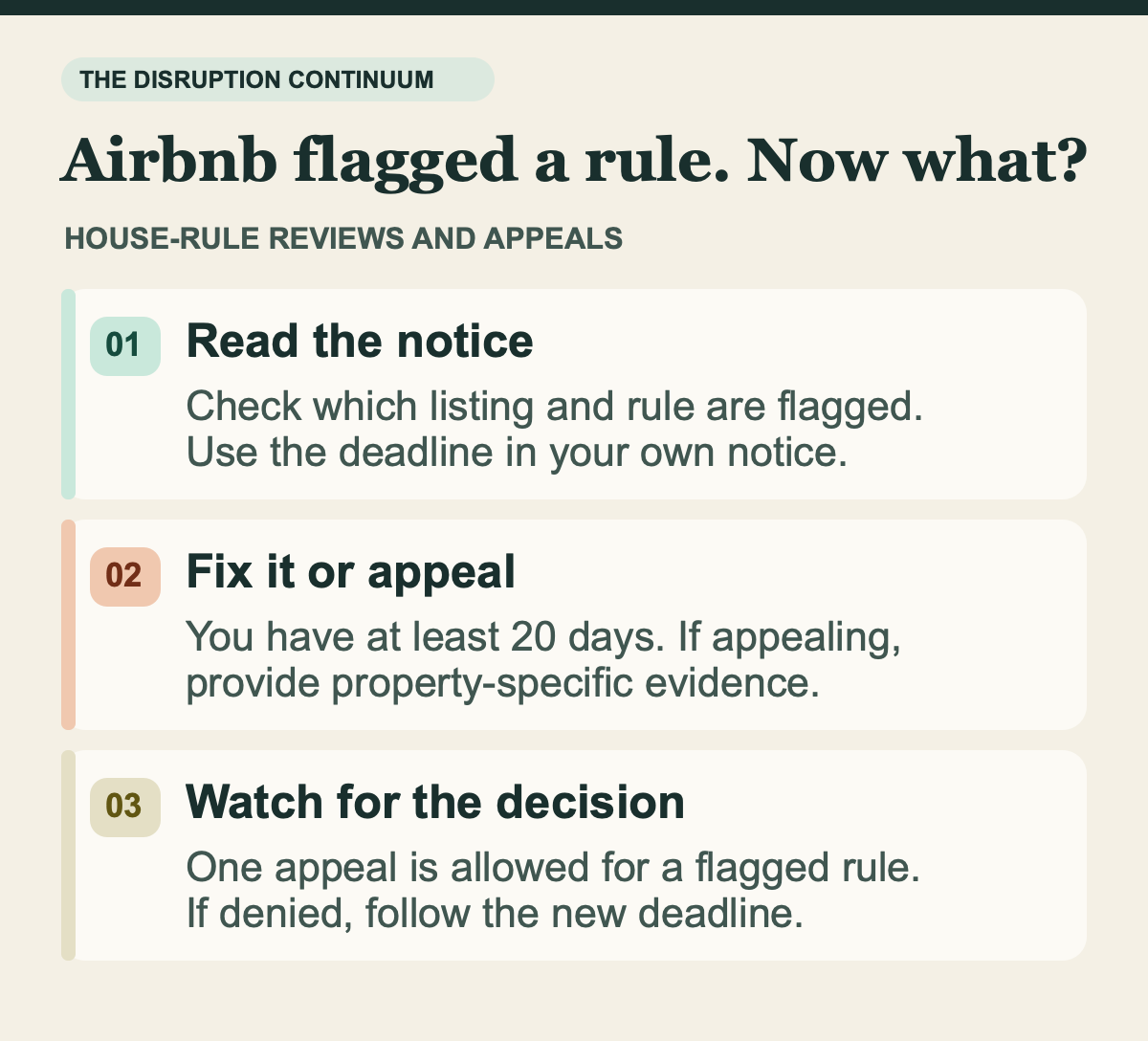
What happens when a rule is flagged
If you have additional rules on your listing that do not meet the new policy, Airbnb says it will let you know by email and in the app. You will have at least 20 days to update them or appeal and explain why a particular rule is needed for your home.
That "at least" matters. Twenty days is the minimum, not a promise that the deadline is exactly twenty days. Read the email properly: it will carry your actual deadline. But do not plan around getting more time than that.
Airbnb judges whether an additional rule is reasonable by considering the type of listing and other relevant factors, including local laws, and it says it may grant exceptions based on your situation. Its own examples: it may be reasonable to ask guests to limit shower time because of drought-related water restrictions, or to dispose of rubbish in an animal-proof container in bear country. A rule that looks unreasonable in the abstract can be reasonable in context — but you have to make that case.
The appeal: four steps, one shot
If you believe an additional rule is reasonable because your listing or location has specific needs, you can submit an appeal. Airbnb's Resource Center sets out the steps:
- Open the appeal. Select the Submit an appeal link in the email Airbnb sent you, or tap the Required action card in the Listing editor.
- Write a statement explaining your situation in detail. This is what Airbnb's team reads when considering your appeal, so be specific about why the rule is needed for your home.
- Upload supporting photos or files — for example, a local ordinance or a homeowners association rule.
- Review everything before you tap Submit — because you can only submit your appeal once.
That last step is the one to take seriously. One appeal, one submission. If you send it with a one-line explanation and no evidence, you do not get a second go with the full file. Gather your proof first, write the statement properly, then submit.
Here’s what Airbnb’s four examples have in common, in plain language:
- In a co-op’s shared kitchen, the person who uses a dish also washes it.
- A month-long stay spans bin collections. If nobody puts the bins out on collection day, waste builds up.
- Bears frequent the area, and the nearest bear-proof bin is at the end of the street. That’s why guests are asked to take rubbish there.
- The building’s own rules require every occupant to register at reception.
Notice what those have in common: a specific local fact, not a general preference. "I prefer it this way" is not an appeal. "The building's written rule requires it, here is the document" is.
Airbnb says it will review your appeal and let you know if your additional rule is approved. If it is not approved, it will email you with a deadline to update or remove it. If you decide to keep the unapproved rule, guests may see a notice on your listing page.
What if you ignore it?
The consequences escalate, and they are different depending on which policy is involved.
Under the house rules policy (Help Centre article 4168), if a rule does not meet the requirements, Airbnb says it may educate you, ask you to update your listing page, and issue warnings. If a violation persists, it may result in a notice on the listing page flagging the issue to guests, reduced listing visibility in search, or other action under Airbnb's Terms of Service.
Under the contracts and personal data policy (Help Centre article 4169), if Airbnb determines you violated it, it says it will take appropriate action, including educating you, issuing warnings, suspending or removing listings, or suspending or removing your account for repeat offences.
One thing to be clear about: the 20-day window and the appeal process described above are the process Airbnb published for its house rules reviews. The Help Centre policy pages themselves do not spell out a 20-day appeal window for contract or personal data violations — those are dealt with under the enforcement wording above. So do not assume a flagged rental agreement or a WiFi portal gets the same 20 days and one appeal. Fix those now, on your own timetable, rather than waiting for Airbnb to start the clock.
What I would do now
As reviews get underway from 20 November, work through this in order:
- ☐ Audit your additional rules today. Open the Listing editor and read every additional rule as if you were a guest seeing it for the first time. Anything that asks guests to do a cleaner's job, pay a fine, sign something, or hand over personal information needs to go — unless it genuinely fits an exception.
- ☐ Fix the easy ones first. Most flagged rules will be simple rewrites: dishes in the sink instead of washed and put away, towels gathered instead of laundry started, rubbish sorted into indoor bins instead of taken off-site. Do those now rather than waiting for a flag.
- ☐ For any rule you think is justified by local context, gather the evidence now. The HOA document, the local ordinance, the building rule, the drought restriction notice. Keep it in a folder, ready to upload. An appeal with evidence attached is a different conversation from an appeal with none.
- ☐ Watch your email and the app from 20 November onwards. Reviews run through March 2027, so a flag could arrive at any point in that initial review period or during ongoing reviews. Check the email address Airbnb uses for your host account, and do not let a notice sit unread.
- ☐ If you are flagged, read the deadline in the email and act on it. You have at least 20 days to update or appeal. Use the first few days to decide which: if the rule is not defensible, rewrite it and move on; if it is defensible, build the appeal with your evidence and submit it once, properly.
- ☐ Do not keep an unapproved rule and hope guests will not notice. If Airbnb denies your appeal and you keep the rule, guests may see a notice on your listing page. Guests can see that warning before they book. Is keeping the rule worth that?
The review process is not a trap. Airbnb is giving hosts months of runway, tips in the editor, a minimum of 20 days to act, and an appeal with a real chance if the local facts support you. The hosts who will have a bad time are the ones who do nothing until the email arrives — and then try to appeal a rule they cannot justify, with no evidence, in one shot.
Sources
Airbnb Resource Center, "Important changes to house rules" (20 October 2026, updated 3 November 2026) — https://www.airbnb.com/resources/hosting-homes/a/important-changes-to-house-rules-21 — review timeline, 20-day window, and appeal steps.
Airbnb Help Centre, "Reasonable house rules", article 4168 — https://www.airbnb.com/help/article/4168 — policy scope and enforcement.
Airbnb Help Centre, "Limiting host-imposed contracts and other requirements", article 4169 — https://www.airbnb.com/help/article/4169 — enforcement for contract and personal data violations.
All three apply to reservations booked on or after 20 November 2026.