

TL;DR: For reservations booked on or after 20 November 2026, you cannot fine a guest. A fee is a price the guest sees before booking, in the price breakdown. A charge that only appears because a guest broke a rule is a fine — and fines are banned. Damage goes through AirCover and the Resolution Center, not through a penalty clause in your house rules.
I used to have a fine in my house rules. It was a neat little deterrent: a set amount if a guest smoked inside, another if they brought extra people. It felt like common sense — put a price on bad behaviour and people behave.
Airbnb has now made it simple: no fines. No penalties, no charges for breaking a rule, no matter how reasonable the amount looks. And once I worked through what replaces them, I realised the fine was doing less work than I thought — and creating more risk than I admitted.
Book my Airbnb services
The fee vs fine test
The distinction is the whole article, so here it is plainly:
- A fee is set before booking and shown in the price the guest sees. Airbnb's pricing policy says hosts must disclose all mandatory fees — utility fees, extra guest fees, pet fees, resort fees, management fees, HOA fees — in the appropriate fee field, or include them in the nightly price if there's no field for them. The guest agrees to the fee when they book. A pet fee is a fee. An extra-guest fee, disclosed upfront, is a fee.
- A fine is a charge that only gets triggered because a guest broke a rule. "$200 if you smoke inside." "$50 per extra guest found at the property." Even if the amount was written in the listing, the guest only pays it for breaking the rule. That's a penalty, and Airbnb's house rules policy now says hosts may not impose fines or other penalties on guests.
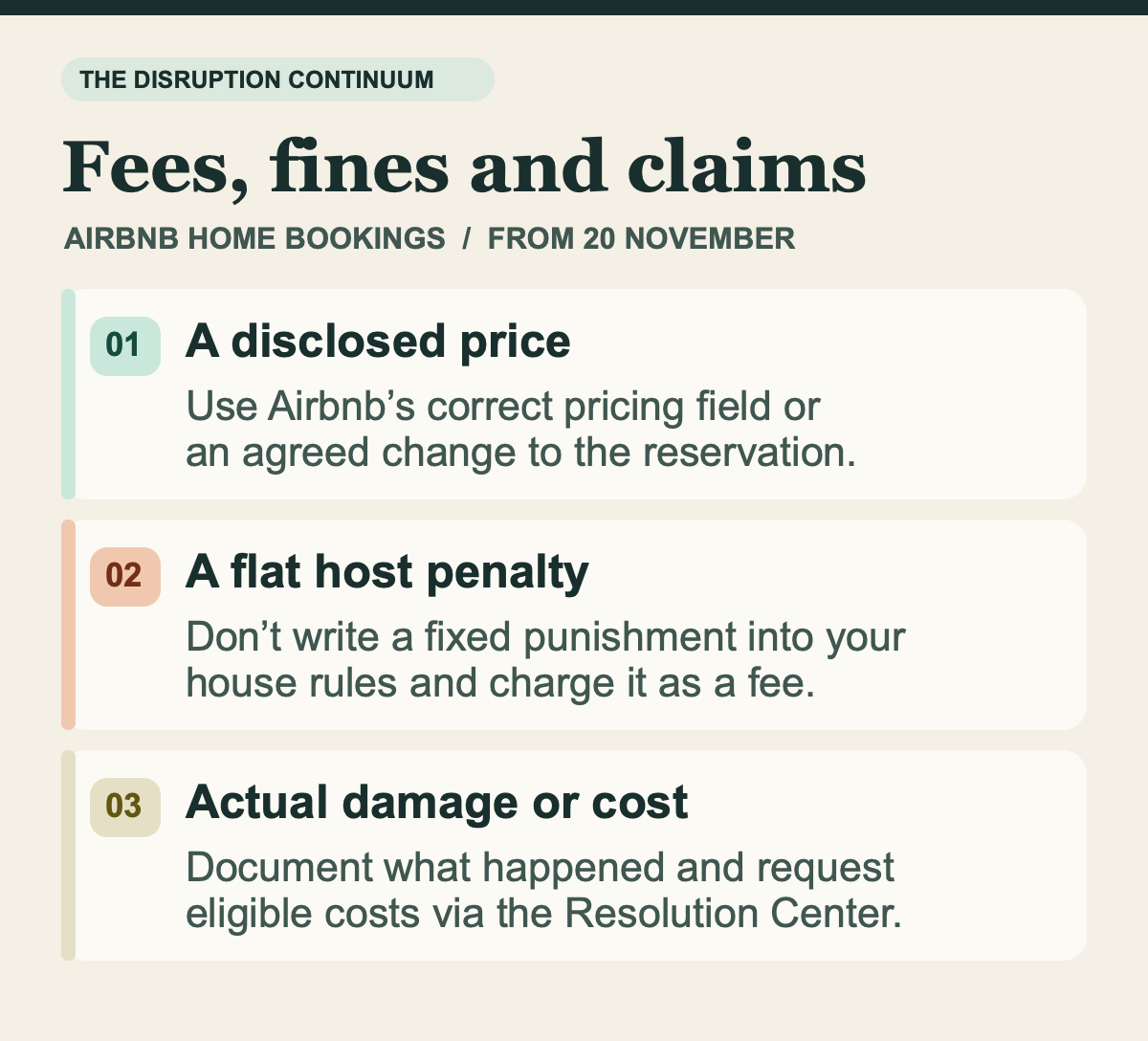
The test I use now: what am I charging for? A mandatory fee pays for part of the stay and must be in the price before booking. A fixed penalty for breaking a house rule is a fine, even if I disclosed it. A claim for actual damage is different.
One narrow exception is worth knowing. If there's a risk that a community association — an HOA or building security — or a local government might impose a fine, you can give guests notice of that in the designated section of your listing. That's warning them about someone else's fine, not imposing your own. Don't confuse the two.
What replaces the extra-guest fine
This is the fine most hosts actually had, so it's the one that needs a real replacement. The answer is in the new standard rules: maximum overnight guests.
Set the overnight guest cap in the listing editor, at the number your home actually sleeps — or lower, if your building or local rules cap occupancy. If a guest brings more people than the cap allows, that's a breach of a standard house rule. And Airbnb's policy says that if a guest violates a house rule during a stay, or tells you before check-in that they intend to, you can cancel the reservation without fees or other consequences, and contact Airbnb for help with the next steps.
So the enforcement moved from charge them after the fact to stop the stay before it gets worse. It's a stronger tool in one way — cancelling a booking hurts more than a $50 charge — and a weaker one in another, because you can't quietly pocket a fee and let the stay continue. That's the trade, and it's Airbnb's call, not mine.
If you do want to charge for extra guests, do it as a fee, not a fine: an extra-guest fee disclosed in the price before booking, in the fee field. The guest sees it, agrees to it, and pays it through Airbnb. That's allowed. If the guest count changes and you agree, use Airbnb’s Change reservation tool. Adding a penalty because they sneaked someone in is not allowed.
What replaces the security deposit
Most hosts already know this one, but the new policy is a good moment to be sure: most hosts are not allowed to charge a security deposit or a credit card hold for incidentals. Airbnb's pricing policy allows deposits and holds only in select cases — some software-connected hosts may collect a deposit off-platform if it's disclosed in the fee field before booking, and hotels may request a hold at check-in as part of their standard procedures. If you do collect one in one of those cases, you must refund it in full within 7 days of checkout (14 days for hotels) if there's no damage or incidental charge — and if you keep any of it, be ready with a written explanation and evidence.
For most of us, the deposit was never really available, and the fine was doing the deposit's job. Both are gone now. What remains is the proper channel.
What replaces fines for damage
Damage is the one place hosts worry most, because a fine felt like the only leverage. Here's the route Airbnb actually gives you:
- AirCover for Hosts. If the guest doesn't pay, you can ask Airbnb to review eligible damage to your place or belongings under host damage protection. For example, actual extra cleaning to remove smoke odour can qualify; a flat smoking fine cannot.
- The Resolution Center. If you seek reimbursement from a guest, Airbnb's pricing policy says you must do it through the Resolution Center — not by message, not by an off-platform payment, and not by a penalty in your rules.
- Evidence, not threats. A fine in your rules doesn't prove damage. Photos and receipts help show what happened, what it cost, and why you're asking the guest to pay. (I'll write a full piece on AirCover claims and the evidence that gets paid — it's worth its own article.)
And remember the enforcement side: if a host keeps a fine in their rules, Airbnb's response runs from education and a request to update the listing, through warnings, to a notice on the listing page flagging the issue to guests, reduced visibility in search, or other action under the Terms of Service. A fine that never gets paid can still cost you bookings.
What I'm doing now — a checklist
- Search my listing for every fine, penalty, and charge. "Fine", "penalty", "will be charged", "$" anywhere in the house rules or house manual. Every one of them comes out if it's a penalty for breaking a rule, even if I've disclosed it.
- Set the maximum overnight guests rule to the number I actually want, and set the extra-guest fee in pricing if I charge one — disclosed before booking, through Airbnb.
- Move any real costs into the price. If pets cost me extra cleaning, that's a pet fee in the fee field, not a "cleaning fine" in the rules. If I want a higher nightly rate to cover wear and tear, that's the nightly price.
- Stop taking deposits or card holds unless I am genuinely in one of the select cases Airbnb allows — and if I am, disclose it in the fee field and refund or release it within the applicable 7 or 14 days if nothing is owed.
- Learn the Resolution Center route before I need it. The worst time to figure out a damage claim is the morning after a bad checkout.
Losing the fine stings, because it felt like control. But a fine I can't collect through Airbnb was never really control — it was a threat that depended on the guest agreeing to pay it. The replacement is less dramatic and more reliable: a price agreed upfront, a guest cap I can enforce by cancelling, and a damage claim through the channel Airbnb uses to review it.
This article is not legal advice, and Airbnb's Help Centre is the final word. Airbnb changes its policies — check the source pages before you edit your listing.
Sources:
- Airbnb Help Centre, "Reasonable house rules" (article 4168) — https://www.airbnb.com/help/article/4168
- Airbnb Help Centre, "Pricing and payment transparency" (article 2799) — https://www.airbnb.com/help/article/2799
- Airbnb Help Centre, "Add house rules to your listing" (article 472) — https://www.airbnb.com/help/article/472
- Airbnb Help Centre, "Host damage protection" (article 279) — https://www.airbnb.com/help/article/279