

TL;DR: From 20 November 2026, Airbnb gives you seven standard house rules to switch on in your listing editor. You can also set reasonable additional rules. Airbnb expects guests to follow those too. Every rule has to be in the listing before the guest books. Nothing new by message, sign on the wall, or word of mouth at the door.
I've rewritten my house rules more times than I can count. Every time a guest did something I didn't expect, I added a line. Over the years my rules section turned into a small novel — shoes off, no eating in the bedrooms, don't touch the thermostat, quiet after ten, and on and on.
Airbnb has now drawn a line under all of that. For every reservation booked on or after 20 November 2026, there are exactly seven standard house rules. The rest of what I ask guests to do lives somewhere else, and I need to be honest with myself about what Airbnb will actually back me up on.
Book my Airbnb services
The seven standard rules
These are the seven standard settings in the listing editor:
- Maximum overnight guests — how many people can stay the night. It sets the limit in advance, without relying on an extra-guest fine.
- Quiet hours — a start and end time. Match your local noise rules rather than inventing stricter ones.
- Events — whether parties and events are allowed. Airbnb's ban on disruptive gatherings and open-invite parties applies regardless.
- Pets — allowed or not, and how many.
- Smoking, vaping, and e-cigarettes — allowed or not.
- Commercial photography and filming — allowed or not.
- Lock up at checkout — required or not, with an optional note on where the keys go.
There's also an eighth setting — limiting which Airbnb Service categories are allowed in your home — but you set that one by contacting Airbnb, not in the editor.
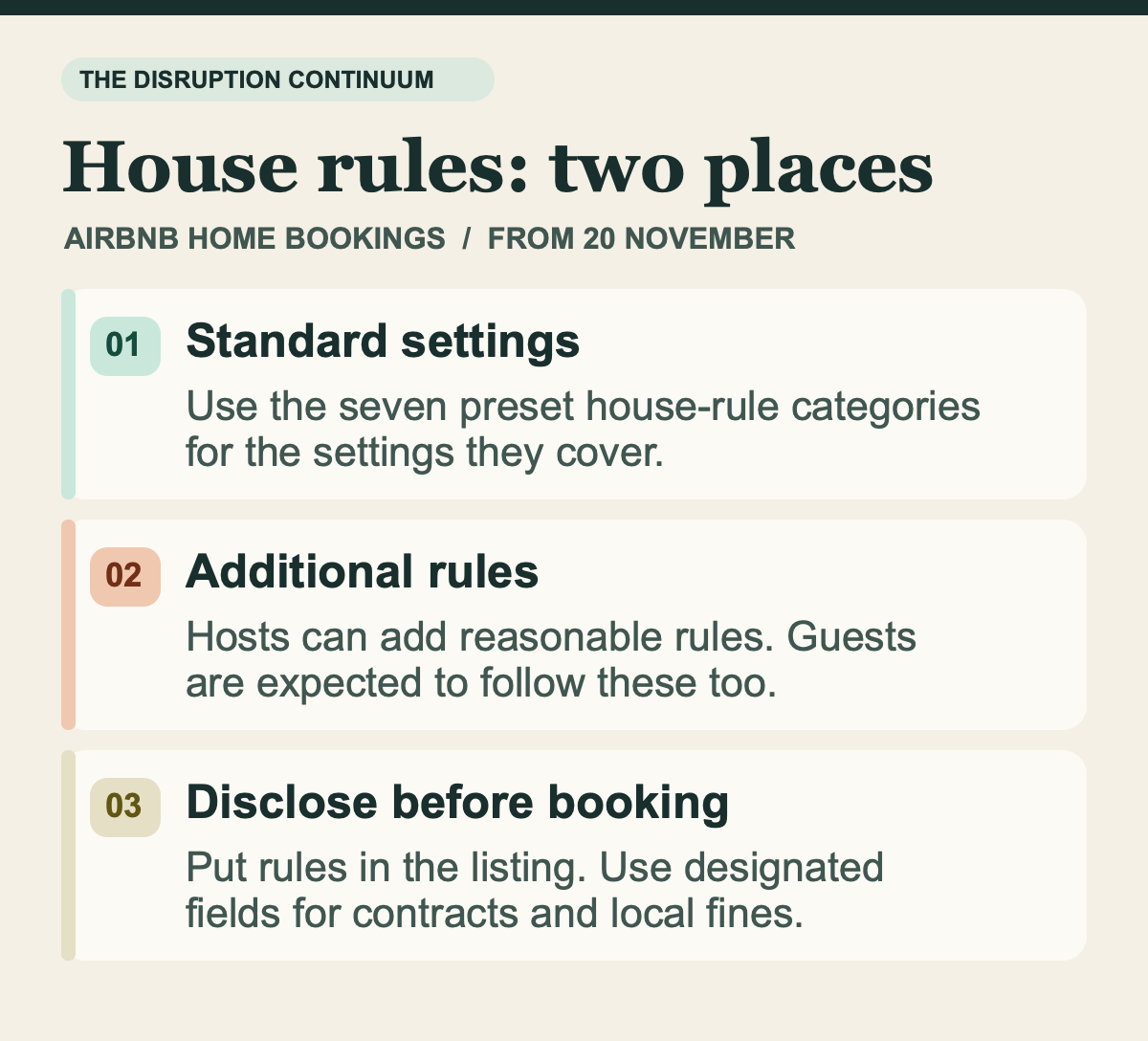
Everything else is an additional rule
Other house rules you write yourself go under Additional rules in the editor. There are separate sections for permitted contracts and for fines a local authority or community association might impose. When you add one, you choose when it applies: During the stay or Before checkout. Shoes off indoors, no daytime visitors after a certain hour, don't use the washing machine after 9pm — that kind of thing lives here.
Here's the part that changes how I write them: an additional rule has to be reasonable. Airbnb's own test is simple. A rule is generally not reasonable if it asks guests to do a job that takes significant effort or time, or that a cleaner would normally do — stripping the bed, taking the rubbish offsite, washing and putting away the dishes. It also can't restrict access to something advertised as part of the listing, and it can't impose a fine or penalty.
Airbnb does say it looks at context. It may be reasonable to ask guests to limit shower time where there's a local drought restriction, or to put rubbish in an animal-proof container in bear country. The setting matters. But the default is: if it reads like a chore list, it doesn't belong.
The one rule about rules: they must be in the listing before booking
This is the change with teeth. Every house rule — standard or additional — must be disclosed in the designated section of the listing page at the time of booking, so guests can judge whether the home is a fit before they commit. Airbnb is explicit: hosts may not communicate new house rules in other sections of the listing, or after booking, including by message, signs in the home, or in person.
That kills a habit most of us have. The laminated sign in the kitchen with five extra rules? It has no standing now. The message I used to send the day before check-in with "just a few house rules"? Same. If it's not in the listing when they book, it's not a rule.
Two more consequences worth knowing:
- Changes only apply to future reservations. If I edit my rules today, guests who already booked keep the old ones. The rules that were on the listing when the reservation came in are the ones that apply.
- The editor now flags non-compliant rules. When you add or edit an additional rule, Airbnb highlights anything it thinks may breach the policy, with a short explanation. If you save anyway, it goes to further review, and Airbnb will reach out with next steps.
What happens if a guest breaks a rule?
Guests are expected to comply with the house rules. If a guest breaks one during a stay — or tells you before check-in that they intend to — Airbnb says you can cancel the reservation without fees or other consequences, and you should contact Airbnb for help with the next steps.
And if a host's rules don't meet the requirements, Airbnb's enforcement runs from education and a request to update the listing, through warnings, to a notice on the listing page flagging the issue to guests, reduced visibility in search, or other action under the Terms of Service.
What I'm doing now — a checklist
- Open the listing editor and set the seven standard rules properly. Don't leave any on a vague default. Quiet hours with actual times, a firm overnight guest number, pets and events set to what I actually allow.
- Move everything else into Additional rules — and cut anything that reads like a chore list. If I wouldn't ask it of a friend staying over, it doesn't go in.
- Delete the extra rules from everywhere else. The house manual, the welcome message, the signs on the wall. If a rule matters, it goes in the listing. If it doesn't matter enough for the listing, it goes.
- Check the wording against the reasonableness test. No fines, no cleaner jobs, no rules that contradict something advertised in the listing.
- Use the 20 November booking cutoff. The policy applies by booking date, not stay date. A guest who books on 21 November for a stay in February is covered by the new rules.
The honest version of this change: Airbnb is telling us that a house rule is only worth having if we were willing to put it in front of the guest before they paid. That's a fair test. If a rule can't survive that, it probably wasn't a rule — it was a hope with a laminated sign.
This article is not legal advice, and Airbnb's Help Centre is the final word. Airbnb changes its policies — check the source pages before you edit your listing.
Sources:
- Airbnb Help Centre, "Reasonable house rules" (article 4168) — https://www.airbnb.com/help/article/4168
- Airbnb Help Centre, "Add house rules to your listing" (article 472) — https://www.airbnb.com/help/article/472
- Airbnb Resource Center, "Important changes to house rules" (updated 3 November 2026) — https://www.airbnb.com/resources/hosting-homes/a/important-changes-to-house-rules-21