
Scored under the revised LDV framework, Module B (Technology and software). Price: US$221.68, 19 November 2026 close. Accounting basis: US GAAP (fiscal year ends on the Friday nearest 30 November; FY2025 ended 28 November 2025). All figures from SEC filings, Adobe releases and public aggregators, researched 20 November 2026. Not investment advice.
The company
I think of Adobe as the company that sells the tools most of the world's designers, photographers and video editors work in — and the documents the rest of us sign and read. It is an American software company based in San Jose, California, listed on the Nasdaq as ADBE. In the year to 28 November 2025 it took in US$23.77bn of revenue, up about 11%, and employed 31,360 people. At the US$221.68 price I am scoring it at, it is worth about US$86bn.
It makes its money the simplest way a software company can: people pay every month, or every year, to keep using its software, and lose access if they stop. Subscriptions were US$22.90bn of the US$23.77bn in FY2025 — 96% of everything it took in. The number I watch is the subscription book: annual recurring revenue was US$25.20bn at the end of FY2025. Cash comes in before the work is done — Adobe sits on nearly US$6.9bn of deferred revenue — but a customer who cancels is gone next month.
The business breaks into two big parts, plus a small leftover. Digital Media is the one most people know: Creative Cloud — Photoshop, Illustrator, Premiere Pro, Lightroom, InDesign — with Acrobat and Document Cloud. It brought in US$17.65bn in FY2025, about 74% of revenue. Digital Experience is the other side: software big companies use to run their marketing and manage the customer journey — worth US$5.86bn, about 25%. The remaining US$256m, about 1%, is Publishing and Advertising — FY2025 was the last year Adobe reported it that way.
Adobe sits in application software, at two points in the chain. In creative work it is the toolmaker at the top — the software other people's work is made with, and its formats (PSD, PDF) are the industry standard. In marketing it sells the plumbing companies use to reach their own customers. It is global: in FY2025 the Americas brought in US$14.12bn, about 59% of revenue, of which the United States alone was US$12.53bn, Europe, the Middle East and Africa US$6.29bn (26%), and Asia-Pacific US$3.36bn (14%).
Its customers run from a single photographer paying monthly for Lightroom, through small studios, to the largest companies buying Experience Cloud. No customer is large enough to matter on its own: none accounted for 10% or more of revenue in FY2025. Over a billion people a month use its products, most of them free Acrobat and Express users, and the bet is that some convert to paying subscribers.
The company was founded in December 1982 by John Warnock and Charles Geschke, two researchers who left Xerox PARC to sell PostScript, the language that told printers how to draw a page; Apple licensed it in 1985, which helped start desktop publishing. Illustrator followed in 1987, Photoshop in 1990, Acrobat in 1993. It grew by acquisition — Macromedia in 2005, Omniture in 2009, Magento and Marketo in 2018 — and in 2013 it stopped selling boxed software and moved everything to Creative Cloud subscriptions. Revenue grew from US$4.4bn in FY2012 to US$23.8bn in FY2025. The US$20bn Figma purchase was abandoned in December 2023, costing a US$1bn break fee; in April 2026 Adobe closed the ~US$1.9bn purchase of Semrush, a search-visibility platform for AI search.
At the 20 November 2026 scoring date, Adobe was led by Shantanu Narayen, chief executive since 1 December 2007, who announced in March 2026 he would step down once a successor was named. That successor has now been named: on 3 September 2026 Adobe announced that Anil Chakravarthy will become president and chief executive on 1 December 2026, with Narayen moving to executive chair. Dan Durn resigned as CFO in June 2026, and Steve Day, a 20-year veteran, is interim CFO. There is no controlling shareholder: it is owned mostly by institutions — Vanguard at about 10.2% and BlackRock at about 9.3%, per the 2026 proxy statement — while all directors and officers together own under 1%, and Narayen himself 0.092%.
In creative software Adobe still leads, but that is where the pressure is now. Canva, at about US$4bn of annual recurring revenue and growing over 30%, has taken the low end; Figma, at about US$1.2bn and growing 40%, leads the interface-design work Adobe once hoped to buy; and AI-first tools — OpenAI, Midjourney, Google — can now do in seconds work that used to take a trained designer hours, as William Blair put it when it cut Adobe in March 2026. In documents it faces Microsoft and DocuSign; in marketing software, Salesforce, Oracle, SAP and HubSpot. Adobe's answer is Firefly, its own AI: AI-first annual recurring revenue has passed US$650m, up over 150% in a year, but that is still only about 2.4% of the subscription book.
What drives it is whether creative professionals and big companies keep paying their subscriptions, and whether the new AI features give them a reason to pay more rather than a reason to leave. The risks follow: generative AI could make the professional tools less special; cheaper rivals could take the next generation before they ever learn Photoshop; the marketing business is a harder fight against bigger rivals; and the balance sheet is thin, as Test 1 shows. The strengths are real — a standard-setting product set, 89% gross margins, US$9.9bn of free cash flow, a subscription book growing 10–11% a year — but they now have to be defended, not just collected.
The headline
LDV gives Adobe no entry price: Test 1 passes one of six rules, with four hard failures and the P/B/EV-to-free-cash-flow rule unscored. The business is genuinely strong: disruption passes, leadership passes at 78%, revenue has grown 10–11% a year for three years, gross margin is 89%, and free cash flow is US$9.9bn. But the balance sheet is too thin for Graham's rules — the current ratio is 1.00×, debt is 53% of equity, and the buybacks have run ahead of free cash flow for three years. And the price is not the constraint that matters most: even if the gate passed, the base case only clears the 15% hurdle at a 12× exit if the price falls to about US$199. On top of that, Adobe announced a 1 December handover to a named chief executive successor, and the chief financial officer had already left at the scoring date. The number to watch is US$199.
Recommendations
- Buy price: none.
- What it would take to buy: (1) the P/E gate passes — price at or below US$204.40 on normal earnings at scoring, or normal EPS rising to US$14.78 (which happens as FY2026–27 earnings enter the three-year average); (2) the current ratio reaches 2.0, or a Module B adjustment is made for SaaS deferred revenue (see Test 1); (3) debt/equity back to ≤50%; (4) buybacks inside free cash flow for three consecutive years; (5) the price at or below ~US$199, the 12×-exit ceiling at which the base case clears 15%.
- Sell price: none.
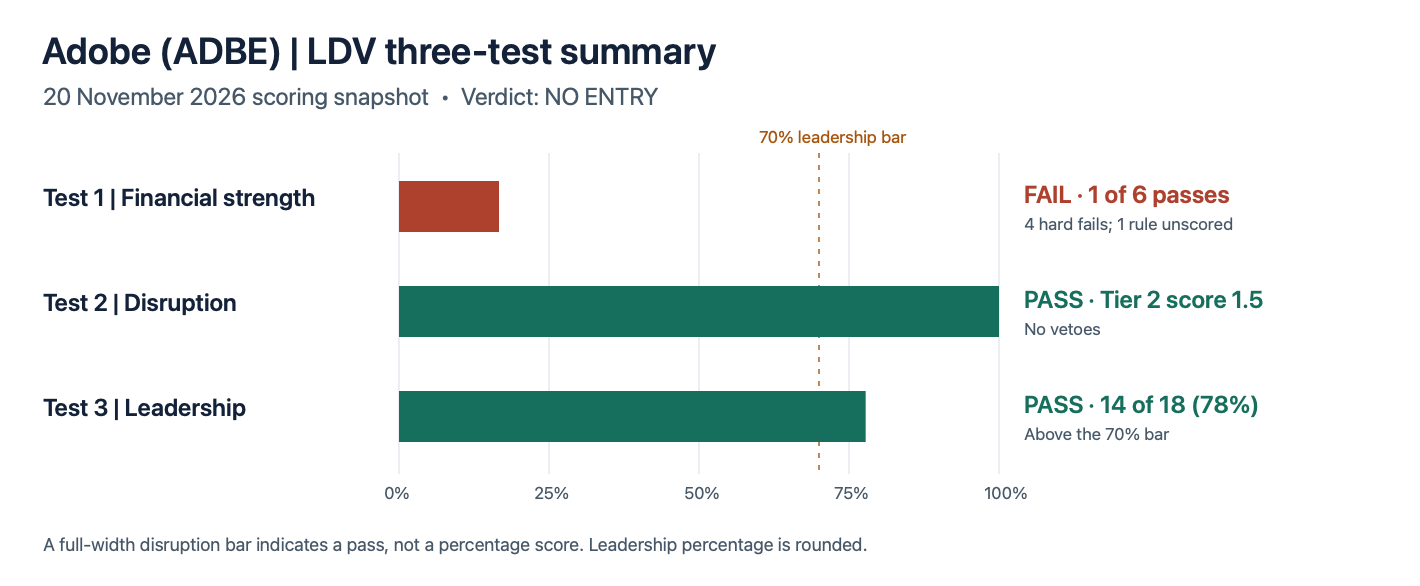
Test 1 — Financial strength: FAIL (1 of 6)
| Rule | Requirement | Adobe | Verdict |
|---|---|---|---|
| P/E | ≤ 15 on normal earnings (3-yr avg EPS) | Normal EPS US$13.63 (FY23 US$11.82, FY24 US$12.36, FY25 US$16.70) → P/E 16.27× | FAIL |
| P/B | ≤ 1.5, or P/E × P/B < 22.5 | Set aside under Module B (see below). P/B 7.98×; P/E × P/B = 129.9; EV/free-cash-flow ~8.8× — no pass mark set | Not scorable |
| Current ratio | ≥ 2 | 1.00× (current assets US$10,163m / current liabilities US$10,200m, 28 Nov 2025) | FAIL |
| Debt / equity | ≤ 50% | 53.4% on interest-bearing debt (US$6,210m / equity US$11,623m); 57.2% including operating leases (US$6,648m) | FAIL |
| Earnings record | Positive in each of the past 10 years | Positive throughout (FY16 US$1,169m → FY25 US$7,130m) | Pass |
| Shareholder return | 3-yr avg total shareholder yield ≥ 3.0% | 3-yr avg 4.92% (FY23 1.70%, FY24 4.37%, FY25 8.68%) — floor passes, but guard 4 fails: net buybacks US$25,899m vs free cash flow US$24,667m = 105.0% | FAIL |
Three things matter here. First, the P/E test uses normal earnings — the three-year average — because Graham's practice stops one exceptional year from making a company look cheap. On trailing twelve-month EPS (US$17.92) the P/E is 12.37×, a pass; on the three-year average it is 16.27×, a fail. The difference is the earnings ramp: FY2023 EPS was US$11.82, FY2025 was US$16.70. The P/E gate price is US$204.40 (15 × US$13.63). But note the moving part: if FY2026–27 earnings arrive as guided, the three-year average for FY2025–27 would be about US$18.39, giving a P/E of 12.0× at the scoring price. The test is backward-looking — it fails today and passes by itself in about a year, if the earnings arrive.
Second, under Module B the P/B rule is set aside for a technology company (its assets are people and code, not plant) and judged on EV/free-cash-flow instead — about 8.8× on FY2025 free cash flow, 8.3× on the trailing twelve months — for which the framework sets no pass mark, so this rule is not scorable and earns no pass. That is the framework excluding asset-light growth stocks by design on this leg, not a price problem.
Third, the current ratio and the debt/equity ratio fail together, and they fail for the same structural reason: Adobe's balance sheet is deliberately thin. Current liabilities of US$10,200m include US$6,905m of deferred revenue — cash already collected from subscribers, owed as service rather than as money. Strip the deferred revenue out and the current ratio is 3.07×. But the rule as written counts it, and the ratio has got worse, not better: at 28 August 2026 (Q3 FY2026) the current ratio was 0.77×. The debt/equity ratio fails on either reading (53.4% on debt alone, 57.2% with leases), and it is rising because the buybacks shrink equity: equity fell from US$16,518m (FY2023) to US$11,623m (FY2025) while debt rose from US$3,634m to US$6,210m. The company is not in distress — it holds US$6,595m of cash and short-term investments against US$6,210m of debt, so it is effectively at zero net debt — but Graham's balance-sheet rules are about the cushion, and the cushion is not there.
On the shareholder-yield rule, the floor passes (4.92% average) and most guards pass: the yield was positive in all three years including the most recent, the diluted share count fell every year (459m → 450m → 427m), R&D rose in absolute terms (US$3,473m → US$3,944m → US$4,294m), and there are no special dividends (Adobe pays no dividend at all). Guard 4 fails: over the three years Adobe returned US$25,899m net of issuance while generating US$24,667m of free cash flow — 105.0% of free cash flow. On the framework's own debt-adjusted reading (deducting the US$2,494m of net new debt raised in FY2024–25), the payout is 116.8% of free cash flow. The only reading on which it passes (97.1%) counts borrowed money as free cash flow — which is exactly what the guard is designed to exclude. Adobe returned borrowed money to shareholders. That is a fail, and it is the same buyback programme that is shrinking equity and pushing the debt/equity ratio up.
Test 2 — Disruption: PASS (no vetoes; Tier 2 score 1.5)
| Veto | Rule | Adobe | Verdict |
|---|---|---|---|
| V1 — Research starved | R&D below 50% of sector median for 2 successive years | R&D 18.1% of revenue (FY2025, US$4,294m), above the large-cap software median of ~15.6% (Microsoft 13.2%, Salesforce 14.4%, Oracle 15.3%, Intuit 15.7%, Autodesk 22.8%). 50% of the median is 7.8% — Adobe is nowhere near it. Absolute R&D up 9% in FY2025 | Not triggered |
| V2 — Margin collapse | Gross margin −5 pts cumulative over 3 years, or operating margin down 2 years while revenue trails industry | Gross margin 87.9% → 89.0% → 89.3% (rising). GAAP operating margin 34.3% → 31.3% → 36.6%; the FY2024 dip is the one-off US$1,000m Figma termination fee — excluding it, FY2024 operating margin was 36.4% and rising | Not triggered |
| V3 — Losing share | Revenue trailing industry by ≥5 pts for 2 years | Revenue +10.2%, +10.8%, +10.5% (FY23–25) vs Gartner worldwide software spending +11.9% (2024), +10.5% (2025) — trails by at most ~1.4 pts, never 5 | Not triggered |
| V4 — Concentrated customers | Top-1 customer above 20% of revenue, or top-5 above 40% | No customer accounted for 10% or more of revenue in FY2025 (10-K). Top-5 concentration is not disclosed | Not triggered — open enquiry on the top-5 |
Scored test: R&D at 18.1% of revenue is above the median, not in the 50–75% band (0). Gross margin is rising, not falling 3 points (0). Capex has run below depreciation for three successive years — FY23 US$360m vs US$618m, FY24 US$183m vs US$585m, FY25 US$179m vs US$536m — +1.0. No customer is at 10–20% of revenue (0). CEO tenure is 18.7 years, above 14 — +0.5. New products launched within five years (Firefly, Acrobat AI Assistant, GenStudio) contribute AI-first ARR of over US$650m — 2.4% of total ARR, well below 30% of revenue (0). Acquisitions: Semrush (closed April 2026, ~US$1.9bn) is unseasoned at seven months, so zero credit; Frame.io (October 2021) and Workfront (December 2020) are seasoned but deal-level ROIC is not disclosed, so zero credit rather than a penalty. Scored total: 1.5 — a pass (≤2.0).
Two nuances, kept as open enquiries rather than waivers. First, the capex signal is weak for a SaaS business: Adobe's productive capacity is its R&D workforce and its cloud infrastructure, not plant, and the depreciation figure includes amortisation of acquired intangibles. Module B says to split data-centre, software and maintenance capex before judging it — Adobe does not disclose that split, so the rule is applied as written (+1.0) and the weakness of the signal is recorded here. Second, the top-5 customer concentration is not disclosed, so V4 is only half-verified: no single customer is above 10%, but the top-5 figure is unknown.
The disruption story itself is the reason the stock is down 37% this year: the market's fear is that generative-AI tools (OpenAI, Midjourney, Canva, Figma) commoditise Adobe's creative franchise. The numbers in the test do not show disruption yet — revenue, margin and R&D are all moving the right way — but the test is backward-looking, and the AI question is the one that will decide whether it stays that way. Citi cut Adobe to Sell on 4 November 2026 with a US$207 target, expecting a weaker FY2027 outlook and cutting its net-new-ARR estimates to US$1.5bn for FY2027.
Test 3 — Leadership: PASS (14 of 18 scored, 78% vs 70% bar)
WACC band set before scoring: 8–10% (top 10%). Adobe's cost of capital is about 9%.
| # | Item | Adobe | Result |
|---|---|---|---|
| 1 | ROIC above the top of the WACC band in 4 of the last 5 years | ROIC (Mauboussin method) FY21 25.26%, FY22 25.50%, FY23 26.91%, FY24 31.27%, FY25 34.72% — above 10% in 5 of 5 years | Pass |
| 2 | 3-year ROIIC above the top of the WACC band | ΔNOPAT US$2,280m (FY22 US$4,827m → FY25 US$7,107m) / Δinvested capital US$1,543m (US$18,930m → US$20,473m) = 147.8% | Pass |
| 3 | No qualifying goodwill impairment in the last 3 years | No impairment disclosed FY2023–25. Goodwill US$12,857m = 44% of total assets — a concentration to watch, not an impairment | Pass |
| 4 | No acquisition in the last 10 years where 3-year post-deal ROIC is below pre-deal ROIC | Deal-level ROIC is not disclosed; the company-level ROIC series is methodology-sensitive (Frame.io looks like a fail on one provider's figures, a pass on another). Attribution is impossible from the filings | Unscored |
| 5 | Buybacks only where the share count is down and the average buyback price is below the current price | Share count down (diluted 459m → 427m; outstanding 452.0m → 410.5m). But the average buyback price is ~US$450–510 — FY2023 US$402.61 (11.5m shares for US$4.63bn), FY2024 US$581.60 (17.5m shares for US$10.18bn) — against today's US$221.68 | Fail |
| 6 | No net debt: cash after debt at the balance sheet date is positive | Cash + short-term investments US$6,595m vs debt US$6,210m = net cash US$385m; including operating leases US$438m, net debt US$53m — effectively zero either way | Pass |
| 7 | CEO owns ≥1% of the company, or is a founder | Shantanu Narayen owns 0.092% (~430,352 shares); not a founder | Fail |
| 8 | Officers and directors own ≥5%, or the CEO's holding is >3× annual base salary | Group ownership is well below 5%. But Narayen's holding is worth ~US$95.4m against a base salary of ~US$1.5m — ~64× | Pass |
| 9 | Net open-market purchases by officers in the last 3 years, and no net CEO selling in the last 12 months except under a disclosed 10b5-1 plan | CFO Daniel Durn bought 1,300 shares (US$507.8k) in March 2025, and director David Ricks bought US$2.9m in 2025–26 — but officers are net sellers by a wide margin: Narayen alone sold US$49.6m in the last 12 months (US$31.3m in September 2026, US$18.3m in April 2026) | Fail |
| 10 | 5-year CEO pay growth does not exceed 5-year TSR growth | Pay +41.6% (FY2021 US$36.13m → FY2025 US$51.17m) vs TSR −66.9% (US$669.85 at 30 Nov 2021 → US$221.68 at 19 Nov 2026; Adobe pays no dividend). On the SEC's own pay-vs-performance table the picture is the same: pay up, TSR down | Fail |
| 11 | No material restatement in the last 3 years | None | Pass |
| 12 | Mean absolute guidance error ≤10% over 3 years, measured on the original guidance | 5.25% across 12 observations (revenue, GAAP EPS, non-GAAP EPS, ARR for FY2023–25 vs the original targets) | Pass |
| 13 | No withdrawal or lowering of a long-range commitment within 90 days of its due date | FY2024 GAAP EPS guidance was cut in June 2024 (Figma fee) — five months before year-end, not within 90 days. FY2025 targets were raised, not lowered | Pass |
| 14 | A named internal successor to the CEO exists | Yes. On 3 September 2026 Adobe announced that Anil Chakravarthy, president of Adobe's Customer Experience Orchestration business and worldwide field operations, will become president and chief executive on 1 December 2026; Narayen moves to executive chair. Chakravarthy is an internal appointment (Adobe since January 2020) | Pass |
| 15 | At least one internal promotion to the executive team in the last 3 years | Steve Day, a 20-year Adobe veteran (joined 2006), promoted from SVP Corporate Finance to interim CFO on 15 June 2026 | Pass |
| 16 | CEO tenure of at least 5 years | 18.7 years (CEO since 1 December 2007) — but he has announced his departure, so the tenure is ending, not extending | Pass |
| 17 | R&D above sector median and ROIIC above WACC | R&D 18.1% vs ~15.6% median; ROIIC ~148% vs WACC 8–10% | Pass |
| 18 | The innovation claim is not contradicted by the numbers | AI-first ARR over US$650m (+150% YoY), AI-influenced ARR over US$5bn, total ARR +11.2%, ~1bn monthly users — the AI claim is supported by adoption | Pass |
| 19 | At least 60% of stated objectives met in the last 3 fiscal years | 11 of 12 met (92%) — FY2023 4 of 4, FY2024 3 of 4, FY2025 4 of 4. The only miss is FY2024 GAAP EPS (US$12.36 vs US$13.45–13.85 guided), caused by the Figma fee | Pass |
| 20 | At least 3 dated long-range commitments with outcomes | Adobe gives one-year targets only — no dated multi-year financial commitments exist to score | Unscored |
Domain tally: capital allocation 4 of 5 scored (items 1, 2, 3, 6 pass; item 5 fails; item 4 unscored) — the floor of 3 of 6 is met. Ownership alignment 1 of 3 (item 8 passes; items 7 and 9 fail). Communication 3 of 3 (items 11, 12, 13 pass). Succession depth 3 of 3 (items 14, 15 and 16 pass). Innovation culture 2 of 2 (items 17, 18 pass). Delivery 1 of 1 scored (item 19 passes; item 20 unscored) — no delivery cap applies.
Total: 14 of 18 scored items, 78% — above the 70% bar. Leadership: pass. The thing that would move it fastest now is insider buying — resolvable in months, not years. The things that would sink it are a successor who arrives with no ownership and a further year of net officer selling.
Two flags on the passes. Item 2's 147.8% ROIIC is flattered by the buybacks: invested capital barely grew (US$18,930m → US$20,473m) because the buybacks shrink equity, so the denominator is small. The item passes on any methodology (a second provider's figures give ~156%), but the number is not a clean read on incremental investment returns. Item 18 passes on the adoption numbers, but AI-first ARR is only 2.4% of total ARR and the monetisation runs through a freemium strategy — "freemium user growth over short-term revenue gains" is management's stated priority — so the revenue proof is still to come.
Step 4 — Valuation (run for information; the gate fails, so it does not govern)
Base case, Portfolio Manager method. FY2026 GAAP EPS is guided at US$18.12–18.17 (raised in September 2026 from US$17.90–18.00). The base case grows GAAP EPS at the non-GAAP consensus growth rate — FY2027 US$20.33 (+12%), FY2028 US$22.77 (+12%), FY2029 US$25.27 (+11%). The consensus anchor is TipRanks non-GAAP EPS of US$24.48 (FY2026), US$27.51 (FY2027) and US$31.20 (FY2028); the GAAP/non-GAAP gap is about US$6.30 a share and widening (stock-based compensation and Semrush amortisation). No dividend — Adobe pays none. Costs 0.15% at each end. No currency stress (US-dollar stock). Hurdle 15% IRR.
| Exit P/E | Sell price (FY2029 EPS × exit P/E) | Ceiling price (highest price clearing 15%) | IRR at US$221.68 |
|---|---|---|---|
| 10× | US$252.72 | US$165.67 | 4.4% |
| 12× | US$303.26 | US$198.80 | 10.9% |
| 15× | US$379.08 | US$248.50 | 19.5% |
| 18× | US$454.89 | US$298.20 | 26.9% |
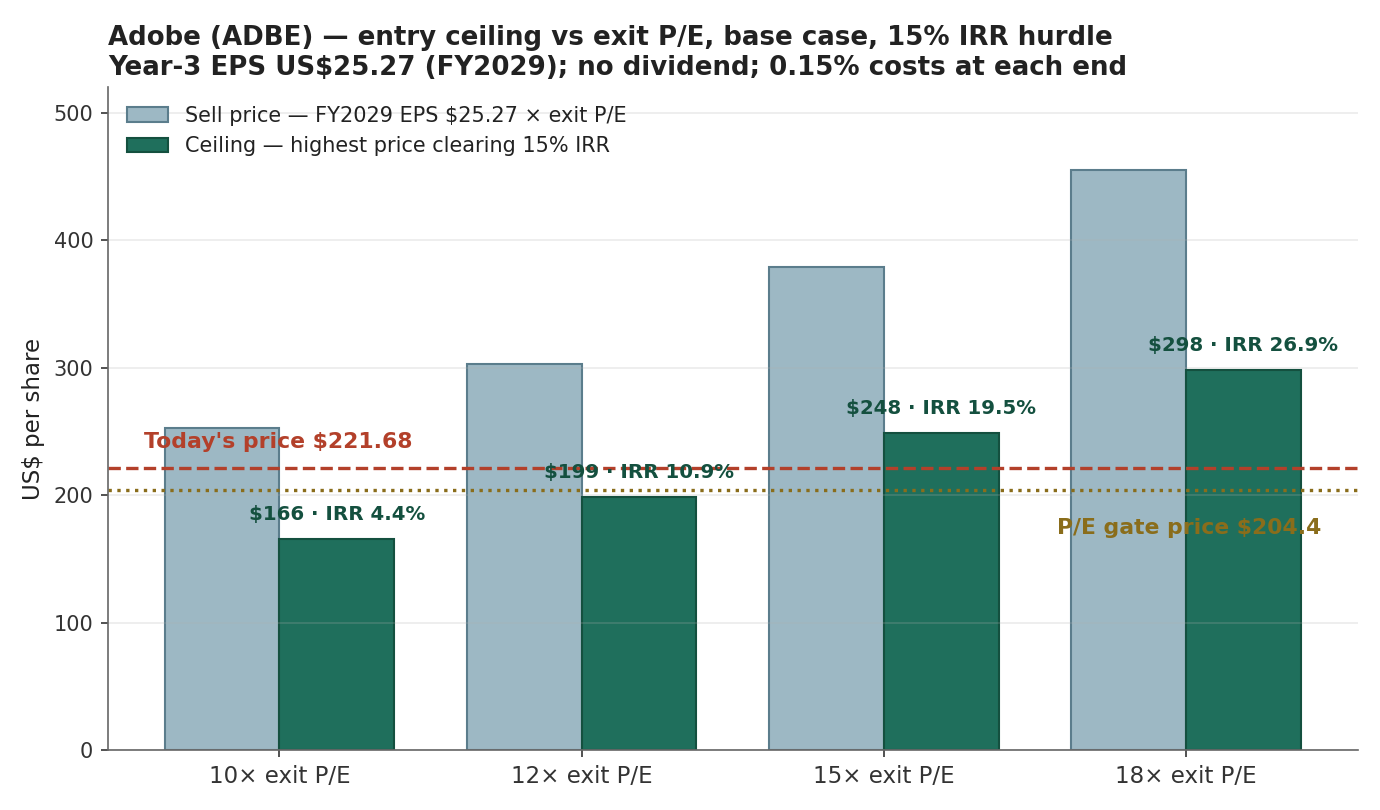
The central case is the 12× exit: it is a real de-rating from the 16.3× normal P/E, and it is the multiple the framework's conservatism points to for a company whose growth is decelerating and whose leadership is in transition. At 12× the ceiling is US$198.80 and the IRR at the scoring price is 10.9% — below the hurdle. At 15× the ceiling is US$248.50 and the IRR is 19.5%, but 15× is barely a de-rating from 16.3×, so it is the optimistic case, not the central one.
Bear case — growth halves (FY2027 +6%, FY2028 +6%, FY2029 +5.5% → FY2029 EPS US$21.51):
| Exit P/E | Sell price | Ceiling price | IRR at US$221.68 |
|---|---|---|---|
| 12× | US$258.18 | US$169.25 | 5.1% |
| 15× | US$322.72 | US$211.56 | 13.2% |
What would have to change
- Test 1 passes on its own in part if the earnings arrive: the three-year average EPS for FY2025–27 would be about US$18.39, giving a P/E of 12.0× at the scoring price. But the balance-sheet rules do not fix themselves with earnings. The current ratio is structural — US$6,905m of deferred revenue sits in current liabilities — and the honest question for the framework is whether Module B should adjust for SaaS deferred revenue, as it already adjusts P/B. That is a framework decision, not a company one. The debt/equity ratio needs debt below ~US$5.8bn at current equity, or equity rebuilt — and continued buybacks push it the other way. The shareholder-yield guard needs buybacks inside free cash flow for three consecutive years; FY2026 is the first year that could start the count.
- Test 2 needs the AI question answered in the numbers: AI-first ARR growing from US$650m into a material share of the US$27.5bn book, and net new ARR holding at or above the US$2.0bn a year Adobe delivered in FY2024. The capex signal (+1.0) would clear if Adobe disclosed data-centre versus maintenance capex and the maintenance figure covered depreciation.
- Test 3 needs insider buying — the fastest mover, with a CEO successor named at scoring (Adobe announced a 1 December 2026 handover to Chakravarthy). The pay-versus-TSR fail (item 10) will not fix itself in a year: the five-year TSR is −67% and the pay is US$51m.
Verdict
NO ENTRY. Adobe is a strong business at a price that has already fallen 37% this year, and the valuation maths says the base case clears 15% at a 15× exit — but LDV does not buy on valuation maths alone. It passes only one of six financial-strength rules: four fail outright and the P/B/EV-to-free-cash-flow rule is not scorable. The four failures are not a rounding error: the P/E is 16.27× on normal earnings, the current ratio is 1.00×, debt is 53% of equity, and the buybacks have run at 105% of free cash flow. The leadership transition — a chief executive handover announced for 1 December, and an interim chief financial officer as of 20 November — sits on top of that, though the successor is now named. The number to watch is US$199: the price at which the base case clears 15% at a conservative 12× exit. If it reaches that level, and the P/E gate has passed on its own as FY2026–27 earnings enter the average, the valuation case holds — and by then, two of the three tests may have resolved themselves.
- Buy price: none.
- What it would take to buy: P/E ≤15 (price ≤US$204.40, or normal EPS ≥US$14.78); current ratio ≥2 or a Module B deferred-revenue adjustment; debt/equity ≤50%; buybacks inside free cash flow for three consecutive years; price ≤~US$199 for the base case to clear 15% at a 12× exit.
- Sell price: none.
Analyst consensus for reference (not part of LDV): Hold. TipRanks average price target US$262.09 (24 analysts: 5 Buy, 14 Hold, 5 Sell); non-GAAP consensus EPS US$24.48 (FY2026), US$27.51 (FY2027), US$31.20 (FY2028). Targets range from US$200 (Goldman Sachs, Sell) to US$267 (HSBC, Hold); Citi cut to Sell at US$207 on 4 November 2026. Sources: Adobe 10-K FY2025 (filed 15 January 2026) and Q3 FY2026 10-Q; Adobe Q4/FY2025, Q4/FY2024, Q4/FY2023, Q3 FY2025 and Q2 FY2025 earnings releases; Adobe 2026 proxy statement (pay vs performance); StockAnalysis; FinanceCharts; TipRanks; MarketBeat; Gartner; Finnhub. Computed figures (normal EPS, TSY percentages, ROIC/ROIIC, ceiling and IRR figures) are arithmetic from SEC/aggregator figures, cross-checked where possible.
Sources
- Adobe Q4 and FY2025 earnings release (balance sheet, income statement, FY2026 targets)
- Adobe Q4 and FY2024 earnings release (FY2024 actuals, FY2025 targets)
- Adobe Q4 and FY2023 earnings release (FY2023 actuals, FY2024 targets)
- Adobe Q3 FY2025 earnings release (FY2025 targets raised)
- Adobe Q2 FY2025 earnings release (FY2025 targets raised)
- Adobe Q4 FY2024 targets (FY2025 original targets)
- Adobe Q4 FY2023 targets (FY2024 original targets)
- Adobe 2026 proxy, pay vs performance table (CEO pay FY2021–24, TSR)
- Simply Wall St, Adobe management (Narayen tenure, compensation, ownership)
- Form 4 insider trading record (Trabud)
- Adobe insider filings (SEC EDGAR)
- CFO resignation and interim CFO appointment (8-K, 11 June 2026)
- Adobe announces Anil Chakravarthy to become president and CEO and Shantanu Narayen to become executive chair on 1 December 2026 (3 Sep 2026)
- CEO stepping down and twin leadership searches
- TipRanks, consensus EPS and price target
- Citi Sell downgrade and FY2027 outlook
- Gartner worldwide software spending forecast (July 2025)
- Peer R&D intensity (10-K based)
- Price history and quote (Finnhub)
- Financial statements (StockAnalysis)
- ROIC history (FinanceCharts)
- Ten-year net income history (roic.ai)
- Q4 FY2025 recap (Aardvark Labs)
- Adobe announces Anil Chakravarthy to become President and CEO on 1 December 2026 (Adobe newsroom, 3 September 2026)
- Adobe Q3 FY2026 earnings call transcript (AI-first ARR, monthly users)
- Adobe FY2025 revenue by geography (10-K based)
- Adobe ownership, 2026 proxy statement (Vanguard, BlackRock, directors and officers)
- Adobe company profile — employees and market capitalisation (PitchBook, aggregator)
- Adobe Inc. history (Wikipedia)
- William Blair downgrade on AI competition — Canva and Figma ARR
- Semrush acquisition, closed 28 April 2026 (~US$1.9bn)
LDV Investing Framework research data — not investment advice. This scorecard is research being developed and tested under the LDV Investing Framework. It is not investment advice, not a recommendation to buy or sell any security, and not personal financial advice. The entry and exit prices are the framework's mechanical outputs — the ceiling at which the base case clears a 15% annual IRR hurdle, and year-3 EPS × exit P/E — not price targets or advice. Do your own research, and consider seeking advice from a licensed financial adviser before making any investment decision.