

By James Hinton — 19 November 2026
TL;DR: For reservations booked on or after 20 November 2026, Airbnb hosts generally may not ask guests to sign a separate rental agreement. There are four exceptions: it is required by law or community association rules, or by your insurance provider; it is needed for an optional amenity; it is a monthly stay of 28 nights or more; or it is a Luxe listing. If your agreement fits an exception, disclose its terms in your listing — and remember Airbnb will not enforce it for you.
For years, a separate rental agreement felt like common sense. You have a property, a guest is staying in it, so you get them to sign something. It covered the breakages, the extra guests, the "you break it, you pay for it" part that Airbnb's own terms never quite spelled out the way you wanted.
From 20 November, that habit is mostly over — at least for reservations booked on or after that date. Airbnb's policy, "Limiting host-imposed contracts and other requirements" (Help Centre article 4169), says hosts generally may not ask guests to sign a separate contract or rental agreement. The cutoff is the booking date, not the stay date: a reservation booked on 19 November stays under the old rules even if the guest arrives in December.
This is not legal advice, and Airbnb's Help Centre is the final word. But here is what the policy actually says, in plain language, and what I would do about it.
Book my Airbnb services
The four exceptions
A separate contract is allowed only if it is:
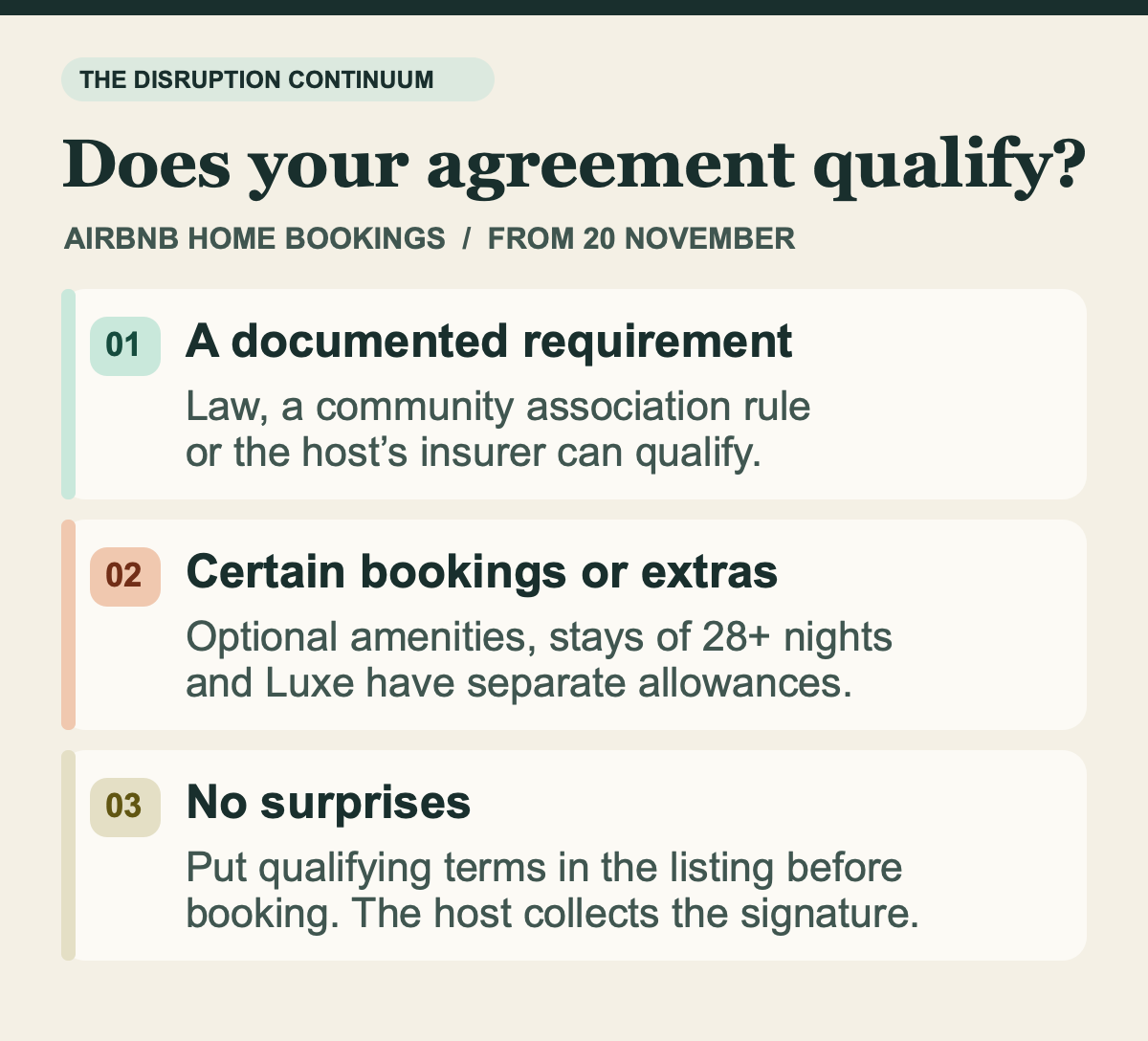
- Required by law or community association rules, or by your insurance provider. This covers things like a local law, an HOA rule, or a building security requirement — and, as Airbnb confirmed in its 3 November 2026 update, a requirement from your own insurer. If your short-term rental policy says guests must sign a rental agreement, that now counts.
- Necessary to facilitate access to an optional amenity. Airbnb's example is a golf cart rental. The key word is optional: the contract covers the extra, not the stay itself.
- Requested in connection with a monthly stay of 28 nights or more. Longer stays are the one place where a proper agreement still makes sense, and Airbnb has kept that door open.
- Related to a stay at a Luxe listing. Airbnb's premium tier keeps its own arrangements.
If your agreement does not fit one of those four, stop asking guests to sign it for any booking made from 20 November onwards.
If your agreement fits an exception, there are still rules
An allowed contract is not a free pass. Airbnb sets conditions, and they are worth following exactly:
- The terms must comply with Airbnb's policies and Terms of Service, and must be relevant to the stay — or to the optional amenity, if that is what the contract is for. You cannot use a rental agreement to reintroduce rules Airbnb does not allow, like a host-imposed fine or an unreasonable checkout chore.
- You must disclose the terms in the designated section of your listing. Guests have to be able to see what they are agreeing to before they book. Airbnb's Resource Center adds that you upload the contract under Contracts in your listing settings — and that you should read its requirements before you do.
- Do not include personal information in the contract. Contracts are publicly visible, so no ID numbers, no phone numbers, no email addresses in the document itself.
- You may be asked to provide evidence that your contract meets one of the four criteria. If your insurer requires it, keep the insurer's written requirement on file. If it is an HOA rule, keep the HOA document. Do not rely on "my insurer wants it" without something to show.
- You are responsible for collecting the signature. Airbnb does not require guests to sign a host-imposed contract, and it does not help enforce the terms. If a guest signs your agreement and then breaks it, that is between you and the guest — Airbnb's Resolution Center and AirCover are the routes for damage, not your contract.
That last point is the one most hosts underestimate. A rental agreement you cannot get Airbnb to enforce is only as strong as your willingness to pursue it yourself. For most stays, that means it is not worth much at all.
What about the bookings already made?
Reservations booked before 20 November 2026 are covered by the previous version of the policy, which Airbnb prints at the bottom of the same Help Centre page. Under that older policy, you could ask guests to sign a contract, but you had to disclose the actual terms in your listing description and include the full terms in your message thread with the guest. If you failed to disclose the terms before booking, a guest could decline to sign after booking and ask you to cancel the reservation for a full refund. And even then, Airbnb could not help enforce any special policies in your contract.
So the practical difference is narrower than it looks: disclosure was always required, and enforcement was never Airbnb's job. What has changed is that from 20 November, the agreement itself is only allowed in the four cases above.
What happens if you keep asking anyway?
If Airbnb determines you have violated the policy, it says it will take appropriate action. That can include educating you on the policy and issuing warnings, and can go as far as suspending or removing listings, or suspending or removing your account for repeat offences.
What I would do now
For bookings made from 20 November, work through this in order:
- ☐ Find every rental agreement you currently send to guests — in your messages, your guidebook, your check-in flow, your property manager's templates.
- ☐ For each one, ask: does it fit one of the four exceptions? Law, HOA or building rule, insurer requirement, optional amenity, monthly stay of 28 nights or more, or Luxe?
- ☐ If it does not fit, stop sending it for any booking made from 20 November onwards. Do not try to dress it up as something else — a "house manual acknowledgement" or a "waiver" is still a contract if it asks the guest to agree to terms.
- ☐ If it does fit, disclose the terms in the designated section of your listing, upload it under Contracts in your listing settings, and strip out any personal information from the document.
- ☐ Keep your evidence on file: the insurer's letter, the HOA rule, the local ordinance. Airbnb may ask for it.
- ☐ If you were relying on the agreement for damage protection, check your real cover instead — your own short-term rental insurance, and AirCover through the Resolution Center. That is where I would check which losses are eligible and how to claim.
The agreement was never the protection most hosts thought it was. Airbnb never enforced it, guests could decline it if you had not disclosed it, and now it is only allowed in four narrow cases. Put your effort into the things that do protect you: a listing that discloses what matters, a cleaner handover, and insurance that actually pays.
Source
Airbnb Help Centre, "Limiting host-imposed contracts and other requirements", article 4169 — https://www.airbnb.com/help/article/4169
Airbnb Resource Center, "Important changes to house rules" (20 October 2026, updated 3 November 2026) — https://www.airbnb.com/resources/hosting-homes/a/important-changes-to-house-rules-21
Both apply to reservations booked on or after 20 November 2026. Reservations booked before that date are covered by the previous policy, printed at the bottom of the Help Centre page.